
The F1-Powered Japanese Supercar Killed By an Economic Disaster
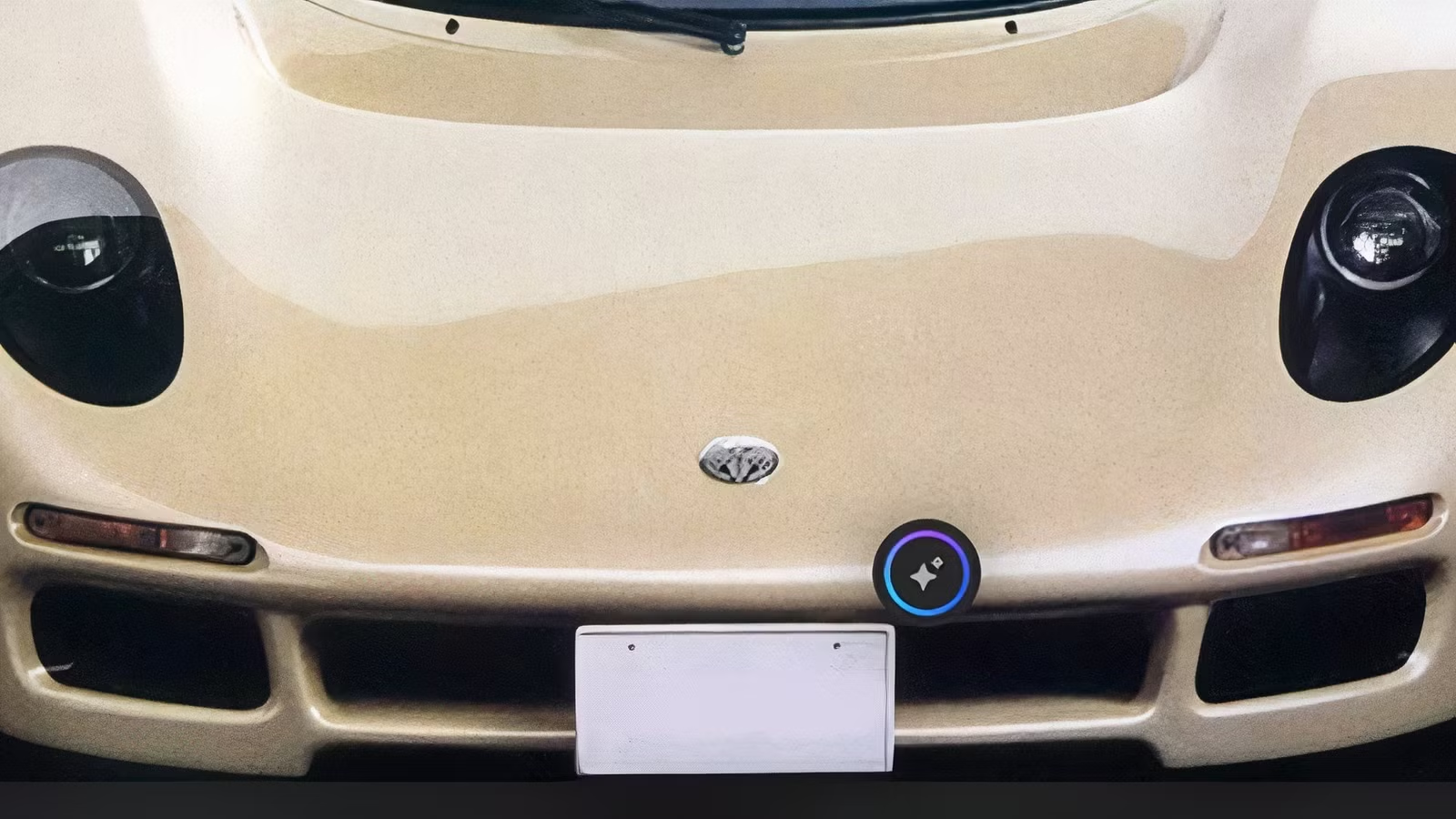
How often does a supercar with all the right looks and all the right hardware manage to slip through the cracks? The more you look, the more you find history is full of the remains of cars that claimed they could challenge Ferrari, Lamborghini, and the established supercar aristocracy. Some failed conceptually, others were victims to unforeseen accidents that brought promising projects to abrupt ends. Other times, things totally unrelated to engineering or automotive design become the culprit—something far more impactful on society.
The Japanese Economy Bubble: An Amazing Place To Be, at Least in the Moment

The best way historians have summed up Japan’s economic revival after the Second World War would simply be “a miracle.” With nearly all its industry destroyed in the wake of war’s end and hardly a drop of oil beneath its surface, Japan’s industrious streak began as nothing more than pure survival. Famous automakers and bike manufacturers like Honda, Subaru, Yamaha, and Suzuki, alongside mainstays like Toyota, Datsun, and Mitsubishi, began to flood their local nook of East Asia with affordable, reliable transportation.
At the same time, Japan’s tech sector bloomed into the envy of the world. Over half the world’s microchips and other computing hardware was fabricated in Japan by the late 1980s, and its culture influenced the west in earnest through anime and Nintendo games. Around the same time, the Tokyo Stock Exchange was firmly on an equal status with London or New York, with real estate prices rumored to be worth entire countries for tiny slivers of its major business districts.
In that kind of environment, eccentric and wealthy Japanese businessmen were free to finance supercars of their dreams as if they’re Corollas or Civics. Many of them did so, but one pair that flew well under the radar were two men named Yoshikata Tsukamoto and Minoru Hayashi. Hayashi was the president of the Dome Co. Ltd, a Shiga Prefecture-based open-wheel race car constructor with experience in F3, F1, and native Japanese open-wheel circuits at home. Tsukamoto, well, was the President of Wacoal, one of Japan’s largest makers of women’s undergarments and lingerie. Can you believe that’s only ONE of the weirdest things about this car? Well, we’re just getting started.

Making a Supercar From Scratch, With Help From Grand Prix Racers

Giggle all you want, but the pairing of one of Japan’s best open-wheel race car markers with a Japanese billionaire way too obsessed with women’s undies legitimately resulted in the formation of Jiotto Inc. Founded jointly in 1988, the upper echelon of the European supercar hierarchy was in Jiotto’s sights from day one. That meant contending with cars like the Ferrari F40, the Porsche 959, and the upcoming Lamborghini Diablo.
Leveraging Dome’s expertise in chassis craft, Jiotto contracted a former journeyman GM/Opel designer named Kunihisa Ito to sketch a body inspired by Group C sports car racing. For a powertrain, Jiotto opted to purchase a 3.5-liter flat-12 engine built by the short lived Italian firm Motori Moderni on behalf of Subaru. The engine made 450 horsepower at the crank, to the tune of 10,000 RPM, and yet, none of that mattered when it was paired to a Coloni C3B Formula 1 car. In that role, the Coloni team found the engine ran hot, was underpowered to a laughable degree, and failed to qualify on eight separate occasions, a new record.
All this failure on the race track just meant there was no competition for orders when Jiotto came calling. Since nobody on the F1 side of things, or anywhere else for that matter, wanted anything to do with it, the path to a killer marketing gimmick was right in Jiotto’s lap. Years before the Ferrari F50 did the same, Jiotto was about to make an “F1-powered” hypercar for the road. Well, the fact you’ve never heard of it tells you how well things wind up for it.
Jiotto Caspita: Mission Objective, Make Ferrari Sweat

Jiotto didn’t just want to stunt on European supercar manufacturers, they wanted to do everything in their power to build something so memorable, it’d be seen as a watershed moment for the entire auto industry. To do it, Jiotto engineered a carbon fiber and aluminum honeycomb monocoque body shell, real space-age tech by the standards of the day. In order to produce it, sheets of aluminum and carbon fiber weave were layered on top of each other and baked in an autoclave over a dozen times before it was finished.
Mitsubishi Rayon, the group tasked with assembling the chassis, took two entire months of intense work just to complete one example. Still, when paired with a semi-legit F1 engine and a proper six-speed manual gearbox, the whole car weighed just over 2,400 lbs. That’s around as much as a diminutive three-cylinder city car usually lugs around. With all that power at the soon-to-be Caspita’s disposal, the chassis and drivetrain was sure on the level of the big names.
Inside, a Jiotto Caspita’s interior was Spartan on a level that’d make a Gen-I Dodge Viper, in development at the same time, feel better about itself. There was no air conditioning, no radio, no cupholders, and a six-point racing harness like a real race car. With inboard double-wishbone rocker arm suspension all around with coil springs and adjustable dampers there was at least a large degree of configurability in the Caspita’s driving experience. Beneath the car, the undercarriage sported air dams that sucked the tires to the road at speed, and it was low enough to rip the bumpers off driving over potholes. In that way, the Caspita really was a true 80s hypercar.
Blistering Performance, Well, Kinda

Let’s paint the scene for a second. The venue? The 1989 Tokyo Motor Show. The star attraction? Well, aside from the production-spec Honda/Acura NSX, there was also the Mk1 Jiotto Caspita doing all it could to claim the limelight. With an electronically actuated rear wing, the Caspita mirrored modern active aero systems from decades later with considerable accuracy.
Visually, it was every bit the match for an NSX, but that race-derived Flat-12 had to be considerably detuned to ensure it didn’t blow up after just a few thousand miles. A zero to 60 sprint in 4.7 seconds and a top speed estimated at 199 mph was certainly admirable, but without the notoriety of a Ferrari or Lamborghini badge, the Caspita sort of, just, looked a bit ridiculous. Knowing this, the Jiotto team went back to the drawing board, and returned to Tokyo with the revised Caspita Mk2.
Packing a 3.5-liter Judd GV10 V10 out of a C1-class WSC racer, the new motor came from a time when World Sportscar Championship engines and F1 drivetrains were nearly one and the same. Unlike the Subaru-designed Flat-12, the English Judd V10 was a gem of an engine, one with 530 horsepower on tap, enough to send the Mk2 Caspita to a top speed of 214 mph. With a zero-to-60 sprint of 3.4 seconds, it made an F40 and even an F50 seem far more civilized than they were. On the surface, the Mk 2 Caspita had everything it needed to succeed. The reality of the situation was very different, and in most ways, down to catastrophic timing.
The Bubble Bursts, and the Party Ends

Had the Mk 2 Caspita debuted 12 months earlier, there’s every chance the tech bros and industrial fat cats in an obvious economic bubble would’ve lapped up every single one. Instead, the Caspita entered a Japanese economy primed to pop in a way that’d make the world look on in shock. Real estate prices fell to fractions of their peak, stock prices plunged, and lines of credit that could’ve financed the absurd asking price of $700,000 in 1990s money suddenly vanished with equal swiftness.
For some context, a McLaren F1 was only about $300,000 more, and as great as it was, we don’t think someone for whom that difference is like pocket change would buy a recalcitrant race car for the road instead. Put simply, one was a race car with a license plate, and the other was the world’s fastest road car, honed from real road car parts. The project was shuttered in 1993, and the two prototypes now sit in automotive museums across Japan. Depending on who you ask, some argue the Japanese economy never recovered from the very same economic downfall that caused the project to fizzle.
Source: Motorcar Museum of Japan

Related posts



Latest Post


No Comments