
The Fast Car With Toyota Reliability And Porsche-Level Grip
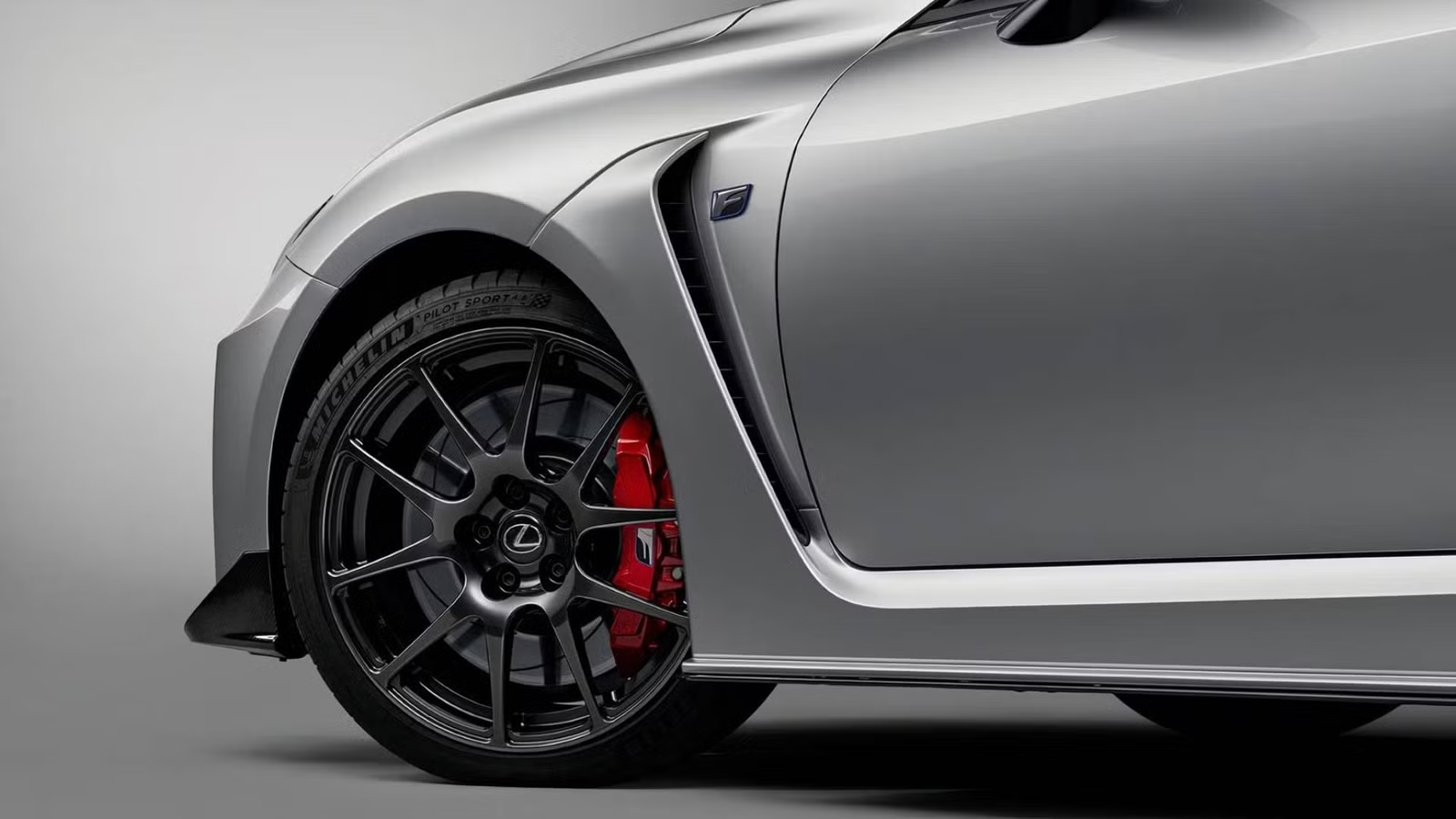
As evidenced by European automakers, reliability and performance do not always go hand in hand. For decades, enthusiasts have willingly accepted an unspoken tax that forced them to tolerate strict maintenance schedules, moody electronics, and eye-watering bills from the dealer in turn for world-class handling and exhilarating exhaust notes. Even when Lexus burst onto the scene in 1989 to address the gripes of luxury car owners, the Japanese automaker’s lineup remained limited to relaxed land yachts. Luckily, the industry eventually reached a point where drivers seeking a low-stress luxury experience didn’t have to tolerate a machine that took corners like a boat. Lexus finally decided to fill the gap that it had left open for years, and one coupe in particular stands at the pinnacle of the brand’s performance efforts.
Lexus F Performance Takes On the Germans

While the established European automakers were undoubtedly intimidated by the arrival of Lexus, their performance divisions such as Mercedes-AMG and BMW M had remained safe. But that suddenly changed in 2007, when Lexus expanded its portfolio beyond cushy, easygoing luxobarges with the debut of the IS F sport sedan.
It featured a 5.0-liter, naturally-aspirated V8 with cylinder heads developed by Yamaha, and it was aimed directly at Germany’s eight-cylinder BMW M3 and Mercedes-AMG C63 of the same vintage. Its giant Brembo brakes and firm suspension were balanced by signature Lexus reliability, which was an unmatched combination at a time when high-strung German V8s were still threatening drivers with pricey faults. The IS F also introduced a world-class eight-speed Sport Direct-Shift automatic, which could lock the torque converter for shockingly quick upshifts and DCT-like downshifts through the paddle shifters.

With Lexus’s rock-solid reliability reputation successfully carried over to a sportier crowd, the F performance brand was gradually expanded. The LFA launched in 2010 as the automaker’s rather unprecedented halo car, flaunting a hauntingly sonorous 4.8-liter naturally-aspirated V10 and a six-speed automated manual. The larger GS sedan received the F badge as well, pairing a naturally-aspirated V8 and track-focused rear-wheel drive layout with the same practical four-door layout as the standard GS. With the IS F and GS F sedans already forming a distinctive naturally-aspirated V8 pattern, Lexus decided to pack this same formula into the RC two-door coupe.

The RC F Is a Lexus Built For the Track

The Lexus RC F made its debut for the 2015 model year, stepping up as a more accessible flagship performance coupe following the retirement of the legendary LFA supercar. While the RC F was never intended to be a direct successor to the V10-powered exotic, Lexus did manage to infuse parts of the LFA’s DNA, equipping it with active aerodynamic trickery and a digital version of its mesmerizing shifting central gauge.
Compared to the RC grand tourer that it was based on, the F model was much more fit for the track. It featured a 5.0-liter naturally-aspirated V8 shared with the GS F sedan, and 472 hp and 395 lb-ft of torque were sent exclusively to the rear wheels for dramatic straight-line power. Stopping power was massively improved thanks to a Brembo braking system, featuring 6-piston front and 4-piston rear calipers. The coupe’s chassis was upgraded with reinforced bracing, stiffer bushings, and an adaptive suspension system, and its widened body, active rear wing, and functional air ducts improved aerodynamics. Curb weight was reduced with the use of various aluminum components, and later special edition models utilized carbon fiber reinforced plastic to further shed weight from the roof, hood, and spoiler.

The RC F was met with divided opinions at launch. Critics doubted that it could truly separate itself from the more tame, luxurious nature of the standard RC’s platform, and weight-saving measures failed to save the performance coupe from tipping the scales at nearly 4,000 pounds. However, optimists noted the coupe’s charming naturally-aspirated V8, which undoubtedly stood out when the rest of the performance coupe segment was chasing the modern perks of forced induction.
A Raw, Naturally-Aspirated V8 Under the Hood

While most European rivals were turning to forced induction, the RC F’s high-revving 2UR-GSE 5.0-liter V8 stubbornly remained naturally-aspirated. As a result, drivers are met with an increasingly rare, old-school power delivery that builds up to a screaming 7,300-rpm redline, with a visceral exhaust note to match. Total output from the highly traditional eight-cylinder engine initially came in at 467 hp and 389 lb-ft of torque, but a mid-cycle refresh for the 2020 model year boosted the numbers slightly to 472 hp and 395 lb-ft. While the RC F’s peak horsepower figure is highly competitive with turbocharged rivals such as the BMW M4 and Mercedes-AMG C63 Coupe, the Germans undeniably had Lexus beat in terms of torque, as their turbochargers deliver maximum pulling power much lower in the rev range at the cost of aural drama.
|
Car |
Power |
Torque |
0-60 MPH |
|
Lexus RC F (2015) |
467 HP |
389 LB-FT |
4.4 seconds |
|
BMW M4 (2015) |
425 HP |
406 LB-FT |
4.0 seconds |
|
Mercedes-AMG C63 Coupe (2015) |
451 HP |
443 LB-FT |
4.1 seconds |
Power is managed by the state-of-the-art eight-speed Sport Direct-Shift automatic that was introduced in the earlier IS F sedan. This sophisticated gearbox was heavily updated for the RC F, featuring revamped software programming to accommodate a wider variety of selectable drive modes, as well as more clutch plates to confidently manage the coupe’s higher output. Lexus also added a larger dedicated oil cooler for the transmission, as the unit that was used in the IS F often failed to properly handle aggressive track driving.
Signature Lexus Reliability

The RC F also maintains the bulletproof reliability reputation that its Lexus badge would suggest. While modern European competitors often face high-strung components, complex electronics, and high under-hood temperatures due to forced induction, the RC F benefits from over-engineered, tried and true parts sourced from Toyota. The lack of added heat or stress from turbochargers keeps the engine relatively cool and under-stressed, and while the RC F’s interior is admittedly antiquated, its older electronics leave room for longevity.
The coupe’s mechanical durability is further elevated by Lexus’s unparalleled quality standards. The 2UR-GSE engine is hand-assembled by the automaker’s highly skilled craftsmen, known as Takumi, a word that means “artisan” in Japanese. Production takes place at Toyota’s Tahara plant, which also built the original Lexus LS400. By blending a robust, naturally-aspirated powertrain with Toyota’s unrivaled quality control, the RC F offers a rare combination of respectable track performance and dependability.
Why The RC F Is Still an Underrated Bargain

Luckily for today’s enthusiasts, earlier RC F examples have faced a rather steep depreciation curve. While pricing originally started at around $60,000, clean examples from the performance coupe’s earlier model years are now selling for $38,988 on average, according to The Classic Valuer. A 2015 model with 47,000 miles sold for $41,250 on Cars and Bids, and another from the same model year and 89,000 miles sold for $32,000. It is worth noting, however, that later Track Edition and Final Edition models have managed to retain their value after the RC was discontinued in late 2025. One such example sold for $82,000 on Bring a Trailer. Yet, for those seeking a standard RC F, the steep depreciation scores buyers with a highly dependable, V8-powered track weapon for roughly half of its original sticker price.
Sources: Bring a Trailer, Cars and Bids, Lexus, The Classic Valuer

Related posts





Latest Post


No Comments