
The 1970s Muscle Car That Represented Peak Detroit Excess

It might be easy to think it went down that way, but the truth is that the muscle car era didn’t lose its mind overnight. It got there through showroom horsepower one-upmanship, louder paint, bigger hood scoops, and the very Detroit belief that the cure for too much engine was usually more engine.

By 1970, that thinking had reached the point where a regular customer could walk into a Plymouth showroom and order something that felt only a few bad decisions removed from a drag-strip special. It had a body built for attention, an engine with a NASCAR-sized reputation, and the kind of resale story that now makes enthusiasts check their bank balance, then close the laptop wide-eyed.
Detroit’s Horsepower War Stopped Pretending To Be Sensible
The early ’70s were the moment when American Muscle Cars stopped trying to make a rational case for themselves. Practicality had technically left the room, but nobody was in a hurry to go looking for it. Detroit was selling image, noise, and torque, and people understood the assignment.
Plymouth had spent much of the ’60s trying to turn the Barracuda into a true performance name. The original 1964 car arrived before the Ford Mustang, but it was still tied closely to the Valiant, which gave it humble bones even if the fastback glass and small-block V8 option hinted at bigger plans.
That changed as the decade wore on. The second-generation Barracuda pushed harder into muscle territory with more aggressive bodywork, coupe and convertible body styles, and bigger V8 options, including the 383 and later the 440 Super Commando. By 1969, Plymouth had a performance image worth building on. What it still needed was a platform that could handle the full Detroit treatment without looking like it had swallowed a gym bag.
Mopar Had The Right Platform For Something Truly Unreasonable

That platform arrived for 1970 with Chrysler’s E-body architecture. The third-generation Barracuda shared that foundation with the Dodge Challenger, and the move finally cut the car loose from its Valiant roots. It became wider, lower, longer, and far more serious-looking, which is exactly what Plymouth needed if it wanted to play in the deepest end of the muscle car pool.
The E-body also gave Plymouth room to offer a broader spread of personalities. People could still get ordinary Barracuda models, but the performance versions carried the shorter, sharper name that mattered more to people who read option sheets like menus. The lineup could run from inline-six engines and small-block V8s to big-block V8s and the kind of top-end choice that made the rest of the spec sheet feel like a warm-up act.
The Wait For Something Bigger

This was peak Mopar theater. High Impact colors such as Lime Light green and Vitamin C orange made the car look like it had been painted during a sugar rush, while graphics packages, shaker hood availability, and the Pistol Grip shifter gave it the proper showroom appeal. Subtlety was available elsewhere, probably in another building.
The real trick was proportion. Earlier pony cars were compact, useful, and quick enough to be fun. This new E-body looked like it had been waiting for a giant engine from the start. In Detroit logic, that meant someone was absolutely going to fill the space.
The Plymouth Hemi ’Cuda Turned Excess Into A Factory Order

|
Engine |
Power |
Torque |
0-60 MPH |
|
426ci Hemi V8 |
425 hp |
490 lb-ft |
5.8 seconds |
The 1970 Plymouth Hemi ’Cuda was the point where all of that escalation became a factory-built product. Under the hood sat the 426 Hemi V8, rated at 425 hp and 490 lb-ft of torque, with power going to the rear wheels through manual or automatic transmission options. In a world already full of big engines, this was still the one that made people lower their voice a little.
The Hemi ’Cuda was the top-of-the-range version of the third-generation Barracuda, the car that made the 383, 440, and 440 Six-Barrel versions feel almost reasonable by comparison. That’s a ridiculous sentence, but the muscle era was not a place where moderation went to thrive.
A 1970 Hemi-powered example was recorded at 5.8 seconds from 0 to 60 mph and 14.0 seconds through the quarter mile, which made it properly quick for the era and still respectable in the context of classic American muscle cars. It wasn’t polished in the modern sense, but that was part of the appeal. This was a car with a huge engine, a short fuse, and the aerodynamic subtlety of a brick wearing boxing gloves.
The timing also made it special. The Plymouth Hemi ’Cuda ran only for 1970 and 1971, which meant it arrived just as the classic muscle car era was peaking and disappeared before the party fully collapsed under emissions rules, insurance pressure, and fuel concerns. That short window is a big part of why the car feels like a final dare from Detroit.
The Hemi Was Only Part Of The Appeal

The engine gets the headline, and fairly so, but the Hemi ’Cuda’s reputation comes from the whole package. The Hemi’s output required uprated suspension and structural reinforcements, which gave the car a more serious mechanical foundation than the usual big-engine fantasy. Plymouth wasn’t simply stuffing in power and hoping for the best, though there was probably still a fair amount of hoping involved.
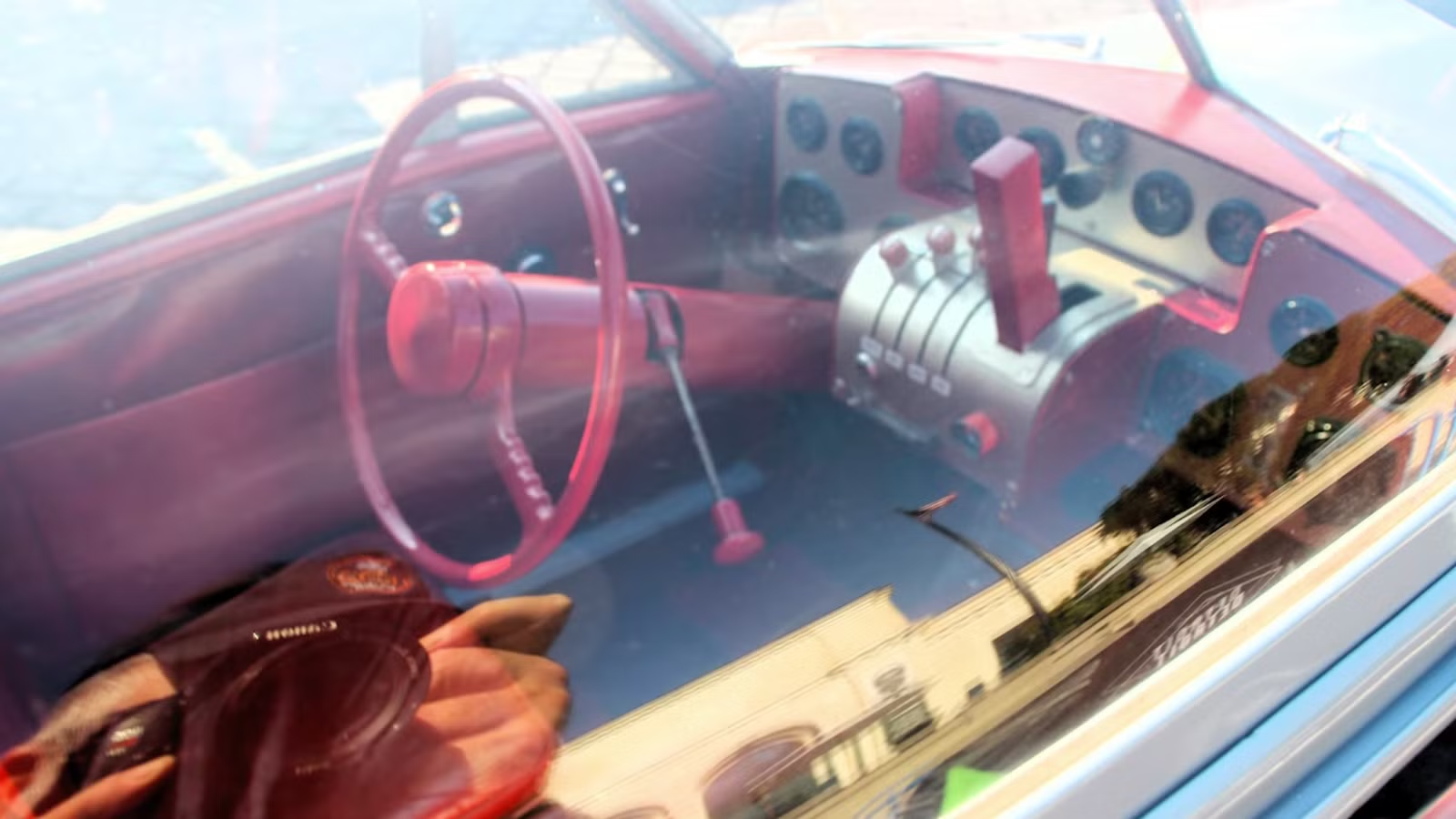
The cabin had the same no-nonsense tone. Four-speed cars could be fitted with the Pistol Grip shifter, one of those details that sounds like fluff until you see it and immediately understand why people still talk about it. It made shifting feel like operating machinery, not selecting a drive mode before grabbing an oat milk latte.
End Of Era Significance

More than that, the 1971 cars added their own layer of drama with a new grille, revised taillights, new seats, four headlights, front fender louvers, and the famous billboard side stripe. It was also the final year for the big-block 383, 426 Hemi, and 440 in the Barracuda line, which gave the 1971 Plymouth Hemi ’Cuda an extra sense of end-of-era significance.
That’s probably why the Hemi ’Cuda lands differently from many other American muscle cars. It had timing, presence, scarcity, and just enough factory-approved misbehavior to feel like something that slipped through before everyone got sensible.
Peak Excess Became A Seven-Figure Muscle-Car Legend

Used values have turned the Plymouth Hemi ’Cuda from outrageous showroom machine into blue-chip Mopar royalty. Only 780 Hemi ’Cuda examples were built across 1970 and 1971, and that number alone explains a lot of the current obsession. Add the Hemi name, the E-body shape, and the short production run, and you’ve got the kind of collector-car math that gets expensive real quick.
The convertible story is even more intense. Hemi ’Cuda convertibles are dramatically rarer than coupes, and 1971 convertibles sit at the top of the food chain. Only 11 Hemi ’Cuda convertibles were built for 1971, and among those, four-speed cars are the ones that make auctions feel less like sales and more like televised financial stunts.
Massive Valuations

The Hemi ‘Cuda market has recorded an average sale price of a touch shy of $1 million, while the highest recorded sale reached $3.3 million for a 1971 example. The market also separates the coupe and convertible worlds clearly, with coupes sitting far below the convertible benchmark, which is deep into seven-figure territory.
All in, that’s peak Detroit excess: a car too outrageous to last, too important to forget, and now too expensive for most of us to do anything except stare at photos and mutter, ‘Yeah, fair enough’.
Sources: Plymouth, Hagerty, CudaBrothers, Classic.com

Related posts


Latest Post


No Comments