
John Cena Reveals His Dream 3 Car Garage
When you think of John Cena, your mind probably jumps straight to a few distinct images depending on how old you are. A 16-time WWE World Champion commanding a stadium, the Hollywood action star trading punches with Vin Diesel in the Fast & Furious franchise, or perhaps the multiple “You Can’t See Me” memes. But for those of us who are just into cars, Cena is one of the most refreshing, down-to-earth, and genuine gearheads in the celebrity world.

Hollywood stars buy expensive cars most times to flaunt them, but he buys them because he enjoys driving them just like any gearhead would. A celebrity like him, with the wealth he has amassed, can afford to buy any car he wants. But when asked what his ultimate three-car garage would look like, he didn’t mention seven-figure modern hypercars or modern supercars. His choices prove his love for the automobile runs far deeper than a massive price tag or a flex on social media.
John Cena’s Love Affair With Cars Started Long Before His Hollywood Career
To appreciate John Cena’s dream garage, you have to understand where he comes from. Long before he was selling out arenas or starring in blockbusters, Cena was just a kid from Massachusetts obsessed with horsepower like any car guy. His obsession didn’t start with flashy European exotics; it was forged in the golden era of American iron. As soon as he had the financial means, Cena began building an incredible collection of classic American muscle cars.

We are talking about the holy grails: a 1969 COPO Chevrolet Camaro (built for serious drag racers), a winged 1970 Plymouth Superbird powered by a 426 Hemi V8, a 1966 Dodge Charger, and a rare 1970 Buick GSX. Fellow automotive enthusiasts respect Cena’s opinion because he speaks their language. He doesn’t just know the horsepower figures; he knows the history, the mechanical issues, and the engineering quirks. When he speaks about a vehicle, it is immediately clear that he knows the machine pretty well.
A Look At Some Of The Cars He Has Owned

While muscle cars formed the bedrock of his automotive identity, Cena’s garage has evolved over the decades. He has owned ultra-high-end luxury cruisers like the iconic 2006 Rolls-Royce Phantom, the baby V10 2009 Lamborghini Gallardo LP560-4 and a Mercedes-Benz SLS AMG with its dramatic gullwing doors. He even commissioned a completely custom, futuristic vehicle known as the “InCENArator”—a jet-canopy supercar built on a C7 Corvette chassis featuring eight functioning, flame-throwing exhaust pipes. Yet, despite having the financial freedom to purchase literally any vehicle, Cena’s actual cars focus on the raw experience of driving, rather than the accumulation of status symbols.
John Cena’s Three-Car Garage Has Something for Every Drive

In a recent short interview with Daniel Mac, John Cena was asked what his three-car garage would look like. This question has been asked a million times by many car guys. His choices form a beautifully balanced, incredibly thoughtful garage that addresses every facet of a true enthusiast’s life: the ultimate daily car, the ultimate piece of rolling art, and the ultimate vintage driving experience.
Civic Type R (The Practical Sports Car)

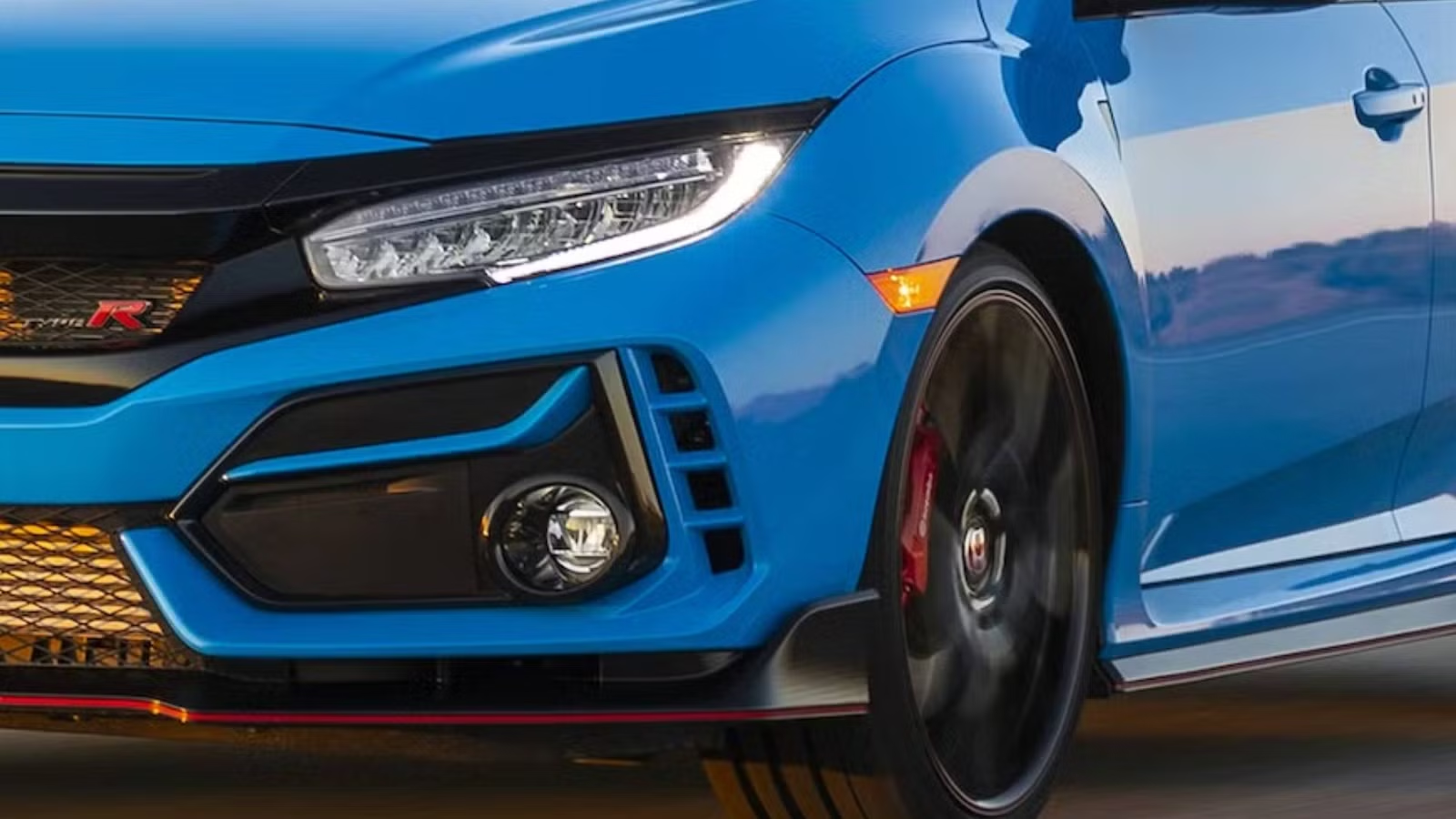
Most car guys might pick a fast truck or SUV, but he chose the Honda Civic Type R as his daily. For a man worth an estimated $80 million, seeing a Japanese hot hatch sitting alongside multimillion-dollar exotics seems out of place. But Cena’s connection to the Type R is real. He famously daily-drives a Boost Blue Pearl Civic Type R, praising it on podcasts and social media as an absolute masterpiece of modern engineering. To Cena, the Type R is a genuinely usable car with pure driver engagement. It has a brilliant 2.0-liter turbocharged inline-four engine with good power and great fuel economy, one of the best front-wheel drive chassis, and what is widely considered one of the greatest six-speed manual gearboxes ever built.
Countach Periscopio (The Iconic Wedge Car)

If the Civic Type R is the logical, analytical side of Cena’s brain, the Lamborghini Countach Periscopio represents pure automotive romance. Specifically, the “Periscopio” models (the early LP400 variants produced in the mid-1970s) are the purest expression of Marcello Gandini’s legendary wedge design.
Named for the unique rearview mirror system that utilized a small periscope tunnel cut into the roofline, the early Countach is a striking, low-slung masterpiece without the massive wings, fender flares, and aerodynamic body kits that defined the later 1980s models. It is a car that redefined what a supercar could be, powered by a howling, naturally aspirated V12 mounted longitudinally behind the driver. It is dramatic, completely impractical, and visually arresting. Most people want the famous Wolf of Wall Street spec, but Cena wants it in its purest form.
E-Type (The Beautiful Drivable Sports Car)

Completing the trio is the Jaguar E-Type, a car that needs no introduction in this space. Enzo Ferrari famously called it “the most beautiful car ever made.” With its impossibly long hood, flowing curves, and perfectly proportioned rear deck, the E-Type is the definitive British grand tourer. Cena’s appreciation for the E-Type centers on its identity as a beautiful, genuinely drivable vintage sports car.
Whether equipped with the iconic 3.8-liter straight-six or the smooth V12 of the later generations, the E-Type offers an analog, sensory-rich driving experience—the smell of leather and fuel, the mechanical sounds of the engine, and a silhouette that makes people stop and stare anywhere in the world.
Why Each Car Earned Its Place

To understand why these three specific cars belong together in John Cena’s ultimate garage, you have to look beyond their spec sheets and dive into how they contrast against one another. Cena isn’t just picking cars he likes; he is crafting an ecosystem of driving experiences. During a memorable appearance on Andrew Santino’s Whiskey Ginger podcast, Cena hilariously contrasted the reality of owning a Countach with the reality of owning his trusty Honda Civic Type R. His insights perfectly illustrate why each car earned its specific spot.
“If you have a purse in a Countach, you’re screwed,” Cena laughed. “They’re a little rough around the edges. The clutch is a dogfight, and it’s really tough to get those things running right. Like, they’re always in the shop because it’s leaking some sort of fluid somewhere. Yeah, if I actually need to drive a car on a distance more than like 10 miles, it’s the Civic.”
The Countach is an exhausting car to own and drive. It is a car meant for short, theatrical bursts of pure V12 drama. The Civic Type R is the exact antithesis. It has modern tech, legendary Japanese reliability, crisp air conditioning, and a back seat spacious enough to actually pick friends up from the airport. Yet when you put your foot down, it remains incredibly stable at 145 mph.
Then steps in the Jaguar E-Type, occupying the perfect emotional middle ground. It strips away the aggressive modern aero of the Honda and the sharp angles of the Lamborghini, replacing them with elegance and analog soul. The E-Type is a mechanical time capsule designed for an effortless Sunday morning cruise down a winding coastal highway.
What John Cena’s Picks Reveal About His Philosophy on Cars

Ultimately, John Cena’s dream three-car garage reveals a deeply mature, refreshingly honest philosophy on car culture. In an era dominated by numbers, Cena has completely opted out of the spec sheet wars. His garage tells us that he values three distinct pillars of the automotive world: practical execution, captivating design, and timeless beauty. John Cena’s three-car garage isn’t a collection designed to impress the public. It is a garage designed by a true fan, a lineup that celebrates the joy of driving and the beauty of these machines.
Sources: Honda, Lamborghini, Jaguar, Instagram.com/itsdanielmac/

Related posts


Latest Post


No Comments