
The Muscle Cruiser That Balances Comfort, Torque, And Peace Of Mind
Imagine you’re dating a model and every time you step out, guys are always jealous of you. But at home, she’s the most toxic girlfriend. That’s how life can feel if you take home a motorcycle that looks the business yet gives you anxiety on every ride about whether it’ll get you back home or not.

This is dialed to 11 for a muscle cruiser since the rides are usually longer than what you would do on, say, a sports bike. And if comfort isn’t right, things get even worse. Thus, it’s crucial you do your homework and find a balanced muscle cruiser that keeps you comfortable and your mind peaceful. It’s a hard line to walk—maybe impossible for most manufacturers.
Muscle cruisers promise weekend freedom, but most deliver weekend anxiety instead. Take a $25,000 Harley Fat Bob on a 500-mile ride, and you’ll spend more time worrying about the next oil change than enjoying the scenery. Miss that 2,500-mile service window, and you’re looking at potential engine damage that makes that expensive bike payment look cheap.
The Triumph Rocket 3 Storm GT Solves The Muscle Cruiser Dilemma
With 2,458cc And 10,000-Mile Service Intervals

Whenever a motorcycle chases performance, the engine usually stays in a stressed state. That means peace of mind depends on how meticulous you are with basic maintenance. The clearest examples are liter-class superbikes. Owners will tell you to change the oil every ~2,000 miles (even if the company states otherwise), given the high-strung nature and low tolerances of the engine. Considering muscle cruisers chase performance as well, the same applies to them in a way.
But Manufacturers Have Found Solutions

There are solutions to reduce the engine’s stress and improve peace of mind, though. Bikemakers achieve this in different ways, but the most common one is bumping engine size. You see, a large engine lets you stay well below the mechanical limit of the parts, while still allowing solid performance. It is particularly useful if the engine has a basic construction, which somewhat explains why the average cubic capacity of Harley Softails is over 1,900cc.

Another way is to infuse more cylinders into the engine. That means a 1,700cc V-twin engine with 120 horsepower will run more stressed than a 1,700cc inline-triple engine with the same power. That’s why Harley-Davidson’s Sportster S has 121 horsepower and 5,000-mile oil change intervals, while Ducati’s 1,158cc Diavel V4 has 168 horsepower and 9,000-mile oil change intervals. The muscle cruiser we’re going to talk about applies both of these solutions to promise a horsepower and torque-loaded ride while still ensuring peace of mind.
The Triumph Rocket 3 Storm GT Has Class-Leading Comfort And Torque

Of course, we’re talking about the Triumph Rocket 3 Storm GT. It justifies the three requirements–comfort, torque, and peace of mind–easily, promising a package no other bike can match in this space. Credit for torque and peace of mind goes to the gigantic powerhouse. A massive cubic capacity (more than all of its rivals) and an inline-triple layout help the Rocket promise class-leading power output and 10,000-mile oil change intervals.
The latter is twice as much as your regular Harley-Davidson cruiser, even though you’re getting almost half the peak power on the H-Ds. Furthermore, if you check ownership portals, overall reliability has proven rock solid, too. Some folks have even accumulated over 100,000 miles on the previous-generation Rocket 3 with just regular services. As for comfort, the GT brings forward-set footpegs, a standard windscreen, swept-back bars, and a pillion backrest as standard.
No Other Muscle Cruiser Can Match The Balance Of The Rocket 3 GT

The Rocket 3 GT is proof of an experiment gone really well. After all, the Rocket 3 GT is arguably one of the most unorthodox cruiser bikes out there. It misses out on most cliches of a cruiser, such as a V-twin engine, double-cradle chassis, and old-school design. Yet, the package receives praises all over the world. In fact, some Triumph dealers claim that once they sell a Rocket 3, owners never bring them in to trade them in. What makes the bike so good? Well, the devil is in the details.
A Behemoth Of An Engine
Here’s Why 2,458cc Matters

This right here is the USP of the Rocket 3. What you have is the world’s largest production motorcycle engine, displacing 2,458 cubic centimeters. That’s bigger than all of your favorite Harley-Davidsons by a fair bit, and not even the ultra-exotic CVO Road Glide RR could beat the figure. All this while, Triumph sticks to its guns by going with an inline-triple layout. The result is 179.5 horsepower and 166 pound-feet, even with a relatively chill 10.8:1 compression ratio. The fuel efficiency is understandably low at around 35 miles per gallon, though.
|
Engine |
Power |
Torque |
Compression ratio |
Transmission |
|
2,548cc, inline-triple |
179.5 HP |
166 LB-FT |
10.8:1 |
Six-speed |
Unique Aluminum Chassis

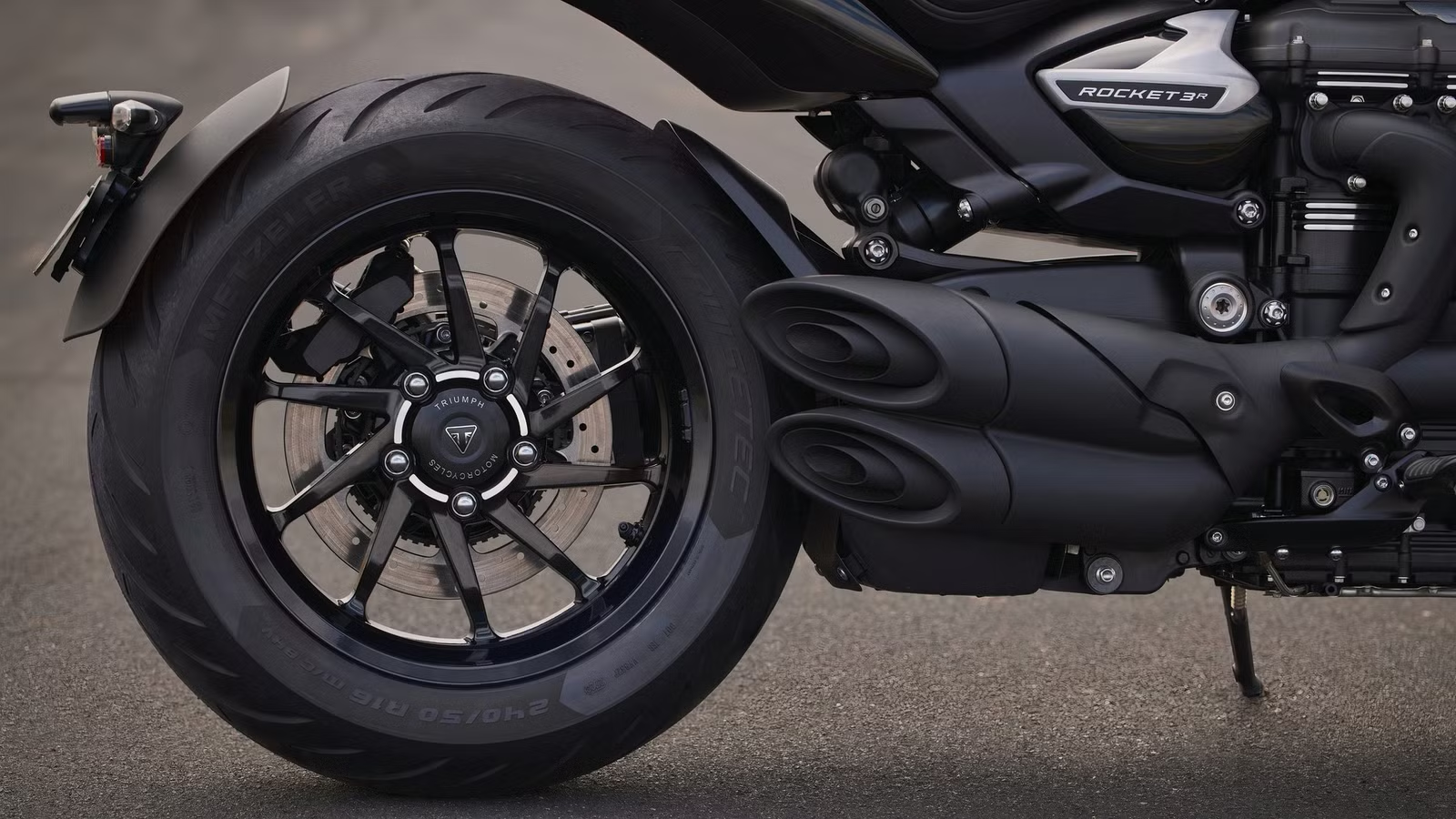
Remember the unorthodox parts we talked about? Well, the chassis is a big example. While most American names use steel, the Rocket 3 employs an aluminum chassis with the engine as a stressed member. The single-sided swingarm is of the same material, too. Helping deal with undulations is Showa suspension, comprising 47 mm USD forks (compression and rebound damping adjustment) and an RSU monoshock (hydraulic preload adjustment). Like all else, the wheel sizes are unorthodox (17/16-inch alloy wheels), too.
Weighs Under 700 LBs

All that aluminum does help keep the weight in check. For a bike with such a massive engine, the curb weight is under 700 pounds. That means it is in the ballpark of American cruisers from Indian and Harley-Davidson. To help deal with the weight, the seat height is low and the wheelbase is long. Oh, and you have four-piston Brembo calipers front and rear to help shed speed, where the front are Stylemas. All other dimensions are par for the course, too, comprising:
- Wheelbase: 66 inches
- Width: 36 inches
- Tire size: 150/240-section (F/R)
- Tank capacity: 4.76 gallons
- Rake: 27.9 degrees
No Shortage Of Comfort For Hours In The Saddle
Coming to the comfort side of things, the ‘GT’ in its name comes into play here. Unlike the R version, there are some long-haul-friendly bits here. The footpegs are now forward-set for a laidback riding triangle, while the handlebars sweep rearward for easy reach. At the same time, the seat height is just 29.5 inches, and once you’re on top, you’re also aided by a windscreen.

There are creature comforts and rider aids, too. A USB port juices up the devices, while cruise control and hill hold add a layer of peace of mind. As for rider aids, a six-axis IMU and ride-by-wire allow cornering ABS, cornering traction control, and dedicated wheelie control, topped with throttle maps and ride modes, are standard inclusions. Triumph has somehow skipped a quickshifter, though, which seems like a crime for a near-$28,000 machine.
The Rocket 3 GT Is Justifiably Expensive

There’s no denying the Rocket 3 GT is a mechanical marvel. And such marvels rarely come cheap. Thus, Triumph’s decision to price the Rocket 3 GT at $27,495 shouldn’t come as a surprise at all. Things start to make more sense if you look at the rival list. The arch-rival is the Ducati Diavel V4, which costs a few hundred dollars more. Yet, it has less performance and a smaller engine.

American rivalry is seriously lacking, meanwhile. The most powerful Softail is the $18,999 Low Rider S, but the base price rises to nearly $22,000 if you pick the blacked-out finish and premium colors. So the price difference comes down to just ~$5,000. Given the pros of the Rocket, that’s a justified moolah.
Rocket 3 vs. Rivals
|
Rocket 3 GT |
Low Rider S/ST |
Diavel V4 |
|
|
Engine |
2,458cc, inline-triple |
Milwaukee Eight 117ci |
1,158cc, V4 |
|
Power |
179.5 HP |
114 HP |
168 HP |
|
Torque |
166 LB-FT |
128 LB-FT |
~93 LB-FT |
|
Transmission |
Six-speed |
Six-speed |
Six-speed |
Source: Triumph Motorcycles, Harley-Davidson, Ducati

Related posts

Latest Post


No Comments