
The World’s First 4×4 Performance Wagon Beat The Audi RS6 By Decades
The concept of a station wagon with a powerful engine and all-wheel-drive capability isn’t really headline news these days. These monster estates are everywhere, from the load-lugging BMW M5 to the Audi RS6. But back in the ’80s, when interesting station wagons tended to be made by Swedish brand Volvo, a turbocharger was about as exciting as it got. Then came the ’90s, with mind-blowing creations such as the Audi RS2, a high-performance estate car tuned by Porsche, and the concept of all-wheel-drive safety with sports car-chasing performance came into fruition. Since then, everyone has jumped into the fast all-wheel-drive wagon game, and you see them everywhere.

But way before all this, there was a British wagon that was touting four-wheel-drive hardware, coupled to a 2.5-liter straight-six engine and a manual gearbox. This unique performance car was a special order in 1972, created for a well-heeled client, but it inadvertently gave a glimpse of the future of high-end family transport. A very similar concept, using the same tech, would go on to be one of America’s most unique and quirky models in the ’80s, too.
Detroit Invented The Performance Wagon, But The Europeans Perfected It
Many enthusiasts believe that the Audi RS2 Avant from the 1990s is the first proper performance wagon, and it’s easy to see why. The RS2 was the first wagon developed to deliver track-level performance, featuring a Porsche-tuned turbocharged five-cylinder engine pushing out 315 horsepower, Porsche-designed suspension, and Audi’s Quattro all-wheel-drive system. It famously accelerated from 0 to 60 mph in under 5 seconds, proving wagons could compete with sports cars if equipped properly.

But long before Audi launched the RS2 Avant, Detroit was already selling incredibly powerful wagons to the public, especially during the muscle car golden era when engine-sharing culture was in full swing. As the horsepower wars escalated, U.S. automakers routinely dropped their largest, most lethal drag-strip engines straight into nine-passenger family station wagons, creating speed demons that probably shouldn’t have existed in the first place.
Most Powerful 1960s American Wagons
|
1963 Pontiac Tempest Super Duty Wagon |
1969 Chevrolet Kingswood Estate L72 |
1969 Ford Country Squire |
|
|
Engine |
421 cubic-inch Super Duty V8 |
427 cubic-inch “L72” V8 |
429 cubic-inch ThunderJet V8 |
|
Output |
405 hp/ 425 lb-ft |
425 hp/ 460 lb-ft |
360 hp/ 480 lb-ft |
|
Drivetrain |
RWD |
RWD |
RWD |
As you can see, Detroit engineers had free rein to create incredibly powerful muscle wagons, with some even getting engines sourced from multi-million-dollar racing programs. However, there was a problem: all of these 1960s American muscle wagons sent 100% of their power to the rear wheels, which would break loose and spin helplessly under load. A little-known British manufacturer came up with a new solution to this problem.
The Europeans Solved The American Muscle Wagon’s Biggest Problem

The combination of massive V8 horsepower, heavy rear-wheel-drive platforms, and primitive 1960s engineering made American muscle wagons notoriously difficult—and often dangerous—to drive. To solve this problem, British automaker Triumph Motor Company collaborated with engineering firm Ferguson Research to create the world’s first 4X4 wagon for a customer.
This one-off wagon was commissioned by a Swiss doctor who needed a fast, comfortable road car capable of navigating treacherous, snow-covered Alpine passes in all seasons. Equipped with a peppy straight-six engine and paired with a sophisticated, motorsport-derived 4X4 system, this ultra-rare car pioneered four-wheel drive technology in wagons and foreshadowed a formula that modern super wagons still use today…
The Triumph 2500 PI 4X4 Is The Station Wagon Most People Would Never Have Heard Of

British Leyland isn’t remembered for its forward-thinking, ground-breaking, and world-beating models. It is remembered for industrial unrest, beige paintwork, square steering wheels, and build quality that could rival a pair of one-dollar earbuds. But when the chuckling subsides, it is worth remembering that Britain in the ’70s was actually creating some truly pioneering cars – it just didn’t really capitalize on them.
There was the V8 Range Rover, which is at least partly responsible for the queues of SUVs we see shuffling through every drive-through. Then there is the Jensen FF, the first 4WD performance sports car, which beat Audi to the game. But there was another trailblazing model that a lot of people won’t remember either: the Triumph 2500 PI station wagon.
The Triumph Wagon Became A Game-Changer

Before the German manufacturers realized that high-flying execs may also have families and dogs to cart around, there weren’t many upmarket station wagons available. The Triumph 2.5 PI changed all that when it was introduced in 1969 as part of the revised MK2 range with station wagon practicality. This was one of the world’s first petrol-injected family wagons, but it hasn’t exactly gone down in history quite as well as it should.
The Lucas fuel-injected load carrier had exotic Michelotti styling and was well proportioned and subtly purposeful. The 2.5-liter mill has a healthy 130 horsepower and 153 lb-ft of torque, and the car was marketed at those who wanted the practicality of an estate as well as a dose of the style and power of a sports car. It’s worth baring in mind that a 1972 Triumph Stag – a favorite of Jeremy Clarkson no less – made do with just 145 horsepower from a 3.0-liter V8 at the time, so this really was sports car power in a wagon body.
The Triumph Was A Good Basis For An AWD Sports Wagon
So not only had Triumph inadvertently helped to create the hot wagon segment, as well as pioneering fuel injection in this corner of the market, it would then be part of a new revolution. This came about when Swiss doctor decided he loved the look of the car, but possibly found the rear-drive layout a touch too Tokyo Drift for the snowy Alps. The would-be owner commissioned Ferguson Research, which was essentially a tractor company, to add four-wheel drive to the Triumph wagon, thus creating a predecessor of the Audi S4 Avant in the process.
The Triumph 2500 PI 4X4 Was The BMW M5 Wagon Of Its Day

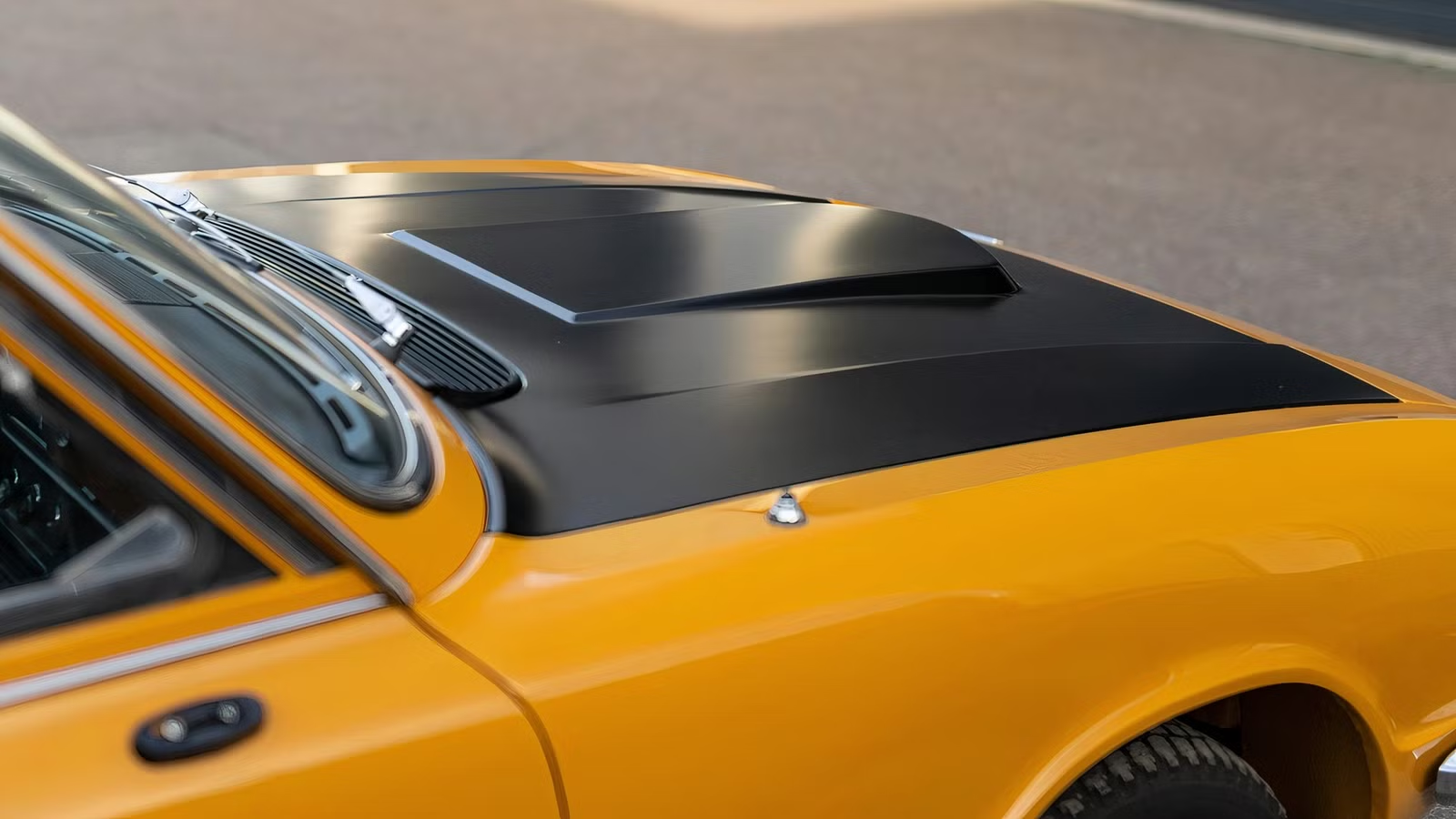
The Triumph 2500 PI 4X4 was a special order for the icy roads of Switzerland. The doctor loved the standard car but had the idea of going down a route normally reserved for strictly off-road vehicles for the military and farmyard machines. This being a rear-wheel-drive car that was never intended to have power to all four corners, the conversion was a seriously complex project. Ferguson Research, according to Hagerty, decided to tilt the engine forward a little and move it upwards to fit the front diff and driveshafts. This probably explains the new power bulge on the now black hood.
A new front subframe was fabricated, and the gearbox tunnel was redesigned to fit the front-drive mechanicals. The suspension was raised slightly to give the Triumph a little more capability over the rough stuff, making it similar to an Audi A6 Allroad or Subaru Outback. Transmission in the Triumph is a four-speed manual, with overdrive on third and fourth, and the car is underpinned with independent suspension that features MacPherson struts at the front and semi-trailing arms at the back.
This is a car that was developed and sold in the late ’60s and early ’70s, so don’t expect the 2.5-liter Triumph to be ridiculously fast by today’s standards, but it was extremely quick for its time. The six-cylinder engine was enough to push it to 60 mph in 11.4 seconds and a top speed of 120 mph. That would be enough to stay with a standard BMW 2002 flat out, which was the 3-Series of its day. One magazine noted that the Triumph will cruise at 100 mph effortlessly and silently, making it something of a ’70s autobahn stormer.
Subaru Also Made A 4WD Wagon In The ’70s

Japanese carmaker Subaru also launched a four-wheel-drive wagon in the ’70s, a move that helped shape the company’s line-up for the next 50 years. The Subaru Leone 4WD Estate Van, Japan’s first mass-produced AWD passenger car, arrived in September 1972. This model has a 1.4-liter flat-four engine under the hood, but it wouldn’t be winning any rally stages any time soon. The engine’s maximum output is 79 horsepower and 76 lb-ft, meaning that it was capable but not exactly a performance car.
The Leone wagon was raised up several inches and features steel wheels with knobbly tires. Interestingly, in the ’80s, AMC partnered with Ferguson Engineering, the British company that converted the Triumph, to create a mass-produced four-wheel-drive wagon for America. The result was the AMC Eagle, which also used a straight-six engine and seemed to use the know-how of the earlier Triumph wagon to create a forgotten off-road wagon that was decades ahead of its time.
Here’s What Happened To The 4X4 Triumph Wagon

The original owner kept the car for 11 years, using it in snow and shine. The vehicle was then sold but stayed in Switzerland, being used as the live-in vehicle for a holiday chalet. The clever Triumph was sold again in 2000 and brought back to its former glory by an extensive restoration. This wasn’t the end of the story for the Triumph, going up for sale again in 2022 at Bonhams. With 60,576 miles on the clock, the legendary Triumph sold for $23,000. For anyone wanting to get their hands on this one-off 4X4 Triumph, you’ll need to wait to see if it ever comes up for sale again. However, you can get a Triumph 2500 PI wagon with the standard rear-wheel drive. A Triumph 2000 will cost on average $10,439 in 2025, according to Classic.com.
Sources: Hagerty.com; Classic.com.

Related posts





Latest Post



No Comments