
Honda’s Most Reliable ADV That Clocks 100,000 Miles With Ease
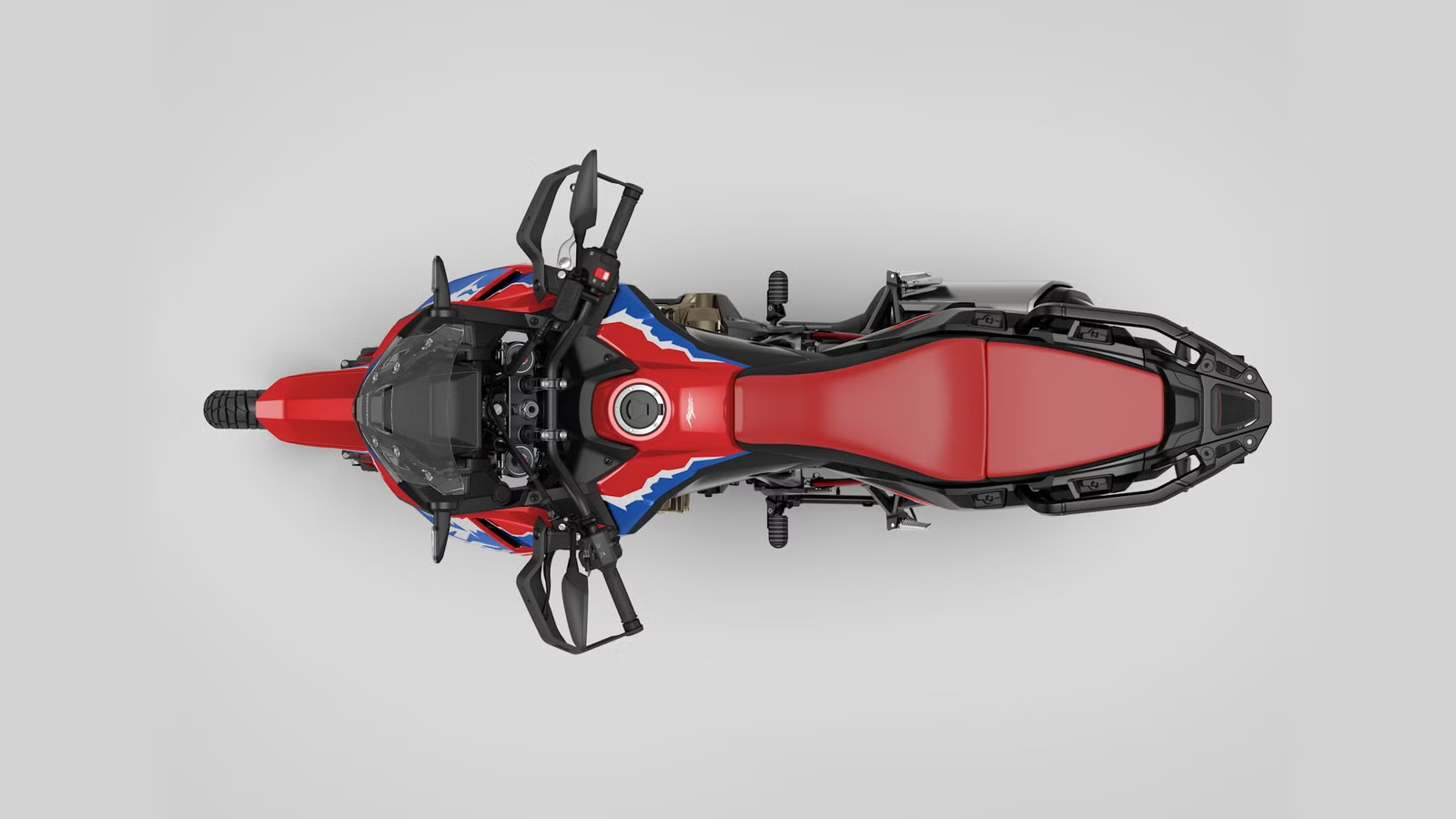
Reliability and Honda have remained synonymous for the longest time. Sure, its big three rivals come close, but if you want something truly unbreakable, something from the Honda stable is usually the weapon of choice. This becomes even more prevalent in the adventure bike segment. After all, ADVs need to tackle everything from city streets to off-beaten trails, and if they’re not reliable, you can end up stranded on a hilltop. It’s not a pleasant experience (don’t ask me how I know). The question then is: which Honda ADV does this best? We’re telling you exactly that.

Why Adventure Bikes Need To Be Reliable Above Everything Else

Reliability matters on every motorcycle, but it becomes absolutely critical in the adventure segment. Unlike sport bikes or weekend cruisers, ADV motorcycles are often expected to handle thousands of miles across changing terrain, weather, and road conditions — sometimes far away from dealerships or even basic service infrastructure. That’s why the best long-distance adventure bikes are usually the ones that prioritize durability, simplicity, and low-stress engineering over chasing extreme performance numbers.
This is an area where Honda has built an almost unmatched reputation over the decades. Many of its motorcycles are known for reaching six-figure mileage with relatively few major mechanical issues, and the ADV platform featured here follows the same philosophy. Owners regularly report examples crossing 100,000 miles and beyond, with some even reaching significantly higher figures with proper maintenance.

Part of that longevity comes from the bike’s understressed parallel-twin engine and comparatively simple design. Lower compression ratios and fewer overly complicated systems reduce mechanical strain over time, which is especially important on a machine intended for global travel and rough conditions.
Adventure motorcycles also tend to accumulate mileage much faster than other types of bikes. Riders use them for commuting, touring, off-road exploration, and everything in between, meaning a truly dependable ADV has to excel in multiple environments without becoming fragile or difficult to maintain. That’s exactly why this Honda has earned such a strong reputation — it’s not just capable of covering huge distances, but doing so consistently, predictably, and with very little drama.
Honda’s ADV Lineup Is Quite Well-Spread In 2026

With the popularity of ADVs at an all-time high, Honda has made sure it has something for everyone in 2026. The lineup starts with the puny CRF300L Rally, which is a dual-sport-based adventure bike. It features the ultra-trusty single-cylinder mill we’ve seen on the CBR300R previously. Next up is the NX500, featuring the 471cc, parallel-twin engine from the versatile mid-capacity lineup comprising the CBR500R, CB500 Hornet, SCL500, and the Rebel 500.

As good as these are, you’ll need a bit more oomph from a long-term perspective of keeping a machine for 100,000 miles. That leaves you with two capable machines: the XL750 Transalp and the Africa Twin. Considering the former has a brand-new engine that debuted just a couple of years ago, the latter becomes the automatic pick.
The Africa Twin Is Honda’s Most Reliable ADV For Reaching The 100,000-Mile Milestone

To be frank, all of these Hondas will cross the 100,000-mile mark, but it’s just that the Africa Twin is arguably one of the best specimens for that in the long run. That is backed by several owners breaching the said milestone on the ownership portals. What’s more impressive is that all owners who have achieved the figure claim that they’ve simply followed routine maintenance rather than having to replace parts like the gearbox or clutch.
In fact, dive deep enough, and you’ll find examples like Hannes Bagar. He reportedly clocked over 580,000 miles on his Africa Twin DCT without any major breakdowns. This would’ve been a bigger number had his motorcycle not been stolen last year. To no one’s surprise, he has bought another Africa Twin to keep the journey going.
The Overall Package Is Highly Impressive On The Africa Twin

What makes the Africa Twin so good in the long-term is its balance of necessary items without overcomplicating the simple engineering elements. Honda’s prowess in the matter really shows from head to toe, be it the understressed engine or the trusty suspension. It also helps that there are a total of four variants to widen the audience. Let’s dive deeper.
Proven Parallel-Twin Performance Without Chasing The Redline

The engine is arguably the USP for its long-term reliability. Honda’s 1,084cc parallel-twin engine takes center stage here, armed with a low compression ratio (10.5:1) and a 270-degree crankshaft. Recent updates, such as the development of ECU settings, valve timing, intake, and exhaust, further help keep things up to date. All that helps promise 100.5 horsepower and 82 pound-feet, kicking in at just 7,500 and 5,500 RPM, respectively. Stay easy on the right hand, and 48 miles per gallon of fuel efficiency is easily possible.
Optional Dual-Clutch Transmission Means Effortless Riding

A six-speed transmission helps put all the power down efficiently. But the party trick is the optional dual-clutch transmission. Chuck it in automatic mode, and it will do the shifting for you. You have two modes for the automatic setting (Drive and Sport), said to be retuned “for smoother, more natural feel at low speeds.” The MT mode lets you shift gears on your own via handlebar triggers.
A Sturdy Chassis Houses The Engine

The engine sits inside a steel double-cradle chassis, paired with an aluminum subframe and double-sided swingarm. Honda claims the frame is tuned for a variety of load conditions, whether riding with luggage, riding with a pillion and luggage, or thrashing around in the dirt. Playing the perfect sidekick is the Showa suspension. 45 mm SFF-BP upside-down forks with 9.1 inches of travel and a monoshock with 8.7 inches of travel come standard, each end being fully adjustable. Electronic suspension is also present, but only on the flagship Adventure Sports variant.
Tips The Scale At 510 LBs

All that steel and aluminum helps the Africa Twin tip the scale at 510 pounds fully fueled. That seems pretty decent for an ADV that has massive dimensions, such as a 62-inch wheelbase and a 91.1-inch length. It also weighs just 40 pounds more than the smaller XL750 Transalp. You will have to be wary of the seat height, though. It is quite tall at 34.3 inches, and it doesn’t get lower automatically at a standstill as it does on a Harley-Davidson Pan America. Finally, the braking package comprises 310 mm dual discs at the front (clamped by Nissin four-piston calipers) and a 256 mm single rear disc (with a single-pot caliper).
Usable Features Are Aplenty

Rounding things off is an impressive kit of features. The cockpit comprises a 6.5-inch touchscreen TFT with Apple CarPlay that pairs up with a secondary LCD below. This smaller display shows you the necessary information, like speed and range, in a simple layout. As for safety aids, six riding modes (Tour, Urban, Gravel, Off-road, User 1, User 2), seven levels of traction control, three levels of wheelie control, three levels of engine brake control, and switchable cornering ABS are all standard inclusions. Cruise control, USB charging, and LED lights add more pizazz.
The 2026 Africa Twin Comes In Four Variants

As good as the base package is, things can be better if you throw in more cash. The base package starts from $15,199, and the price rises to $15,999 if you want the convenience of the DCT. Then, there is the Africa Twin Adventure Sports. It costs $17,799, where the extra moolah is justified by a bigger tank, more road-friendly wheel sizes, Showa EERA electronic suspension with dedicated modes, and a special livery. Again, the price further rises to $18,599 if you add DCT to the mix. There is currently no other ADV in the segment that offers a mix of such variety and convenience under $20,000.
Source: Honda Powersports

Related posts


Latest Post


No Comments