
The Long Forgotten First CAD-Designed Supercar Never Had a Chance
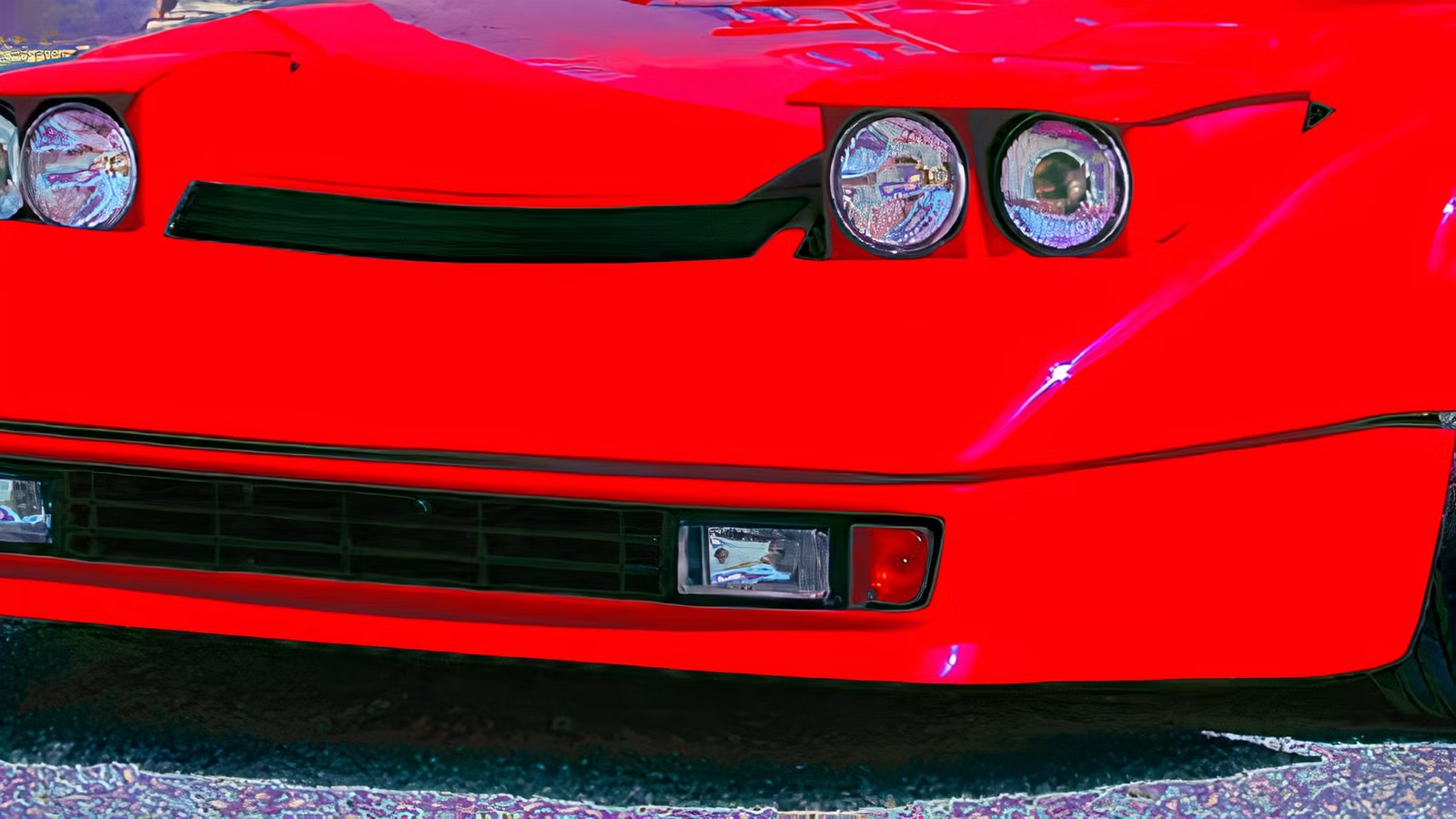
You might think you’ve cataloged every obscure supercar that ever came out of the 20th century. With the way the internet is, you can learn anything you want to know about all the world’s long-forgotten automotive passion projects by accident—just from doom-scrolling TikTok for a while. Well, here’s one that almost no Zoomer or Millennial has ever heard of. In truth, that’s a shock, because it brought the paradigm of digital design to the automotive forefront.
Supercars Designed With Computers, Like Witchcraft in the Old Days

It doesn’t take a genius to understand why using dedicated computer software to design cars instead of the old fashion way is a total game changer. But to conceptualize just how many jobs the computer altered or outright replaced in automotive design, it’s worth remembering the process every OEM used to follow. Before the late 1980s, every step of the design process was done by hand, with pencils, clay models, T-squares, and X-Acto knives.
To start, a basic sketch was drawn up by a combination of the lead designer and close confidants in a design team’s inner circle. From there, the sketch would be handed off to a technical drafting team. It’s here where the clay gets broken out in abundance, starting with scale models, and working their way up to massive 1 to 1-scale mockups designed by consensus, and a shared artistic vision. Then, a separate team of woodworkers hand-crafted test articles for the wind tunnel, and then, just maybe then, plans would come into place for a metal concept car, and maybe they’d even put an engine in it.
As far as concept cars go, all this hand assembly often meant body panels didn’t align correctly on the first test-fit. It was a problem you could fix with a ball peen hammer, not lines of C or C++ code. From a modern perspective, the process was so unscientific that it’s pure comedy to modern sensibilities. As far as supercars are concerned, everything changed when a man born halfway across the world from the US thought he could do things differently.
Mladen Mitrovic: An Under-the-Radar Visionary

The spirit of innovation knows no national borders. That’s why a Yugoslav national of Serbian origin named Mladen Mitrovic uprooted himself from home and traveled to Germany to learn the art of supercar craft. Settling in Stuttgart, not far from Porsche and Mercedes-Benz’s HQs, Mitrovic founded Speed & Sport GmbH, a firm dedicated to building aftermarket convertible tops and other high-end accessories for local German sports cars.
A modest success in its own right, the company was among the first, if not the very first bespoke maker of aftermarket convertible tops in all of West Germany in the period. With his sights firmly set on the supercar establishment of the day, Mitrovic was able to leverage his company’s influence, until the University of Stuttgart, along with scientists at the Technical University of Munich, gave him access to something truly novel. That being dedicated computer-aided design (CAD) 3D modeling software.
Then the domain of prestigious colleges, aerospace engineers, and the upper echelon of automotive OEMs, CAD software didn’t replace human designers outright. But one thing is for sure: it changed their job description, and it showed in the results of Mitrovic’s tinkering.
Kodiak F1: The First CAD-Designed Supercar

Back in those days, the early 80s in particular, CAD software was in its infancy. In the days before mainstream vendors like Autodesk, MicroStation, and CADKEY released their first consumer iterations, Mitrovic used bare-basic distributions intended to run on primitive IBM-based business computers. In the end, his first and only supercar prototype, the Kodiak F1, sure looks like it was designed in CAD.
Low-slung and almost Lamborghini-like in its look, the Kodiak F1 used a Mercedes-adjacent gullwing door setup rather than Lamborghini’s trademark scissor doors. Clever quad pop-up headlights with two on each side certainly matched the theme of other supercars from the era. With the powertrain mounted comfortably behind the driver, but far back enough to be labeled rear mid-engine, the Kodiak F1 mirrored the Lamborghini Countach and De Tomaso Pantera in design philosophy.
Under the hood was something not even remotely chic or European. Instead, the 350 cubic-inch L48 variant of GM’s small block Chevy motor was chosen. It was borrowed from the same lineage that appeared in a number of Chevrolets, including the Camaro, and Holdens like the Monaro. With forged pistons, beefed-up cylinder heads, and higher compression, the most powerful Kodiak tune profile topped out at 450 horsepower. Another, in standard EU spec, made 230 hp. Though performance data is hard to verify, the most powerful Kodiak F1 surely had the raw power to compete with the supercar segment’s biggest names.
The Right Car, The Right People, The Worst Possible Timing

|
Power |
Torque |
Weight |
Top Speed |
|
450 HP |
340 LB-FT |
2,840 lbs |
170 MPH |
On the surface, the Kodiak F1 had everything it needed to succeed. It had a striking body, a screaming, reliable, all-American V8 under the hatch, and an interior full of leather. But beneath the surface, tension was brewing on the administrative side of things. For starters, upon its unveiling at the 1983 Frankfurt Motor Show, the F1 was marketed as having a sale price of $48,000. In 2026 money, that’s a touch under $160,500.
For what you get out of the deal, that sounded like a bargain, but no sooner did the unveiling complete than the time table for release, as well as the price, began to slip. By 1986, the suggested manufacturer’s retail price had climbed closer to $117,000. In modern money, that’s deep into quarter million-dollar territory, and getting close to overtaking the base price of a Countach LP5000 S. In short, the economics simply didn’t add up at the time.
If you can believe it, that wasn’t the Kodiak F1’s biggest problem. That would come in the form of the supplier Mladen Mitrovic chose to manufacture the carbon Kevlar composite bodies. With the help of the coachbuilding firm Waggonfabrik Rastatt, the Kodiak team meticulously mapped out a viable path to production that even saw six pre-production examples built, two with engines and the rest without. But then a massive fire ripped through the facility, destroying all the tooling needed to complete production and effectively ending the venture before it started, by 1989.
The Ugly Aftermath

In the end, the fire ruined any opportunity for the Kodiak F1 to take center stage. Instead, Mitrovic spent the next decade or more bogged down in a blame game that his business partners were never going to concede defeat on. In the end, all but one Kodiak F1 was destroyed in the fire, or soon afterward when the project went bust.
The lone survivor, a US-spec with the small block motor, made its way to the collection of a Californian man by 1990. Then after nearly 20 years, the car was sold on eBay for a sum of $50,000. At least without inflation, the number isn’t far off from the Kodiak F1’s original MSRP. Somehow, that makes its journey all the more poetic. Meanwhile, the project’s entire existence appears to be the automotive equivalent of the backrooms — a liminal state in space and time that very nearly became a household name, had things gone even a little differently. Instead, it’s a cautionary tale of what can happen when everything goes wrong.
Source: techeblog.com, DrivingYourDream, Speed and Sport GmbH

Related posts





Latest Post


No Comments