
5 Pickup Trucks That Built America
Few machines have shaped a country like the pickup truck has done for the US. Used for everything from being trusted workhorses for businesses, helping them grow, to hauling families off the beaten track. It’s become the best-selling vehicle type in the country, with Dodge, Chevrolet, GMC, Ford and Jeep all having a range of pick-ups (barring Jeep who has one) as part of their current product portfolio. The pickup’s unparalleled popularity in the US has helped their parent companies prosper, as well as their supply chains and dealer networks.

Modern truck production requires suppliers ranging from those contracted directly by the company to build the complete modules, right down to those contracted by the higher tiers to supply the raw materials like the aluminum, steel, rubber and glass – the core foundations to the truck’s production process. As a result, demand for pick-ups has been keeping the American people in work and upholding America’s economy-first attitude. So what were the greats that defined the pickup’s contribution to America’s success? These five, ranked according to their production numbers, not only shaped America, but turned ‘utility’ into respect.
5
Dodge Power Wagon (1945 – 1968)
Over 95,000 made
|
Engine Displacement |
 7 autotech Power |
Payload |
|
230 ci (3.8L) – 251 ci (4.1L) |
Up to 125 hp |
3,000 lbs |
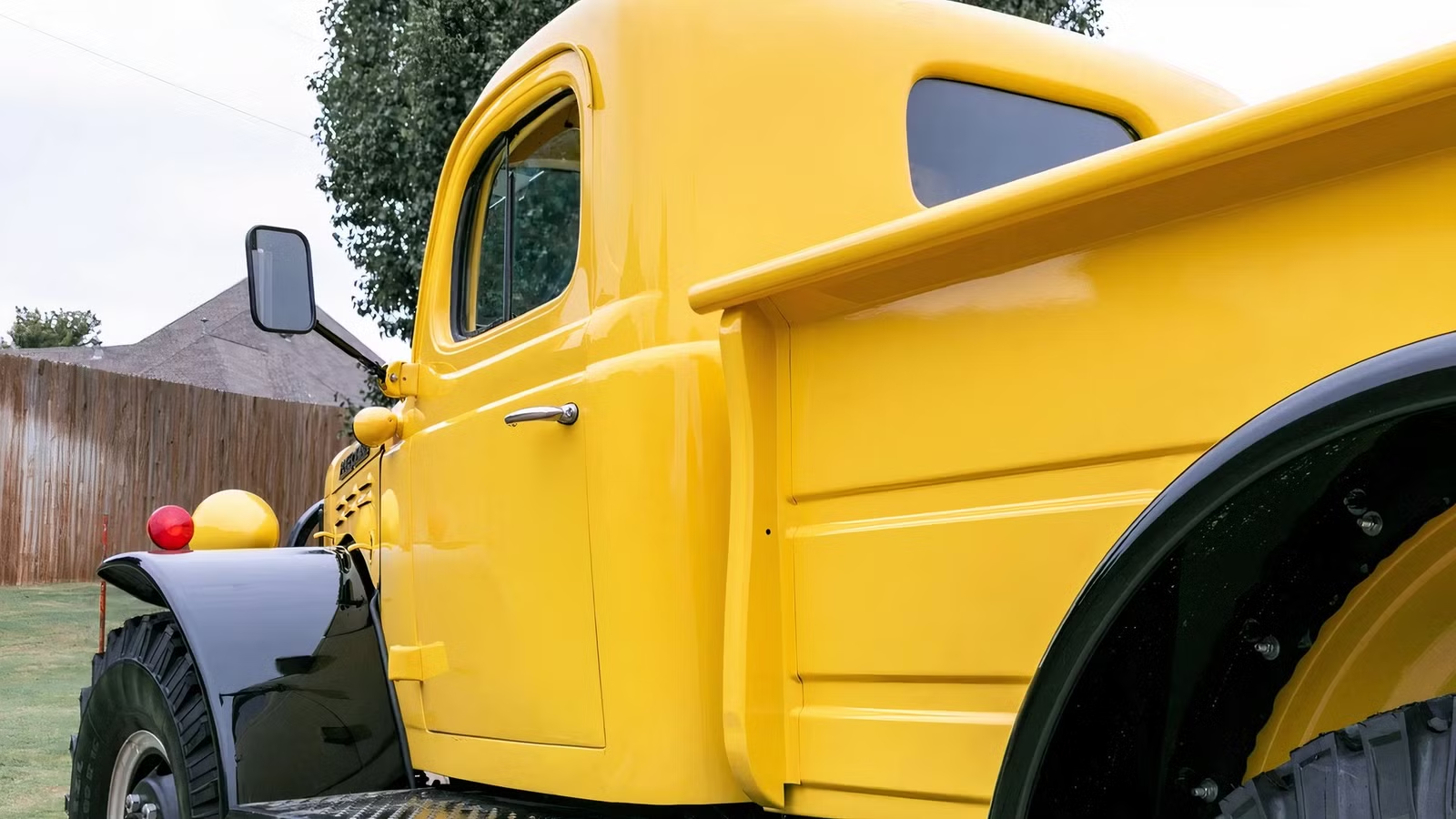
When Dodge revealed its Power Wagon in 1945, the same year World War 2 (WW2) came to an end, it revolutionized America as it became the nation’s first mass-produced, civilian 4×4 truck. Designed from the firm’s WW2 military vehicles, it brought off-road ruggedness to farmers, loggers and crews, allowing them to conquer parts of America’s landscape which was otherwise untouched, as most civilian trucks before it were only two-wheel drive. It introduced rugged, four-wheel drive to the people and became one of the best workhorses to have come out of ‘The Land of Opportunity’. Equipped with a factory-available Power Take-Off system, it allowed the engine to run auxiliary equipment like generators, hydraulic pumps, winches, saws, and compressors, turning it into a mobile workstation for construction and farming.
It allowed crews to access and develop isolated regions of the country for timber, mining and power grids. Aside from pioneering parts of America’s economy, it also helped to save lives as components were shared with Dodge’s military grade M37 truck used for medical and defense use. Dodge’s Power Wagon became one of the most respected American trucks ever made. So much so, in 1994, United Arab Emirates billionaire and member of the Abu Dhabi ruling family Sheik Hamad bin Hamdan Al Nahyan, also known as the “Rainbow Sheik”, created a driveable, customizable, mobile living quarters version of the Power Wagon. Coming in at 50 tons and 10 times larger than the original. This mam.moth Power Wagon featured four bedrooms, a kitchen, a conference room, and a patio in the tailgate. The truck is currently on display at the Emirates National Auto Museum, south of Abu Dhabi, where you can view his jaw-dropping creation.
4
Ford Model TT (1917 – 1928)
Over 1.3 million made

|
Engine Displacement |
Power |
Payload |
|
177 ci (2.9L) |
20 hp |
2,000 lbs |
Ford’s Model TT pickup took the Model T’s engine and mated it to a reinforced, extended chassis and a heavy-duty ‘worm-drive’ rear axle. Buyers only bought the chassis from Ford, and were required to source their own after-market bolt-on ‘cabs’ and ‘beds’ up until 1924. By doing so, this little truck revolutionized America’s agriculture and construction industries by providing rural and urban businesses with durable, dependable workhorses which could handle heavy loads at an affordable price.
Farmers used them to haul heavy crops, merchants used them for their city deliveries, and the US military used them as cargo vans and ambulances during the First World War. Supplied with over 12,000 TTs from Ford, 7,000 of them were used overseas with the American Expeditionary Forces. Like its passenger Model T counterpart on which it was based, Ford was able to save on costs thanks to mass production. Using standardized parts and continuous manufacturing, the base chassis was offered at an accessible price. As a result, Ford made over 1.3 million of them.
3
Dodge Ram (1980 – present)
Over 10 million made

|
Engine Displacement |
Power |
Payload |
|
183 ci (3.0L) – 505 ci (8.3L) |
Up to 777 hp |
Up to 2,370 lbs |
*This data applies to full-size 1/2 ton Ram models only across the generations.
Debuting in October 1980, the ‘Ram’ name was introduced to the world, and succeeded Dodge’s D-Series trucks. Dodge marked a significant milestone in 1994 with the Ram’s “big-rig” redesign language, which featured a raised hood and a large, prominent crosshatch grille. In 2009, parent company Chrysler, officially made Ram trucks as a separate, stand-alone brand. By doing so, Dodge was able to concentrate its efforts on performance muscle cars while Ram concentrated on the commercial side with vans and trucks. Like the Power Wagon, the Ram provided rugged, heavy-duty capabilities needed for farming, construction, and building America’s industry on both small and large scales.
Today, Rams make up the cornerstone of America’s economy. Millions of Stellantis’ best-selling pickups are currently built at Sterling Heights Assembly Plant in Michigan. By operating a lean, “just in time” supply chain, Tier 1 suppliers for Ram production produce larger-scale modules in facilities directly adjacent to the assembly plant, which are then delivered for final assembly to reduce transit times.
2
Chevrolet C/K Series (1960 – 2002)
Over 15 million made

|
Engine Displacement |
Power |
Payload |
|
230 ci (3.8L) – 496 ci (8.1L) |
Up to 350 hp |
Up to 2,400 lbs |
*This data applies to 1/2 ton C/K models only across the generations.
Evolving over four generations between 1960 and 2002, Chevrolet’s C/K models were available in multiple combinations of body styles and drivetrains, prefixed with a “C” for rear-wheel drive models and a “K” for four-wheel drive models. They offered more trim and comfort levels for buyers as the model years progressed, which helped transition the pickup design from crude, basic farm vehicles into purpose-built, luxury, car-like daily drivers. But what made the Chevrolet C/K series important was its commitment to building America: its introduction coincided with the construction of US highways. It provided the heavy-duty towing and hauling capacity needed for the construction crews to build the interstates. Serving as the vital channel between the distribution hubs and localized development projects, helping to expand the US’s infrastructure and freedom of movement for its people.
It was also heavily used in agriculture, hauling seed, fertilizer, crops, and livestock from fields to processing sites, serving as a critical asset connecting farms to wider agricultural supply chains. It naturally supported a multitude of tradespeople with transportation for their small businesses. The C/K helped to pioneer modern SUVs thanks to its chassis, which underpinned its modern successors in the form of the Suburban and Blazer, which revolutionized the US’s high demand for SUVs (in the late 90s and early 00s) compared to standard passenger cars. Over 15 million C/Ks have been estimated to have been built across the generations, with its popularity helping to maintain America’s economy for over 40 years and production sites scattered across the US, including Michigan, Atlanta, Wisconsin, and Missouri.
1
Ford F-Series (1948 – present)
Over 43 million made

|
Engine Displacement |
Power |
Payload |
|
164 ci (2.7L) – 460 ci (7.5L) |
Up to 720 hp |
Up to 3,325 lbs |
*This data applies to Ford F-150 models only, across the generations, excluding other F-Series models.
But at the top of the list is the best-selling vehicle to grace American shores, and the longest surviving pick-up in this list. It’s Ford’s F-Series. Since its introduction in 1947, over 43 million have been produced, with the F-150 light-duty pick-up being the most popular in the series thanks to its focus centered towards private use over the other F-Series’ model’s wider commercial use. While the F-Series production commenced in 1947, it wasn’t until 1975 that Ford introduced the F-150 name, to slot between the F-100 and the F-250, designed to meet strict federal emissions standards (which dominated the 70s), while maintaining the hauling capabilities that defined the F-Series range.
Due to its longevity, it’s become the backbone of the American economy for over 70 years. Studies from the Boston Consulting Group suggested Ford’s F-Series supports around 500,000 jobs, supporting supply chains and dealerships in the process. The F-Series has also survived this long thanks to its ability to adapt with the times. During the 70s, trucks were adapted for efficiency, while during the 90s, customers were given trucks with car-like performance, comfort, and safety features such as the SVT Lightning performance variants, the Eddie Bauer luxury edition trim line, as well as anti-lock brakes and airbags fitted as standard. Today, the F-Series has switched to aluminum bodies and beds to aid towing capacity, and became one of the first pickups to make the switch to electric with the F-150 Lightning. Major construction companies use Ford’s smallest F-Series truck as part of their fleets alongside other Ford heavy-duty trucks, including Skanska USA, Kiewit, and Turner Construction, for commercial and engineering projects.
Sources: Boston Consulting Group, Chevrolet, Dodge, Ford, Hagerty, Skanska USA

Related posts





Latest Post


No Comments