
The German-Designed Japanese Superbike That Was Briefly The Fastest Production Bike On Earth
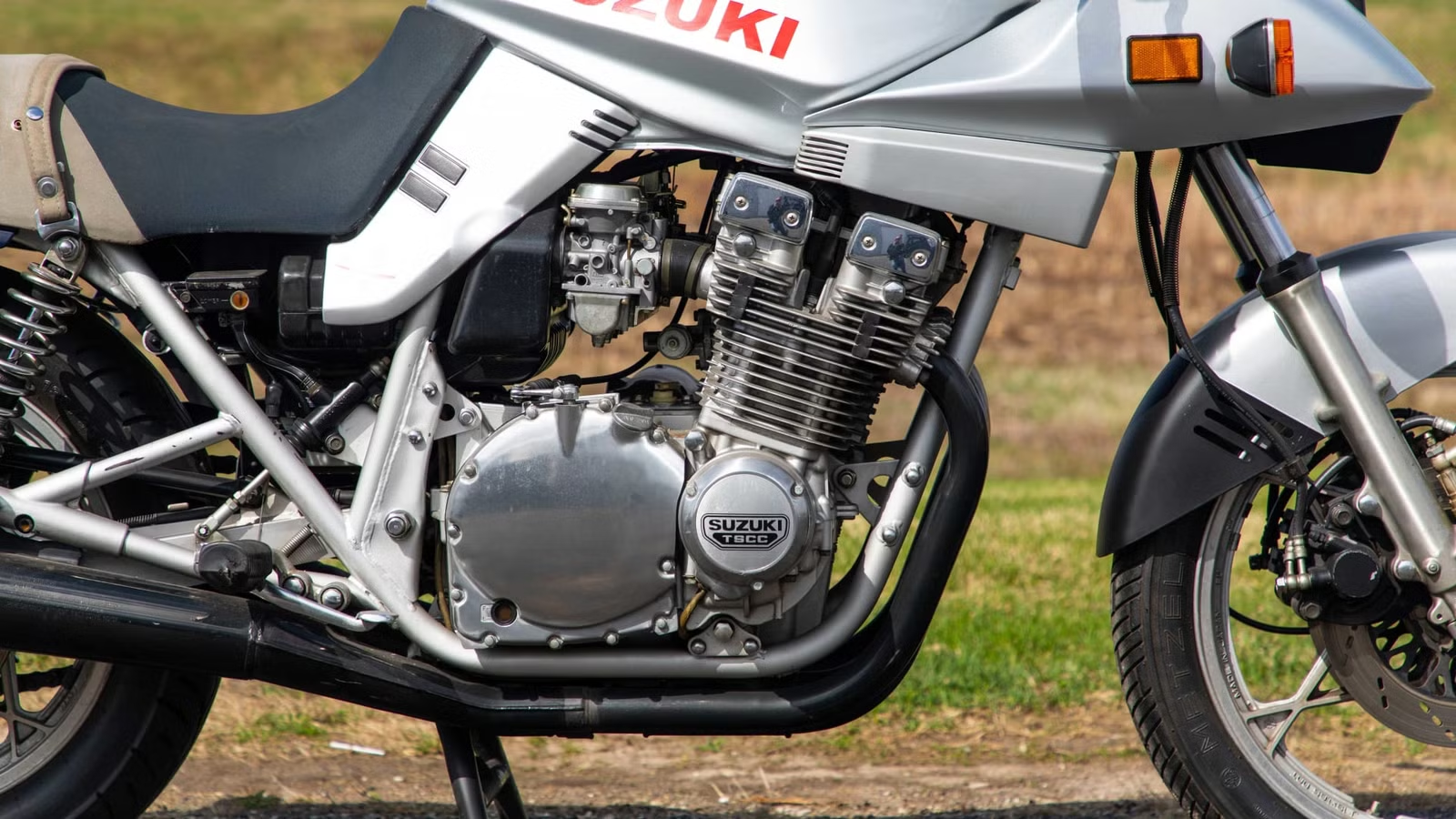
Japan ruled the motorcycle industry in the 1980s. The “Big Four” of Honda, Suzuki, Yamaha, and Kawasaki were offering powerful, exciting bikes that had both performance and reliability all in one package, and each brand was perpetually trying to one-up the other. While they were doing it all from Japan, one brand got help from a German design firm to create a radical new bike, creating the fastest production bike on the planet at the time.
Japan’s Motorcycle Industry Was Locked In A Power War During The Late 1970s

The story of Japanese motorcycles in the 1970s starts, somewhat predictably, with the Honda CB750. Released in 1969, the CB750 rewrote what a modern motorcycle was by combining a four-cylinder engine with an electric start, Japanese reliability, audacious power for the time, and a price point that undercut even some of the most reasonable European bikes.
With the motorcycle world irrevocably changed, Kawasaki challenged the CB750 with the introduction of the Z1 in 1972, surpassing Honda’s bike in both power and speed. Suzuki had also entered the water-cooled market with the GT750 in 1971, while Yamaha introduced the TX750 to little fanfare in 1972. Power was a key factor in marketing materials and, as the decade wore on, it became increasingly important — almost at the expense of everything else.
European Styling Was Becoming Just As Important As Performance


As power increased, so did the need for aerodynamic styling. Manufacturers had largely been putting increasingly powerful engines into increasingly unsuitable frames, leading to claims of poor handling and earning Kawasaki’s H2 its notorious “widowmaker” nickname. But this focus on power also led to a lack of differentiators between Japanese bikes, while, at the same time, European brands like Ducati and BMW had established reputations for having elegant, if not as powerful, bikes.
Exports were also a crucial battleground. Britain had already demonstrated a strong appetite for Japanese motorcycles following the success of the CB750, contributing to the decline of its own domestic motorcycle industry.
North America was also an important market, as Japanese bikes offered something different from the cruisers its riders were accustomed to. Europe was another particularly lucrative market that the Big Four Japanese brands wanted to crack and, by the end of the 1970s, brands were searching for ways to stand out in an increasingly crowded market. With power alone no longer enough, distinctive styling was becoming as important. In 1981, Suzuki released a bike that combined the best of Japan and Germany and became, for a short time, the fastest production motorcycle on the planet.
Suzuki Built The Fastest Motorcycle Nobody Could Handle
This 194-mph machine ended the speed wars by forcing a global truce that capped all future production motorcycles.
The Suzuki GSX1100S Katana Was A German-Designed Japanese Bike

|
Engine |
Power |
Torque |
Top Speed |
Dry Weight |
|
1,074 cc air-cooled inline-four |
111 hp @ 9,500 rpm |
71 lb-ft @ 6,500 rpm |
~140 mph |
511 lbs |
With a name like “Katana”, and coming from Suzuki, you’d be forgiven for thinking that the GSX1100S was a profoundly Japanese creation. And while, yes, it did wear the Suzuki name, the bike actually started off as a German invention with Italians in mind.
That’s because the bike was designed by German firm Target Design. Led by Hans Muth, BMW’s former Chief of Styling, the team created an MV Agusta-based concept that had four cylinders, an aggressively angled front fairing that connected to the tank, a wedge silhouette, and a deeply futuristic look. It was created for a design competition held by German magazine Motorrad, and the bike, known as the MV Agusta ED-1, actually won the competition, though it didn’t make it to the MV Agusta assembly lines due to it being an independent concept. But while MV Agusta didn’t pursue the design, it caught Suzuki’s eye.
Seeing and appreciating the design, Suzuki contracted Target Design to work on it for mass production in their burgeoning GSX series. While the ED-1 was a particularly outlandish (and separate) design, many of its core ideas were carried over to the GSX1100S. These included the aggressive front fairing (which was integrated into the bike itself), the sculpted fuel tank leading into the seat, the rider-focused cockpit, and the sharp lines — along with the triangular nose jutting out from beneath the headlight that the bike is known for today.

While the bike was aesthetically unlike anything else that had graced the roads, it was mechanically interesting, too. Its four-cylinder, air-cooled engine and steel frame were conventional, but its 1,074 cc engine produced 111 horsepower and could propel the bike to around 140 mph (exact speeds are debated). It was helped to that speed by Target Design’s focus on aerodynamics and extensive wind tunnel testing (not standard for road bikes at the time), which treated the rider as part of the bike. Positioning the rider inside the bike, rather than atop it, did lead to some ergonomic complaints. However, comfort improved at higher speeds.
And while some bikes of the previous decade could very quickly get riders up to speed, they’d forgotten that riders needed to slow down, too. Suzuki had put some thought into this, claiming it was the first production bike released with anti-dive forks. However, these claims were dubiously received as riders found the brakes unpredictable and stiff.
Regardless of braking prowess (or lack thereof), the bike was undoubtedly powerful. Powerful enough, in fact, that Suzuki proclaimed it the fastest production bike on the planet on its 1981 launch. It would hold onto that self-imposed title for just three years, however, before being usurped by the Kawasaki GPZ900R Ninja in 1984, which claimed a 149 mph top speed.
Why The Katana Changed Motorcycle Design Forever

The Katana’s looks were divisive on launch and, arguably, remain divisive to this day. Motorcycles had largely followed a predictable design path before its release, particularly those from Japan where the Universal Japanese Motorcycle (UJM) aesthetics of round tanks, soft lines, and mechanical looks were commonplace. The Katana sliced through these, introducing the wedge design, far more conscious aerodynamics, and backing up the jaw-dropping looks with prodigious power.
Suzuki would continue and evolve the Katana’s philosophy with bikes like the GSX650F, GSX750ES, and super-rare XN85, with the Katana itself lasting until 2006. It was revived in 2019 and retains a lot of the design that made it popular.
The First Production Bike To Run A 10-Second Quarter Mile
It was a benchmark that manufacturers were vying to hit, but who actually hit it first?
The Katana’s Legacy Lives On Over Four Decades Later

Just as the Honda CB750 had changed what a superbike was in 1969, the Katana did so in 1981. But while the CB750 held onto the typical UJM design, the Katana eschewed the norm and pursued a radical, genre-disrupting approach that still holds weight today. That the bike backed up its alien design with world-beating performance proved that it wasn’t just weird for the sake of weird; it was the ultimate in function over form, and helped redefine what a production superbike could be. Feelings of ire toward that design have mellowed over time, helping detractors see it for what it really was: a defining moment in motorcycle history, and proof that innovation lies in the unknown.
Sources: Route 21 Africa, The Flying Banana, Bennetts

Related posts
Latest Post


No Comments