
The Suzuki Motorcycle That Deserves A Massive Comeback
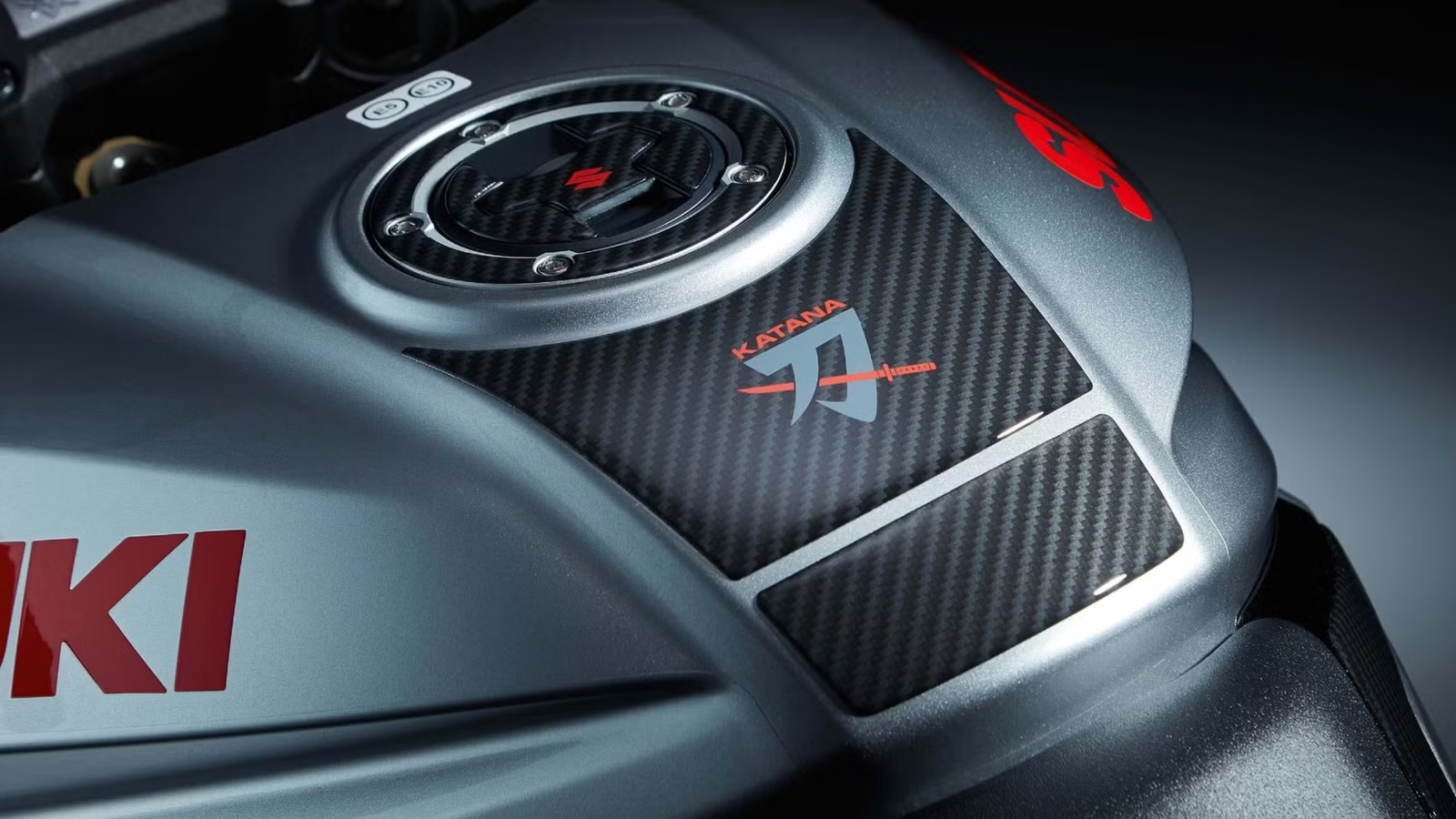
The Suzuki we know today looks like a safe, no-risk two-wheeler manufacturer that banks on models with longevity and reliability. This wasn’t always the case, though. Suzuki’s two-wheeler division has an R&D department that is the equal of any other, should they put their mind to it (and get the budget from the bean counters).
Suzuki has become a safe manufacturer because sometimes it has taken a risk and it hasn’t worked out. When your company operates on slim margins, you can’t afford to take a second bite at the apple. That’s a shame because there are some Suzukis that didn’t work out, but we wish they were back in the lineup today. Here’s a prime example bearing an iconic moniker.
Some Interesting Suzuki Models Have Not Been Successful
We know that Suzuki has had some incredibly successful models like the Hayabusa. The US market is also unique for Suzuki because its lax emission norms allow it to keep stalwarts like the Boulevard M109R, DR650S, and SV650 on sale. However, it has had models in the past that bombed at the sales office for different reasons. Not many will remember the RE5 with its rotary engine that was on sale in the 1970s. Its high fuel consumption and low reliability turned away customers at a time when fuel prices were at incredible highs.


More will remember the B-King from the mid-2000s. This brutal streetfighter was based on the Hayabusa, promising to be something of a hyper naked bike. But it was priced at such a premium that not many in the US market wanted one. There is one discontinued Suzuki, however, that was ahead of its time, and it deserves a massive comeback.
The Katana Is The Suzuki Motorcycle That Deserves A Massive Comeback

Suzuki has an inline-four 1,000 cc naked bike on sale today in the GSX-S1000, but it is styled like a modern streetfighter. Although it occupies the budget end of the liter-naked spectrum, these days everyone is capitalizing on the neo-retro styling wave, the latest entrant being the Honda CB1000F.
These are models that deliver usable everyday performance at a usable everyday price, and the Katana, with its unique looks, would definitely have stood out in the present company. Also, judging by the reliability of the GSX-S1000, the Katana would have aced that test with flying colors, and its combination of price, performance, and looks certainly makes us wish that Suzuki gave it another opportunity on American soil.

The Motorcycle That Proves Suzuki Still Knows Best
This Suzuki is a legend in the motorcycle world, but what makes it truly stand out is its ability to remain relevant and desirable even today
The ‘Katana’ Name Holds A Lot Of Value

The Katana name has a lot of history, and not just on American soil. The first Katana was launched globally in 1982. It ran a 1,100 cc engine, but we got one that was just under 1,000 cc so that Suzuki could homologate it for AMA racing. It then shifted to a fully faired sport tourer design, covering a number of displacements from 125 cc onward, a few of which the US market got.
Finally, a few years ago, the modern Katana was launched in the US market, but poor sales meant that it got pulled from showrooms in just a couple of years, and we haven’t seen it since… Except for that one time in 2023 when Suzuki allowed customers to book one. That one was a limited run, and available on order only.
It Has Held Its Value Really Well

Suzuki sold it officially in the US market for just one model year, the 2020 model year. You might get examples registered in years after that, but they are from the same 2020 model year. There is one exception, though: the limited-edition 2024 model. By and large, the 2020 models are now valued at $10,478.
This means it is valued more like a collector’s item than a regular street bike because of its rarity. Of course, it is easy to maintain as well because it is a global model that is still on sale, plus the GSX-S1000 is on sale in the US market. This is going to be more of an appreciating asset rather than a regular motorcycle.
GSX-R-Derived Inline-Four Powerhouse Tuned For Torque

The modern Katana uses an inline-four engine, and just like the original US-spec Katana, it displaces just under a liter at 999 cc. This engine is derived from the K5 GSX-R1000 engine, but it has been detuned for more flexibility. It has a compression ratio of 12.2:1 and produces 148 horsepower at 10,000 RPM and 79.8 pound-feet of torque at 9,500 RPM. This tune is great because, in the GSX-S1000, it delivers thrills without the stress.

However, if you get one of the 2024 models, it will have slightly different cams and valve springs, and it achieves the same peak power 1,000 RPM higher than the figure of the 2020 model mentioned above. This was sent through a six-speed gearbox and chain drive to the wheel. Despite being a little portly, this is a quick motorcycle; its 60 miles an hour coming up in 3.2 seconds and a quarter-mile in a shade under 11 seconds. Once again, the two-way quickshifter was standard on models produced in 2022 onward.

The Japanese Cruiser That Makes Harley Riders Look Twice
Here is a rare cruiser gem from Japan that can make Harley riders sweat with its presence, even though it has had no updates in 20 years
Surprisingly Advanced Chassis For A Retro-Styled Bike

Metallic Mystic Silver 2020 Suzuki Katana leaning into a curve, front fascia zoomed-out shot
The chassis is where Suzuki may have gone wide of the mark because it wanted the modern Katana to echo the capabilities of the original Katana, which once laid claim to the “fastest production motorcycle” title. This is why it has an aluminum twin-spar chassis and a sports bike-style banana swingarm. Not only is a twin-spar chassis heavier than the trellis frames utilized by the current competition, but it is also more expensive to manufacture.
The suspension is similarly premium, with 43 mm inverted KYB forks with full adjustability. At the rear, there is a link-type monoshock with seven-way adjustable preload and rebound adjustment as well. Two 310 mm fully floating brake discs are present at the front with Brembo radial monobloc calipers. At the rear, there is a 240 mm disc with a single-piston Nissin caliper. 17-inch cast-aluminum wheels and tubeless radial tires round out the chassis specs.
What about dimensions, you ask? Being a liter bike that looks the business, this has a length of 83.9 inches and a width of 32.3 inches. Its wheelbase is fun-size, though, at 57.5 inches. The ground clearance is a standard 5.5 inches, just like the seat height of 32.5 inches. It weighs 474 pounds, which makes it a little on the heavier side for its segment. The fuel tank can hold 3.2 gallons of fuel.
Decent Electronics Set, But No TFT Screen

The Katana provides a basic set of features at the price. The 2020-year models did not have a quickshifter as standard; that was introduced on later models. You will find them on the limited-edition MY 2022 and 2024 models. It does have ABS and traction control, neither of which ties into an IMU. Another area of this bike that desperately needs an update is the instrument cluster. This is an old-school LCD with a very interesting orange nighttime color.
The Performance Bike With Kawasaki Reliability And Indian-Level Handling
What happens when bulletproof dependability meets corner-hungry confidence? You get a naked performance machine that refuses to pick a side.
No Shortage Of Quality Competition For The Katana

The Katana is a design icon, and the power output is definitely exciting, but it has some really stiff competition in this segment if it launches again. The trouble is, at 10,000-plus dollars, it already has a retro bike available in the form of the GSX-8T, which is based on a Suzuki that exceeds expectations. Reintroducing the Katana will mean either pricing it above this product or dropping the price of the 800 cc product, which would be the right thing to do since its performance puts it in a segment below the other two competitors.

However, if you want a full-size, liter-class retro naked, then there is the Honda CB1000F, which is possibly the most balanced choice here. It asks for the exact same amount of money as the Yamaha, so its value is unquestionable. At the same time, it offers things like a six-axis IMU, but it does not offer the same amount of performance as the Suzuki since the engine is detuned to a little over 120 horsepower.
Sources: Suzuki Cycles, Suzuki Global

Related posts
Latest Post


No Comments