
The First Production Car To Break 800 Pound-Feet Of Torque
Think massive torque, and Muscle Cars will no doubt pop into your head. Starting in the ’60s, muscle cars had ridonculous torque figures, generally down to the bog block engines up front that were better suited to a military tank. During the Golden Era, it wasn’t unusual to see torque figures of 500 lb-ft, with the 1970 Buick GS 455 Stage 1 even hitting 510 lb-ft.

Things calmed down a bit after then, primarily due to an oil crisis reining in outputs, but in the 2000s a torque war started again. This was when one car broke the 800 lb-ft barrier with ease — and, guess what? It wasn’t a muscle car…
Let’s Talk About Torque
Let’s be honest, we all love to talk about power, so why does torque so rarely get a mention? It might not sound as zingy as “horsepower”, but torque is often just as important as horsepower, and is particularly useful when it comes to acceleration. Similar to trying to explain the Infield Fly Rule in baseball to an English tourist in a loud sports bar after one too many beers, torque is also a tricky one to parlay to non-car enthusiasts.

Essentially, torque is a rotating force produced by an engine’s crankshaft, designed to measure the work an engine can perform. This is essential in a heavy muscle car, where you will need a decent slug of torque to overcome inertia and accelerate the mass from a standstill. The only time torque isn’t going to be so important is in a featherweight sports car, but you are still gonna need some to get going. But while sturdy muscle cars pioneered the need for huge levels of torque, it was a hypercar that took it to the next level in the 2000s.
Torque Was Reaching Unprecedented Levels In The ’90s

Before we get there, let’s have a quick look at the preceding decade. The McLaren F1 would be seen as a car with immense amounts of torque when it arrived in 1992. The British Hypercar was among the first production cars to exceed 600 horsepower with its naturally aspirated 6.1-liter BMW S70/2 V12, with a torque figure of 479 lb-ft. You might be thinking, surely the Dodge Viper’s V10 makes more than that? Nope, that 465 lb-ft. In fact, the Vector W8 had broken the 600 lb-ft barrier in the ’80s, and the only other cars in the ’90s that were getting near it were the 1999 Aston Martin V8 Vantage Le Mans with 600 lb-ft, and the 1998 Bentley Continental T with 650 lb-ft. Then came a car that added another 300 lb-ft to these figures.
The Bugatti Veyron 16:4 Introduced A Whole New Level Of Torque

|
Engine |
Power |
Torque |
0-60 MPH |
Top Speed |
|---|---|---|---|---|
|
Quad turbo 8.0-liter W16 |
987 hp |
922 lb-ft |
2.5 seconds |
253.81 mph |
2005 Bugatti Veyron 16:4 Specs
A lot of people talk about the Bugatti Veyron’s power and speed, and there is a good reason for that. Not only does the OG Veyron 16:4 have 987 horsepower, it will take you to a top speed of 253.81 mph. In 2005, you didn’t need any more than that to shut down every barroom debate on earth — the quad-turbo W16 Veyron simply beat everything, everywhere. But one aspect few people mentioned was the torque figure of the Veyron.
To put the figure into context, remember that the Ferrari 360 of 2005, for many the quintessential modern supercar of the time, had 275 lb-ft of torque from its 3.6-liter naturally aspirated V8. The Veyron, on the other hand, produced 922 lb-ft of torque – that’s almost four times the Ferrari. Or to put it another way, the Bugatti Veyron has the same torque as a modern Petersbilt 520 garbage truck.
The Veyron’s Engine Is A Masterpiece

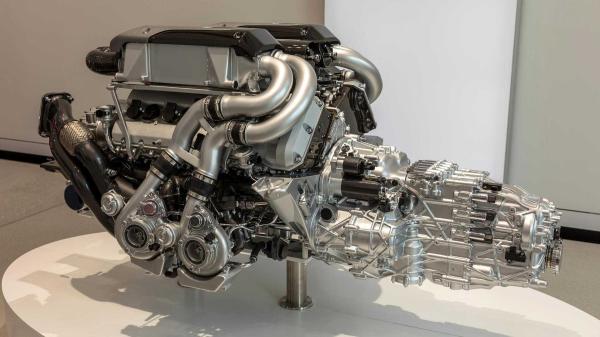
OK, so I think we have established that the Veyron has a lot of torque. But where did it all come from? Bugatti developed a new quad-turbo 8.0-liter W16 engine from two narrow-bank 4.0-liter V8 mills, packing 987 horsepower and 922 lb-ft of torque. Ten radiators keep the unit and its add-on parts from getting hotter than the sun, and the power and torque are channeled trhough a seven-speed, dual clutch gearbox. All-wheel drive and sophisticated aerodynamics create sufficient traction at all speeds, while carbon-ceramic brake discs and an air brake provide the stopping power. The Veyron needs just 2.5 seconds to reach 60 mph, while 124 mph arrives in 7.3 seconds, and 186 mph in 16.7 seconds.
Top 13 Fastest American RWD Cars Ever Made
These thirteen American cars prove you don’t need AWD to break speed records and outrun supercars.
The Engineering Challenges Behind 922 Lb-Ft Of Torque

The Bugatti Veyron’s massive torque figure was a huge jump compared to the 1998 Bentley Continental T that held the torque record before it, and Bugatti knew it had to come up with engineering solutions never seen before to ensure that kind of power was safe to use on public roads. Every component, from the wheels to the aerodynamics, had to be engineered around performance figures that previously existed only in concept cars and racing prototypes. We already mentioned how the gargantuan quad-turbocharged mill needed ten radiators to keep the heat in check, but that’s just the start of the madness.
The biggest challenge Bugatti faced was actually transferring that kind of power to the road without instantly breaking the car, since no production gearbox at the time could reliably withstand such immense loads. As such, Bugatti worked with highly regarded British engineering and defense consulting firm Ricardo to develop a seven-speed dual-clutch transmission specifically for the Veyron. Though the underlying dual-clutch concept already existed, the physical architecture for the Veyron was an entirely blank-sheet design that significantly lowered the car’s center of gravity. The drivetrain also relied on an advanced all-wheel-drive system, giving the Veyron the traction it needed for neck-snapping launches.
Even the tires required a clean-sheet approach. Bugatti partnered with Michelin to create bespoke high-speed tires capable of safely supporting a 250-mph-plus vehicle while also coping with the enormous forces generated during acceleration and braking.
Fun Fact: The Veyron’s W16 was a packaging miracle as much as a powertrain. Bugatti says the engine was compressed to just 645 mm (25.4 inches) long, helping make the car’s relatively compact 2,700 mm (106.3-inch) wheelbase possible.
The Real Achievement Was Making It Easy To Drive

The Veyron’s spec sheet was just as intimidating as it was exciting in 2005, especially for owners with no racing experience. On paper, a quad-turbo W16 producing 922 lb-ft of torque and capable of exceeding 250 mph sounded more like an engineering experiment than something you could drive to dinner. Yet through expert engineering, Bugatti was determined to ensure that owners didn’t need racing licenses or professional driving experience to enjoy it.
Despite the Veyron’s insane record-breaking numbers, owners could commute through traffic, take long-distance road trips, or unleash all four turbochargers on an open road without needing specialized training. In many ways, making 922 lb-ft of torque usable every day was an even greater engineering achievement than producing the car in the first place.
The Most Turbochargers Ever Put In A Production Car
There are multiple cars with three or more turbochargers, but we found one that stands head and shoulders above all the rest.
How Bugatti’s Torque Output And Engines Developed

In 2010, Bugatti introduced the Veyron Super Sport, generating 1,184 hp and 1,106 lb⋅ft from the 8-liter W16 and pushing it to a top speed of 267.91 mph. The 2021 Bugatti Chiron Sport arrived with a $3.3 million price tag and 1,479 horsepower on tap from the quad-turbo 16-cylinder. Torque is a cool 1180 lb-ft at 2000 rpm, and the Chiron uses a 7-speed dual-clutch automatic. The sprint to 60 mph takes 2.4 seconds, and top speed is 261 mph.
Then Things Got Even Crazier

If that sounds like the pinnacle of torque over at Bugatti, the new Tourbillon mixes the instant torque and flexibility of electric motors with the a naturally aspirated V16 engine. The engine itself generates 1,000 hp and 664 lb-ft of torque (without turbochargers of course), and the combined hp with the hybrid powertrain is 1775 horsepower. There doesn’t seem to be a combined official torque figure, but some sources put it at 1,696 lb-ft.
How America Re-Entered The Torque War

Of course, the American manufacturers weren’t going to sit back and let Bugatti take all the torque headlines. In 2023, Dodge launched the Dodge Challenger SRT Demon 170, aka the fastest muscle car over the quarter mile, with a National Hot Rod Association (NHRA)-certified 8.91-second ET at 151.17 mph. The Dodge Demon 170’s Hemi V8 produces 1,025 horsepower at 6,500 rpm and 945 Ib-ft of torque at 4,200 rpm on an E85 ethanol blend. The 6.2-liter HEMI under the hood uses a modified 3.0-liter supercharger with a larger snout, 105mm throttle body, and a 3.02-inch pulley, to boost pressure 40% over the Challenger Hellcat Redeye Widebody.
Then there is the Hennessey F5 Venom Evolution. This American hypercar packs a 6.6-liter V8 twin-turbo unit code named ‘Fury’ developing 2,031 bhp at 8000 rpm and 1,445 lb-ft of torque at 5200 rpm on environmentally-friendly Shell E85 pump fuel. How does that translate into speed? The Venom accelerates from zero to 200 mph in 10.3 seconds. With electric powertrains helping hybrids to reach new levels of torque — this Chinese SUV has 1,400 hp and 1,040 lb-ft of torque from a two-liter four-pot — who knows where the torque wars will take us next?
High Mileage Bugatti Sets A New Standard For Real World Use
This hypercar just hit a milestone that’s made for Honda’s.
How Torque Has Evolved In Today’s Electrified Supercars

In the good ol’ days, torque in its simplest terms was a measurement of the rotational twisting force generated directly by an engine’s crankshaft. In other words, it measured the sheer strength of each twist of the crankshaft. For over a century, chasing higher torque figures meant building larger engine blocks, adding cylinders, or strapping on massive turbochargers, which is why the Veyron needed four massive turbos to break the 800 lb-ft barrier. Fast-forward to 2026, and the tide has changed. The fundamental physics of how torque is generated, delivered, and managed has changed completely.
Modern electrification has completely decoupled torque from engine speed since electric drive units deliver 100 percent of their peak torque almost immediately, unlike internal combustion engines, which force drivers to wait for the engine to “spool” and rev to feel that maximum neck-snapping force. Because electric cars rely on magnetic flux and electrical current rather than mechanical levers to generate torque, full twisting force is available when the driver touches the pedal, virtually eliminating the delays associated with turbocharging, gear changes, and engine response. The torque delivery has also evolved: while older supercars relied on advanced transmissions and complex physical locking differentials to distribute power without snapping drive axles, modern hyper-hybrids use torque vectoring systems to determine how much torque flows to individual wheels millisecond by millisecond.
The Corvette ZR1X Shows Why Peak Torque No Longer Tells The Whole Story

The Veyron’s 922 lb-ft torque figure was revolutionary in 2005, but modern supercars show that instant electric torque matters more than the headline number. The latest and greatest Corvette iteration, the ZR1X, shows how torque has evolved both in numbers and real-world performance. Instead of relying solely on displacement, the 1,250-hp American hypercar uses a hybrid powertrain that splits duties across both axles. The rear wheels are driven by a 5.5-liter twin-turbo LT7 V8 generating 828 lb-ft, while the front axle features a compact electric drive unit contributing 145 lb-ft of instant torque. Chevrolet doesn’t provide an official torque figure for the ZR1X because engines and electric motors never peak at the same time.
While the multi-million dollar Bugatti Veyron requires engine speed (RPM) to build torque, the ZR1X’s electric front motor delivers peak torque from a standstill and manages it through pure code, resulting in an astonishing 1.89-second 60 mph sprint. Meanwhile, the Veyron completed a standard 0–60 mph sprint in roughly 2.5 seconds despite generating more torque from its engine, occasionally fighting for rear grip even with its all-wheel-drive system. The ZR1X demonstrates that modern performance is increasingly defined by how quickly torque can be delivered and managed, rather than by the peak torque figure alone.
Sources: Peterbilt.com

Related posts
Latest Post


No Comments