
10 American Cars That Aged Better Than Anyone Expected
John Carpenter’s 1982 remake of the sci-fi/horror film The Thing took in $20.9 million on a budget of $15 million, which according to Hollywood math, qualifies it as a colossal bomb. Because of promotion and distribution costs, a movie has to make two or even three times its budget, just to break even, so this wasn’t remotely successful. It didn’t flop because it’s a bad flick; it just had the misfortune of being released around the same time as E.T. the Extra-Terrestrial and Poltergeist, so it was just kind of lost in the shuffle. It did, however, find an audience on home video and has since gone on to be regarded as one of the greatest splatterfests ever committed to film.

When a car flops, on the other hand, it’s usually because it was just awful, like the Chevrolet SSR convertible pickup truck that was positively hideous and incredibly impractical. That’s not always the case with models that fail to capture the public interest and, in fact, there are several really great sets of wheels that initially flopped. In some cases, these rides were ahead of their time with radical designs that scared off buyers, but also many times the automakers failed to promote them properly, so people didn’t know how awesome they really were. Here are some of the most amazing American automobiles that were dismissed in their time, but have aged wonderfully to become cult classics.
10
1934 Chrysler Airflow
Aerodynamic Abomination
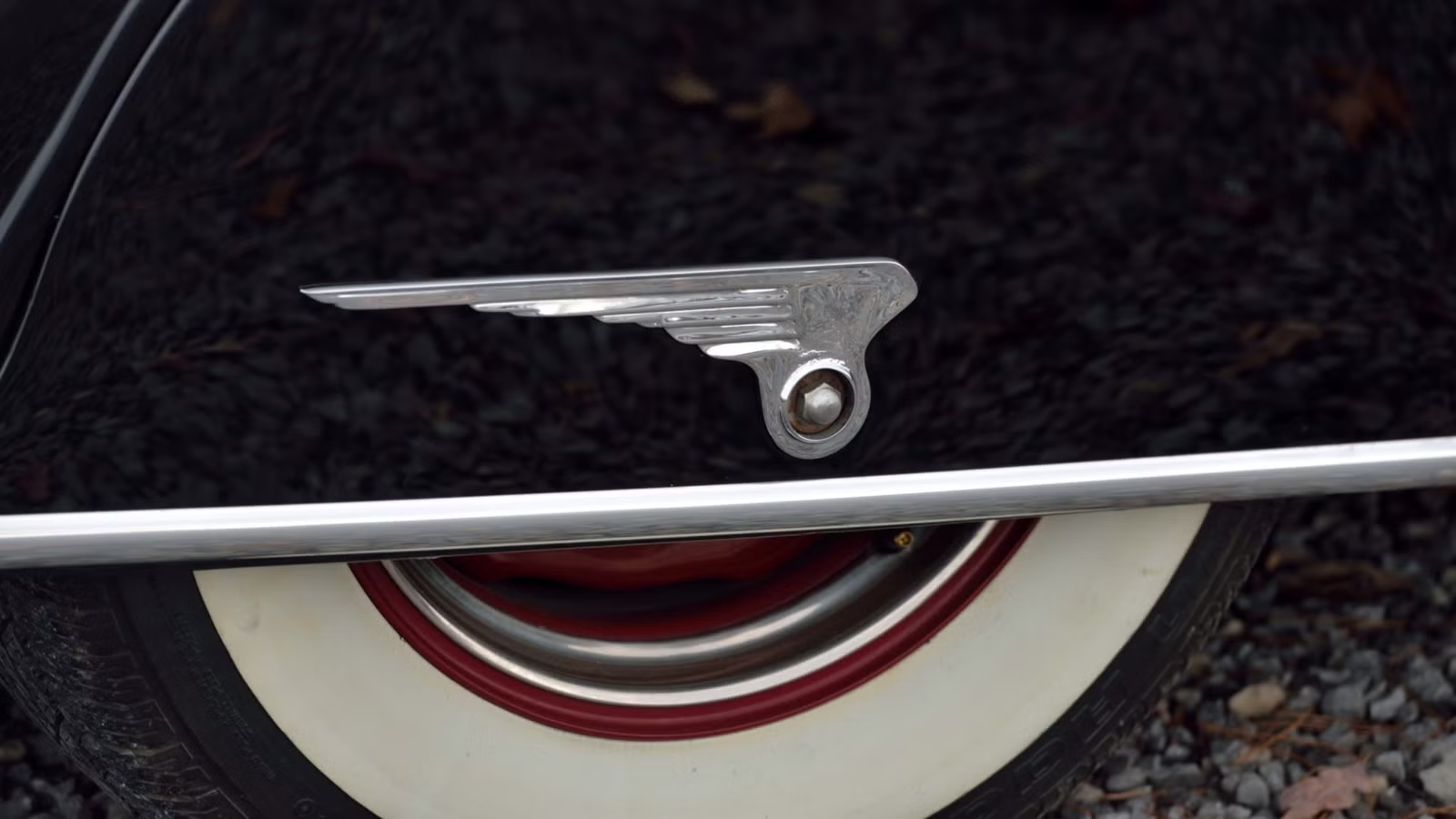
Cars in the 1930s were about as aerodynamic as a stack of crates until the streamlined 1934 Chrysler Airflow came along. With a rounded nose, sloping hood, curved fenders, integrated headlights, split V windshield, and flowing roofline, the Airflow lived up to its name with a revolutionary design that could slice through the wind. It was also a commercial failure, selling less than 30,000 units over its three-year production run, mostly because it was so radical that people couldn’t deal with it, but also because it was genuinely ugly. Today, it is considered one of the most important cars ever built, that changed the direction of car design and influenced automotive style for decades. It has also become a collector’s favorite both for its uniqueness and affordability, with Airflows in great shape selling for around $40,000.

10 Rare Cars Collectors Hardly Ever See For Sale
We always want what we can’t have, and these elusive cars drive collectors crazy trying to find them with “for sale” signs.
9
1948 Tucker 48
All Tuckered Out

Speaking of radical, the 1948 Tucker 48 was incredibly advanced with safety features like pop-out windshields, padded dashboards, and recessed controls to reduce the risk of injury in a collision. It also had four-wheel independent suspension and a rear-engine trans-mounted 335 cubic-inch flat-six that delivered 166 horsepower, which was scorching for the day. Only 51 of these futuristic masterpieces were ever sold, and it didn’t fail because the public hated it, but rather because owner Preston Tucker’s financial issues sunk the company before the car really had a chance to wow people. Conspiracy theorists claim that the Detroit automakers colluded to destroy Tucker because his car was a threat, though we can neither vouch for nor disprove that claim. It is believed that 47 Tucker 48s still exist, and it’s a hot collectible with cars selling for over a million dollars. It is also remembered as one of the most daring cars ever built.
8
1954 Kaiser Darrin
The Rich Man’s Corvette

Though the 1954 Kaiser Darrin has one of the worst car names of all time and kind of sounds like a WWI-era German munitions truck, it is one of the most incredible American sports cars nobody has ever heard of. With crazy pocket doors that slid open into the fenders and a sleek fiberglass body, this was both an innovative and attractive ride. Just 435 of these ever rolled off the factory floor, so it was a failure, but not necessarily because it was a bad car. It had the unfortunate release date after the Chevrolet Corvette had already hit the showrooms, and Kaiser was a struggling company with hardly any dealerships to showcase the Darrin. Also, it cost $3,688, or nearly $1,000 more than the Corvette, which is beyond what people were willing to pay for a Kaiser. Fast-forward to 2026, and these beauties are collector favorites, with top examples topping $100,000.
7
1963 Studebaker Avanti R2
Hail Mary Halo Car

The 1963 Avanti was Studebaker’s last-ditch effort to stave off bankruptcy by establishing itself as a performance-oriented company. It didn’t work and Studebaker went belly up three years later, but the Avanti was as cool as they come. As one of the first cars to use the sleek Coke bottle design, the all-fiberglass tourer was a clean aerodynamic machine, and with the optional 290-horsepower 289ci supercharged V-8, it was quite a performer. Studebaker had hoped to sell 20,000 Avantis each year but only ended up making 4,643 before they shut down production. Price is likely the reason for the Avanti’s failure, with a $4,445 MSRP, which was more than a Corvette or Ford T-Bird cost that year. Almost immediately after it was discontinued, the Avanti’s rights and tooling were purchased and the Avanti II was in sporadic production until 2006.
8 Forgotten American V8 Classics Cheaper Than A New Camry
Buying a Toyota Camry is admitting you’re done having a good time, but for the same price, you can keep the party going with a classic American V8.
6
1970 AMC Gremlin
Revenge of the Nerdmobile

You can almost picture Ogre from Revenge of the Nerds screaming “Nerd!” the first time a 1970 AMC Gremlin was seen rolling down the boulevard. This was a time when the classic muscle cars still ruled the streets and coolness actually mattered, so the ultra-dorky Gremlin must have caused quite a stir. The compact, not-so-hot hatch was cheap and offered the best fuel economy of any American car, so unlike many of the other cars on this list, it was a genuine hit. However, nobody thought this doofus-looking car would do anything but be forgotten in time and yet people love them nowadays. Apparently “Nerd Chic” is a thing, and the oddball Gremlin, as well as its even uglier AMC Pacer fishbowl car, are part of the mix, with scores of fans. Also, interestingly enough, the tiny Gremlin made for a pretty fantastic pro-stock drag car, but again, nobody could have guessed it would be a sought-after ride 56 years later.
5
1981 DeLorean DMC-12
It’s a Time Machine But Not a Street Machine

The super-sporty stainless steel 1981 DeLorean DMC-12 was the hottest-looking American car built until that point and should have been a smash hit, but it wasn’t, with only 9,000 or so cars built in three years of production. The reason was quite simple, as it was overpriced, underpowered, and built like crap. When the DeLorean faded away in 1983, most folks figured it was doomed to obscurity, but then something funny happened. The 1985 Blockbuster Back to the Future used a DeLorean DMC prominently as a four-wheeled time machine and the car became an icon. Even after the movie was released, the DeLorean was still kind of a joke, but in the late 1990s/early 2000s ’80s retro started picking up steam and suddenly everyone wanted their own DeLorean time machine. There are plenty of tribute movie cars, but collectors also dig a clean stock version, and either way, these are six-figure rides today.
4
1984 Pontiac Fiero
Compact Fire Starter

The Pontiac Fiero, introduced in 1984, is another car that was marginally successful, but didn’t indicate any future greatness or collectibility. The compact mid-engine was actually very attractive, but because GM didn’t want it sapping sales from the Corvette, it wasn’t allowed to have killer performance to match. Initially equipped with a 92-horsepower 2.5-liter I-4, the Fiero had a 12.0-second 0-60 time that should have been its quarter-mile ERT. Besides its mild performance, early cars tended to catch on fire, so it didn’t really build a positive reputation, even after the issue was addressed. Nowadays, collectors recognize what a sweet ride the Fiero actually was, and since they are so cheap, with an average retail value of just $3,325 according to J.D. Power, they are perfect budget project cars that leave plenty of room to give them the kind of power they should have always had.
3
1987 Cadillac Allanté
Big-Money Bomb

Cadillac wanted to create a luxury grand touring convertible that would compete with the likes of the Mercedes-Benz SL and Jaguar XJS, so in 1987 it unveiled the Allanté. The car was designed by Italian coachbuilder Pininfarina and featured a 170-horsepower 4.1-liter V-8, which was mediocre at best for the time. It also had a cheap Chevy-esque interior and cost a whopping $54,700, which is the equivalent of over $150,000 today. Needless to say, this was not a huge success by any metric, and astonishingly, Cadillac built it for seven years despite never even hitting 5,000 units in a model year. With a grand total of 21,814 sales over its run, the Allanté was for sure a bomb, but collectors have rediscovered it and love its sharp styling and affordable price. That low-mileage, great-condition car pictured above sold for just $7,150 at Mecum Indy 2025, making it one of the greatest value-to-cost ratios ever.
A Detailed History Of Cadillac V8 Engines
Cadillac started the V-8 revolution and has been innovating engine performance technology for over 100 years.
2
1999 Plymouth Prowler
The Last Great Plymouth Performance Vehicle

The Plymouth Prowler, which was introduced in 1997, is arguably the coolest factory vehicle to ever roll out of Detroit. The neo-retro roadster was essentially a rail-job hot rod that you could pick up at your local Plymouth dealer, which is, again, remarkably cool. Not everyone shared our enthusiasm for this amazing ride, and it only sold 11,702 cars in five years of production, including 2001-2002 when it was billed as the Chrysler Prowler. Plymouth ceased to be an automaker in 2001, and while many people blame the Prowler, it was corporate restructuring BS that ultimately did the iconic automaker in. While buyers weren’t particularly keen on the Prowler when it was new, it’s too awesome to ignore, and collectors are jumping on them now. With an excellent condition Hagerty value of $34,200, there’s no reason why you shouldn’t own two of them.
1
2005 Dodge Magnum
Muscle Wagon Family Ride

When the Dodge Magnum hit the scene in 2005, people had no idea what to make of it. As basically a station wagon, it was assumed to be a family ride, but its aggressive styling and high-performance engine options said it was a modern muscle car. It was first available with a 5.7-liter V8 that marked the triumphant return of the Hemi engine, and in 2006 it got access to the 6.1-liter Hemi that delivered 425 horsepower. What most people didn’t know was that this car was made during the Daimler-Chrysler era, so much of its engineering was Mercedes-Benz, and that meant getting a finely tuned German luxury car for a base-model American price. It did some okay business with 129,660 sales over four years of production, but it was not enough to keep it going past 2008, when it was discontinued. Now that collectors have had time to think, they realize this was a cool-looking ride with some serious performance, and with an average value below $10,000 is the deal of the century.
Sources: Hagerty, J.D. Power, Mecum

Related posts


Latest Post


No Comments