
The 1990s Jeep SUV That Still Outlives Modern Crossovers At Half The Price
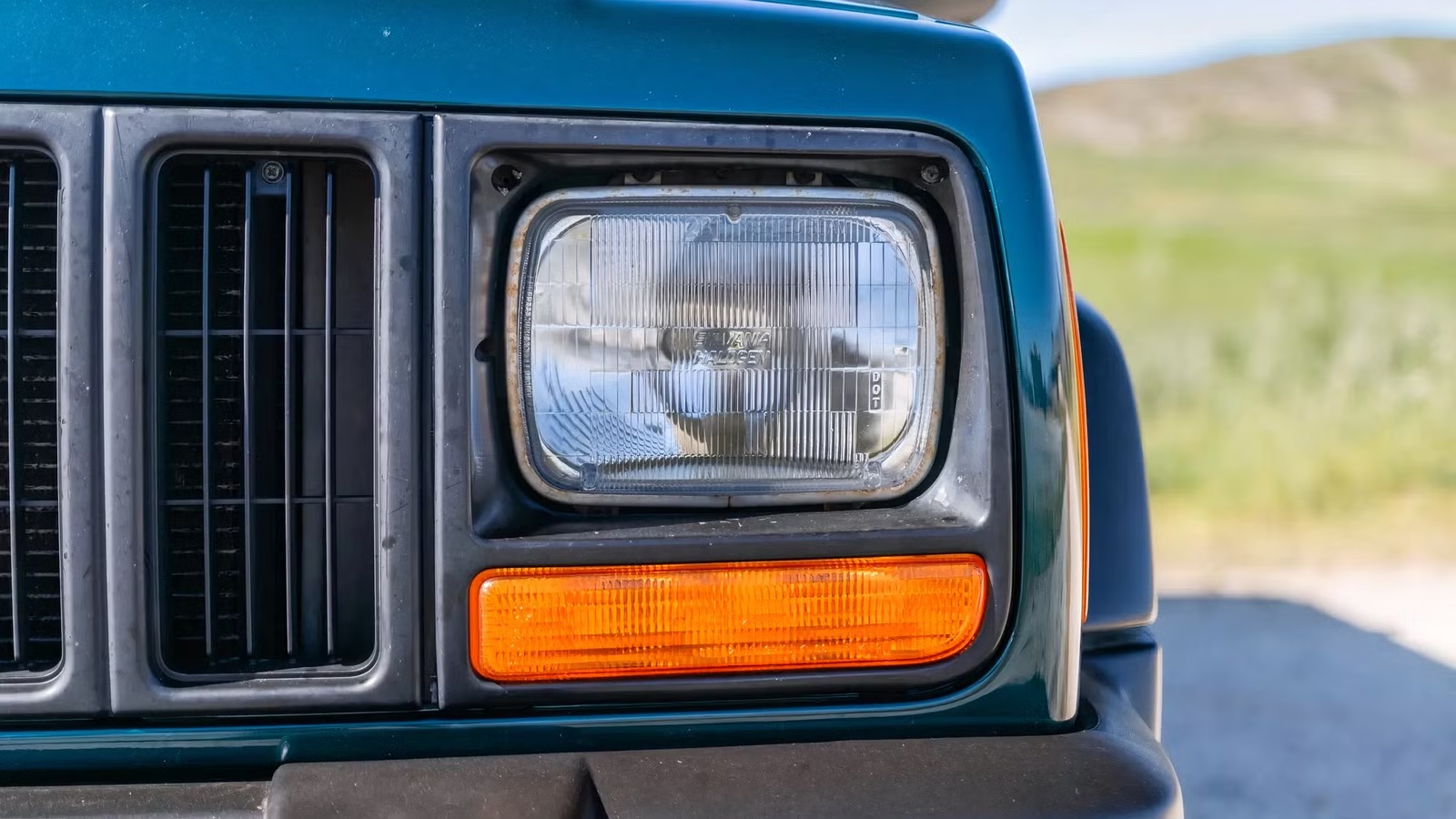
Jeep and SUVs go together better than most brands do. For decades, they have been turning out some of the most iconic off-roading beasts and family SUVs on the market. They have been used for everything from military duty to family cruisers, and up there with the likes of Toyota and Honda, Jeep SUVs are some of the most popular SUVs in the U.S.

There is one older Jeep SUV, though, that refuses to die. This machine ruled the roads from the mid-1980s to the early 2000s. Today, there are a lot of examples still running, and the best bit: you can pick them up for less than half the price of new crossovers and SUVs.
Why Some Old SUVs Just Keep Going
Some SUVs seem to age out of relevance the moment their production run ends. Others quietly refuse to die, racking up miles after miles in the hands of owners who stopped treating them as disposable transport a long time ago. The difference is rarely cosmetic; it is rooted in how they were engineered.

If you look at engines like Toyota’s 3.4-liter 5VZ-FE V6 or Volvo’s old white-block inline-fives, they weren’t chasing massive outputs or tight emissions standards the way modern mills have to. They were built with conservative compression ratios, thick cast-iron or reinforced aluminum architectures, and valvetrains that were built for stability over efficiency.

Add in simple hydraulic lifters, non-interference designs, and beefy cooling systems, and you get engines that tolerate neglect and abuse far better than today’s tightly wound, smaller, and more complex engines.
Then you have the ladder frames that many older SUVs ride on, the hydraulic steering systems, and minimal reliance on complex wiring systems to make things work. All this results in a generation of SUVs that soak up the miles.
Some Modern Crossovers Aren’t Built With Longevity In Mind

In the U.S. crossover market, the shift toward complexity is more obvious when you look at how mainstream models have evolved over the past decade. Models like the Ford Escape, Chevy Equinox, and Jeep Compass are some of the best-selling compact SUVs in the U.S., but they’ve steadily moved away from the simple, long-life engineering that defined earlier generations.
The early third-generation of the Ford Escape (2013–2016) has a 2.5-liter Duratec inline-four, which is a straightforward, naturally aspirated engine that prioritizes durability and low-cost maintenance over efficiency. By the time later models of the Escape were released with the 1.6-liter EcoBoost, and later the 1.5-liter EcoBoost inline-three, turbocharging and direct injection had been introduced. The result is better efficiency and performance on paper, but a far more thermally stressed, maintenance-sensitive setup.

Up against older models like the 2000–2009 Toyota 4Runner with the 1GR-FE 4.0 V6 or the 2002–2009 Chevrolet TrailBlazer with the 4.2-liter Atlas inline-six, the gap can become financial as much as mechanical. These older platforms were engineered for sustained highway mileage, towing duties, and low-cost servicing, with fewer emissions subsystems and less electronic dependency. The newer generation isn’t worse, but things can get more complicated when warranties run out, or the mileage really stacks up.
Reliability Still Matters More Than Touchscreens

According to the 2026 Vehicle Dependability Survey, reliability in the modern market is increasingly determined by how well tech and screens work, and how well they fare over time. The SUV market is now dominated by infotainment displays, digital instrument clusters, and increasingly complex driver-assist systems, which look great and make life easier, but long-term ownership tends to reward something far simpler: how well the vehicle holds up over time.
Once the warranty window closes, it’s not the size of the screen that matters; it’s how many systems sit behind it. Most modern SUVs rely on tightly networked electronics where climate control, safety systems, and chassis functions all communicate through shared control modules. That delivers easy driving in the first couple of years, but adds layers of dependence as miles accumulate. In a perfect world, all of these systems would keep going, but we are not quite there yet.
1990s SUVs With The Biggest Engines
The 1990s had some iconic full-size SUVs with similarly iconic engines. Here are ten of them that are sure to impress.
The Jeep Cherokee XJ Earned Its Legendary Reputation

Built between 1984 and 2001, the Jeep Cherokee XJ is living proof that the old way is sometimes the best way of doing things. Some 2.8 million Cherokee XJ models were built in its lifetime, and they became synonymous with reliability, off-road capability (even though it is built on a unibody), and genuine usability.
It is the XJ Cherokee models from the 1990s, though, that are the most durable of the bunch and have become a true icon of the classic SUV market. A lot of that has to do with the overbuilt design and the unkillable engine that it is equipped with.
The 4.0-Liter Inline-Six Is Almost Impossible To Kill

The Cherokee XJ’s reputation for durability ultimately comes back to the AMC 4.0-liter inline-six under the hood. It was made in an era when manufacturers still expected vehicles to spend their lives towing, hauling, and being abused off-road. The high-output (H.O.) engine used in the XJ Cherokee has the following specs.
|
Spec |
Jeep Cherokee XJ |
|---|---|
|
Engine |
4.0-Liter NA Inline-Six |
|
Transmission |
Four-Speed Automatic or Five-Speed Manual |
|
Horsepower |
190 hp |
|
Torque |
225 lb-ft |
It is not the most powerful engine ever used in a Jeep, but it is torque-rich, and the cast-iron block is exceptionally rigid, while the seven-main-bearing crankshaft gives the rotating assembly ample support and reduces crank flex and bearing wear over hundreds of thousands of miles.
Multiple owners on the Cherokee Forum have claimed to have put over 200,000 miles on these engines without a rebuild, while some even report 500,000 miles or more with a rebuild. While there are some newer models that have the capability to see over 200,000 miles, it has become a lot less common now that the evolution of turbo tech has taken over, and engines are more complicated.
Simple Engineering Keeps Ownership Simple

What makes the inline-six used in the XJ so capable is its simplicity. It uses an old-school overhead-valve layout with a single camshaft buried deep in the block, operating the valves through lifters, pushrods, and rocker arms.
While this is old-fashioned technology, it dramatically reduces complexity. There are fewer moving parts, no turbos, fewer timing components, and fewer things to go wrong.

The hardy cylinder walls also help the engine withstand years of heavy loads and repeated heat cycles without distorting. Unlike a lot of modern engines, this beast never operates beyond its mechanical limits. Its conservative power output, beefy build, and simple cooling needs mean major failures are rare. Just what you want from an SUV made to see high mileage.
90s SUVs That Are Still Good Cars For Families In 2026
Generally speaking, these 90s SUVs are simple, analog, easy to work on, and — in many cases — still practical for family use in 2026.
Why The XJ Still Makes Sense In 2026

For one, the XJ Cherokee looks the part as a boxy SUV that is made for an adventurous life. Despite its lack of body-on-frame construction, the chassis does have integrated frame rails and is lightweight, and it really does work well in the mud.
The wheelbase is only 101.4 inches, so it is maneuverable in wooded terrain; the torque-rich engine is well-suited for crawling; solid axles sit at the front and rear, and most models from the 1990s feature a part-time four-wheel-drive system and a locking center differential to shore up traction on loose ground.

In a modern market full of polished SUV models that look impressive but can be mechanically complex, models that take a step back while still offering what is truly needed from a no-nonsense SUV (usability and reliability) can be worth more than their price tags suggest.
The basics the XJ Cherokee gets right are high towing capacity (5,000 pounds with the originally available tow package), decent cargo capacity (69 cubic feet), and a good payload of 1,550 pounds.
The 1995–1999 Models Hit The Reliability Sweet Spot

While the XJ Cherokee has made a name for itself, it is the ’95 to ’99 models that really nail it. Out of the 62 owner reviews on Edmunds, the 1995 model gets a 4.4 out of 5 overall, while the subsequent years get the following overall ratings.
|
Jeep Cherokee XJ |
1996 |
1997 |
1998 |
1999 |
|---|---|---|---|---|
|
Number Of Owner Reviews |
77 |
48 |
120 |
120 |
|
Overall Rating |
4.4/5 |
4.3/5 |
4.3/5 |
4.1/5 |
The 1995–1999 Cherokee also gets an overall rating of 4.5 out of 5 on Kelley Blue Book, with a quality rating of 4.5 out of 5, a reliability rating of 4.7 out of 5, and an owner recommendation rate of 95 percent.
The reason the ’95–’99 does so well for reliability and is so highly regarded is that its engine has a strengthened block compared to the early models, its fuel injector systems are upgraded compared to the Renix system used in earlier models, and it doesn’t suffer from the crack-prone cylinder heads of the 2000 and 2001 models.
The XJ Cherokee Offers Great Price-Per-Mile Costs, Even Against Newer Crossovers And SUVs

According to Classic.com, the average auction price for an XJ Cherokee is $11,872. Well-worn models with high mileage can be picked up for a few thousand dollars, with the lowest auction price in the past year at just $3,750; it was a 1987 model with 143,000 miles on the odometer. The highest price paid at auction in the past year was a 2000 model with 52,000 miles on the odometer, which sold at auction for $35,000. If you are looking for a 1995–1999 model, they have the following past-year auction price information.
|
Jeep Cherokee XJ |
1995 |
1996 |
1997 |
1998 |
1999 |
|---|---|---|---|---|---|
|
Sales Count |
5 |
11 |
5 |
16 |
15 |
|
Lowest Sale |
$4,400 |
$4,700 |
$10,907 |
$5,111 |
$5,000 |
|
Top Sale |
$13,250 |
$20,500 |
$24,000 |
$24,000 |
$21,250 |
|
Average Auction Price |
$9,000 |
$10,791 |
$12,500 |
$9,800 |
$8,300 |
The auction prices are low across the board, but then there is the cost to run a Cherokee each month. RepairPal says it will cost you, on average, $520 a year for maintenance (before replacement parts), while FuelEconomy.gov estimates that the 4.0-liter inline-six-equipped XJ Cherokee achieves between 15 and 16 combined mpg, costing you between $3,900 and $4,150 a year for gas (the two-wheel-drive models are slightly more fuel efficient).

FuelEconomy.gov’s estimate is based on driving 15,000 miles. This means the yearly fuel expenditure per mile is between 26 cents and 28 cents. Again, based on 15,000 miles driven a year, insurance rates for an XJ Cherokee range widely, from $300 to $1,500 a year, depending on your driving record and where you live; this works out to between 0.02 and 0.10 cents per mile.
Up against even modern crossovers, bearing in mind the purchasing price as well, the Cherokee XJ does very well. Compared to some of the best new and used crossovers this year, the price-per-mile (15,000 miles a year for the first year, which includes the outright purchase price) is as follows.
|
Jeep Cherokee XJ |
2016 Hyundai Tucson |
2019 Volvo XC40 |
2026 Chevrolet Trax |
2023 Honda CR-V |
|
|---|---|---|---|---|---|
|
Average Purchase Price |
$11,872 |
$11,225 |
$18,830 |
$25,575 |
$27,267 |
|
Purchase Price Per Mile |
$0.79 |
$0.75 |
$1.26 |
$1.71 |
$1.82 |
|
Average Annual Maintenance Cost |
$520 |
$426 |
$769 |
$488 |
$428 |
|
Maintenance Cost Per Mile |
$0.03 |
$0.03 |
$0.05 |
$0.03 |
$0.03 |
|
Average Annual Insurance Cost Range |
$300 – $1,500 |
$1,024 – $1,984 |
$1,400 – $2,700 |
$1,788 – $2,100 |
$1,160 – $2,111 |
|
Insurance Cost Per Mile Range |
$0.02 – $0.10 |
$0.07 – $0.13 |
$0.09 – $0.18 |
$0.12 – $0.14 |
$0.08 – $0.14 |
|
Annual Fuel Cost Range |
$3,900 – $4,150 |
$2,200 – $2,700 |
$2,300 – $2,950 |
$1,800 – $2,150 |
$1,550 – $2,150 |
|
Fuel Cost Per Mile Range |
$0.26 – $0.28 |
$0.15 – $0.18 |
$0.15 – $0.20 |
$0.12 – $0.14 |
$0.10 – $0.14 |
|
Total Annual Cost Range |
$16,592 – $18,042 |
$14,875 – $16,335 |
$23,299 – $25,249 |
$29,651 – $30,313 |
$30,405 –$31,956 |
|
Price Per Mile Range |
$1.11 – $1.20 |
$1.00 – $1.09 |
$1.55 – $1.68 |
$1.98 – $2.02 |
$2.03 – $2.13 |
Top Boxy SUVs For Big & Small Budgets
Believe it or not, boxy cars still exist in today’s market, and they look good. Here are 13 of them.
The Jeep Cherokee XJ Is The Ultimate Long-Haul SUV

We are not saying that the Jeep Cherokee XJ is going to be cheaper to buy and run at all times compared to a newer crossover, but it is hard to ignore the low auction prices, high reliability ratings, the number of high-mileage models still on the road, its off-road prowess, and the classic, old-school boxy SUV appeal.
The cabin isn’t built around screens, software layers, or configurable drive modes. The switchgear is physical, the ergonomics are basic but logical, and everything inside seems purposely utilitarian. You get hard-wearing plastics, simple HVAC controls, and a driving position that prioritizes visibility over refinement. Compared to modern crossovers, it feels a bit stripped back, but it works without needing all the bells and whistles that can go wrong and bring down their reliability and usability.
The XJ also makes no attempt to disguise what it is, and that is the point of it. There’s a raw mechanical honesty to the drive, and the inputs you make aren’t filtered through anything other than mechanical components. Modern SUVs smooth everything out with adaptive damping, electronic systems, and isolation tuned to the millimeter; the XJ simply doesn’t.
You feel the solid axles working underneath you, the chassis moving as a single piece, and the inline-six delivering torque in a way that modern crossovers have long engineered away. Fewer systems mean fewer weak links, and fewer weak links mean a vehicle that doesn’t age half as badly when the warranty runs out. The Jeep Cherokee XJ relies on solid build quality and simplicity, and that is why it will keep going, regardless of what you put it through.
Sources: Bring A Trailer, J.D. Power, Classic.com, Cherokee Forum, FuelEconomy.gov, RepairPal, and CarEdge

Related posts
Latest Post


No Comments