
The Forgotten Yamaha Two-Stroke That Won Daytona Before The TZ350 Erased It
Two-strokes are an integral part of Yamaha’s history from both a commercial and racing standpoint. Its very first motorcycle, the YA-1 of 1955, was powered by a humble 123cc two-stroke single, and the manufacturer continued down that same route with the later YD-1 from 1957. Things snowballed in the years that followed, with Yamaha’s reputation as a cornerstone of two-stroke performance firmly established by the sixties. Then came the brand’s first 250cc Grand Prix World Championships in ‘64 and ‘65, courtesy of the legendary RD56 race bike we still remember so fondly today. In fact, that 1964 victory also marked the very first instance when a GP world title was won by a two-stroke. Yamaha’s success wasn’t confined to the racetrack, either.
Yamaha Was The King Of Two-Strokes Back In The Day

On the commercial side of things, Yamaha was busy releasing what would later become some of the most iconic vintage two-strokes in existence. The DT-1 of 1968 is widely regarded as the world’s first dual-sport motorcycle, and then you’ve also got other cult classic models like the RD350 and RD400. The competition wasn’t idle, with machines such as the Kawasaki H2 Mach IV and Suzuki’s liquid-cooled, three-cylinder GT750 rising up to challenge Yamaha’s reign. But the brand remained a dominant force right up until road-going two-strokes were killed off by tightening emissions regulations, sticking to what it knew best all the way to the bitter end. There have been plenty of memorable moments during those golden days, and today we’re here to talk about one of them in particular.
 81 autotech
The Kawasaki Two-Stroke Triple Riders Still Fear
This legendary triple transformed Kawasaki’s reputation and still commands respect on the road today.
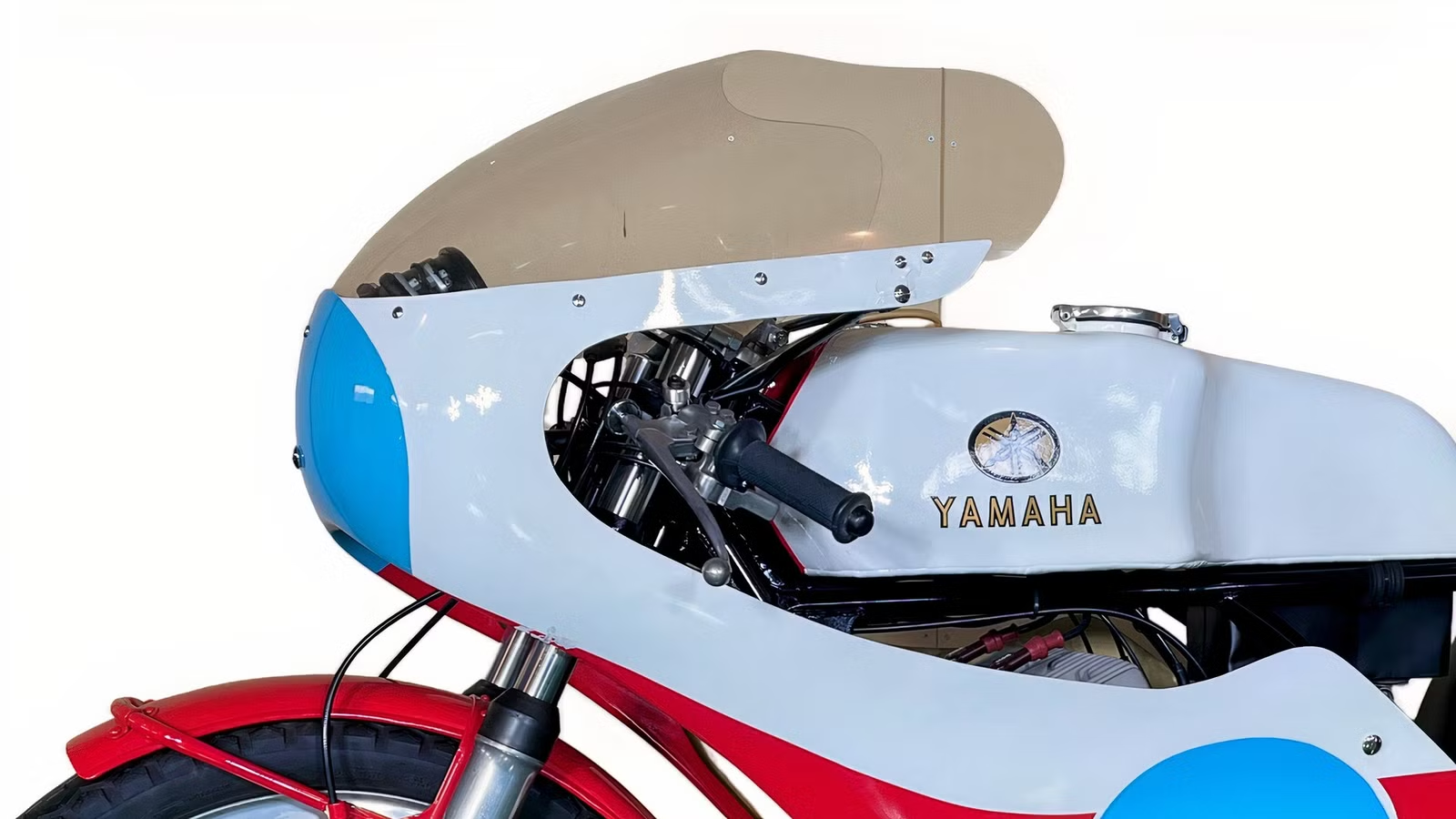
Dissecting The Fabled 1972 Yamaha TR3

Even though it was short-lived, the Yamaha TR3 left a lasting impression on the world of motorcycle racing. It debuted in 1972 as a dedicated production racer built for privateers, equipped with a 347cc parallel-twin mill and a six-speed transmission. The two-stroke engine inhaled via Mikuni carbs, had five transfer ports per cylinder, and was capable of producing a stout 54 horsepower at 9,500 rpm. That output doesn’t sound particularly remarkable until you consider how light the TR3 was, tipping the scales at just 220 pounds dry. This made for an exceptional power-to-weight ratio by early 1970s standards, and the TR3 was incredibly quick for a bike its size. What that meant in practice was blistering acceleration and a top speed of 140 mph.
Technical Specifications
|
Engine Type |
Two-Stroke Parallel-Twin |
|
Cooling |
Air-Cooled |
|
Displacement |
347cc |
|
Transmission |
6-Speed |
|
Horsepower |
54 HP @ 9,500 RPM |
|
Top Speed |
140 MPH |
|
Dry Weight |
220 LBS |
As great as it might’ve been, though, the TR3 had already been put aside to make room for the liquid-cooled TZ350 by 1973. The new model was made to address the limitations of air cooling, ending the TR3’s story as quickly as it began. But Yamaha’s air-cooled machine went out with a bang, achieving what seemed impossible with a very ambitious young rider in its saddle. To this day, the Daytona 200 race of 1972 remains one of the greatest moments in two-stroke racing history, cementing the TR3’s reputation as a fearsome giant killer. So, despite its short lifespan, the bike’s impact reverberated throughout the realm of two-wheeled motorsports, and its story continues to fascinate enthusiasts to this day.
The Honda Motorcycle That Secretly Birthed The Superbike Era
Before superbikes became a category, Honda built the machine that changed everything forever.
A Crazy Plan For Daytona 200

Enter privateer racer Don Emde, the son of 1948 Daytona 200 winner Floyd Emde. Don was born in 1951 with racing in his blood and was already making a name for himself in AMA professional racing by the tail end of the sixties, but the biggest highlight of his career was yet to come. He made history at the 1972 Daytona 200 race, and it all started with an idea that seemed utterly insane at first. More specifically, Don planned on taking a 350cc two-stroke up against much bigger, factory-backed 750s, which seemed like a surefire way to get beaten on race day. But the man knew what he was doing, so he stuck to his guns and went on to prove all the naysayers wrong, thanks to Yamaha’s epic TR3 punching well above its weight.
David vs. Goliath: The TR3 Shocks The World At Daytona

It’s difficult to overstate just how impressive Emde’s performance was at the Daytona 200 race of 1972, where he prevailed in the face of seemingly impossible odds. The TR3 took him across the finish line in first place, despite competing against 750cc machines whose prospects appeared to be far more promising. But, as history has repeatedly shown, the racing landscape is always full of surprises, and the little TR3 proved that there was, in fact, a replacement for displacement. In doing so, it became the smallest motorcycle to ever win the main Daytona race and also the first Yamaha to achieve that same feat. And even though Don Emde retired from racing thereafter and the TR3 got the axe after just one year, the Japanese brand was there to stay. That 1972 win kicked off quite the winning streak for Yamaha at Daytona, which only enhanced the TR3’s reputation even further.
No fewer than 13 consecutive victories were claimed by the manufacturer from that moment on, and it wasn’t until 1985 that Yamaha was defeated by Freddie Spencer on a Honda VF750F. The year after Emde’s win, the TZ350 demonstrated that it, too, could hang with the big boys at Daytona, securing first place with Finnish rider Jarno Saarinen. Another key moment for Yamaha came in 1974, when the great Giacomo Agostini famously won his Daytona 200 debut on a TZ750. And going back to the TR3 for a minute, the fact that 750cc four-strokes lost to a bike half their size is a clear indication as to why people find two-strokes so intriguing. But the TR3 remains fairly obscure compared to other successful racers, which is a shame, because it certainly deserves far more recognition than it actually receives.
The Yamaha R7 Homologation Bike Collectors Quietly Hunt Now
Aside from the name, it has nothing to do with the twin-cylinder R7 currently in production, instead tracing its origin back to WorldSBK racing.
Why Doesn’t The Yamaha TR3 Get More Attention Today?

Given its historical significance and incredible racetrack performance in the hands of Don Emde, you’d think the TR3 would come up in conversations more often. That is sadly not the case, though, because it simply wasn’t around long enough for people to realize its true worth. Had Yamaha not abandoned it in favor of the TZ350 after a single year, it might’ve continued to act as a giant slayer and solidified its racing credentials in public consciousness to a much greater extent. But then Yamaha may have lost at Daytona in ’73 and missed out on that remarkable 13-year winning streak, so things probably turned out the way they did for a reason. In any case, the TR3 is a crucial part of the company’s two-stroke legacy, standing as a clear reminder that, oftentimes, less is indeed more.
Sources: Yamaha, Bonhams

Related posts

Latest Post


No Comments