
10 Classic Muscle Cars That Ain’t Worth Restoring
Every dollar you sink into a Boss 429 restoration will come back to you exponentially as it’s a hot collectible that will only increase in value. There are classic muscle cars, especially rarish big-blocks, which are pretty much ATMs that will do nothing but print money as an investment, but even more that simply aren’t worth restoring. Taking the price of the project car plus restoration costs that start around $40,000 and can go way up from there, the value of some Golden Age muscle cars doesn’t justify the expense. We’ve come up with some otherwise compelling rides that aren’t worth restoring as an investment, and the formula we’re using is the J.D. Power low retail price plus a minimal $40k restoration that doesn’t exceed the Hagerty excellent condition value when finished. That being said, if it’s done out of love for personal enjoyment, no amount of money is too much to bring a classic back to life.
10
1971 Chevrolet Nova SS
Excellent Condition Value: $38,500

The early ’70s Chevy Nova SS is the baddest compact muscle car there ever was and the 396 SS is well worth restoring, but by 1971 the fabled big-block was discontinued. The best a ’71 Nova SS could do was a 270 hp 350 V8, which wasn’t bad and is highly tunable, but the truth is, no matter how perfect an example it is, the car just isn’t worth that much. You can probably find a project car for under $7,000, but after bodywork, paint, mechanical rebuilds, interior, and tires, you’re close to $50,000 on the build, which is substantially more than its excellent condition value of $38,500. Maybe a resto mod on this one, with either a 396 swap or even a modern 6.2-liter crate would make the project worth it, but an all-original restoration is a money pit.
9
1968 Oldsmobile 442
Excellent Condition Value: $36,700

The 1968 Olds 442 is one on this list that kind of surprised us because it is particularly badass, and it’s hard to believe it’s not a restoration candidate. There are actually some ’68s definitely worth the time and effort, like the 455-equipped Hurst/Olds and even the 400 W-30, but a stock 442 with a 290-350 hp 400 V8 falls below the viability line. Putting upwards of $50k into a car that will only be worth $36,700 in near-perfect condition doesn’t make a lick of sense, no matter how cool it looks. That black beauty pictured above, which we can’t take our eyes off of, underwent an extensive restoration but only sold for $30,250 at Mecum Indy 2018. We know, it seems like some sort of crime, but it’s a reality that this amazing set of wheels doesn’t have that much value.

8
1967 Mercury Cougar GT
Excellent Condition Value: $35,300

Most people probably don’t remember that the Mercury Cougar was the upscale version of the Mustang, but it was always in the Ford pony car’s shadow and basically a second-rate ride. In 1967, the Cougar GT came equipped with a 320 horsepower 390 V8 and had just as much performance as a Mustang GT but with more luxury and features, yet is worth substantially less. A ’67 Mustang GT in excellent condition is valued at $92,833, while a same year Cougar GT is worth barely over $35,000. The thing is, the Cougar is far rarer, with 5,791 units, versus the 24,079 Mustang GTs made in ’67. Muscle car prices are dictated like anything else with demand being the biggest driver, so this is a car that not many collectors actually want, which makes for great budget pickup, but not a very good project.
7
1971 Plymouth Duster Twister
Excellent Condition Value: $33,700

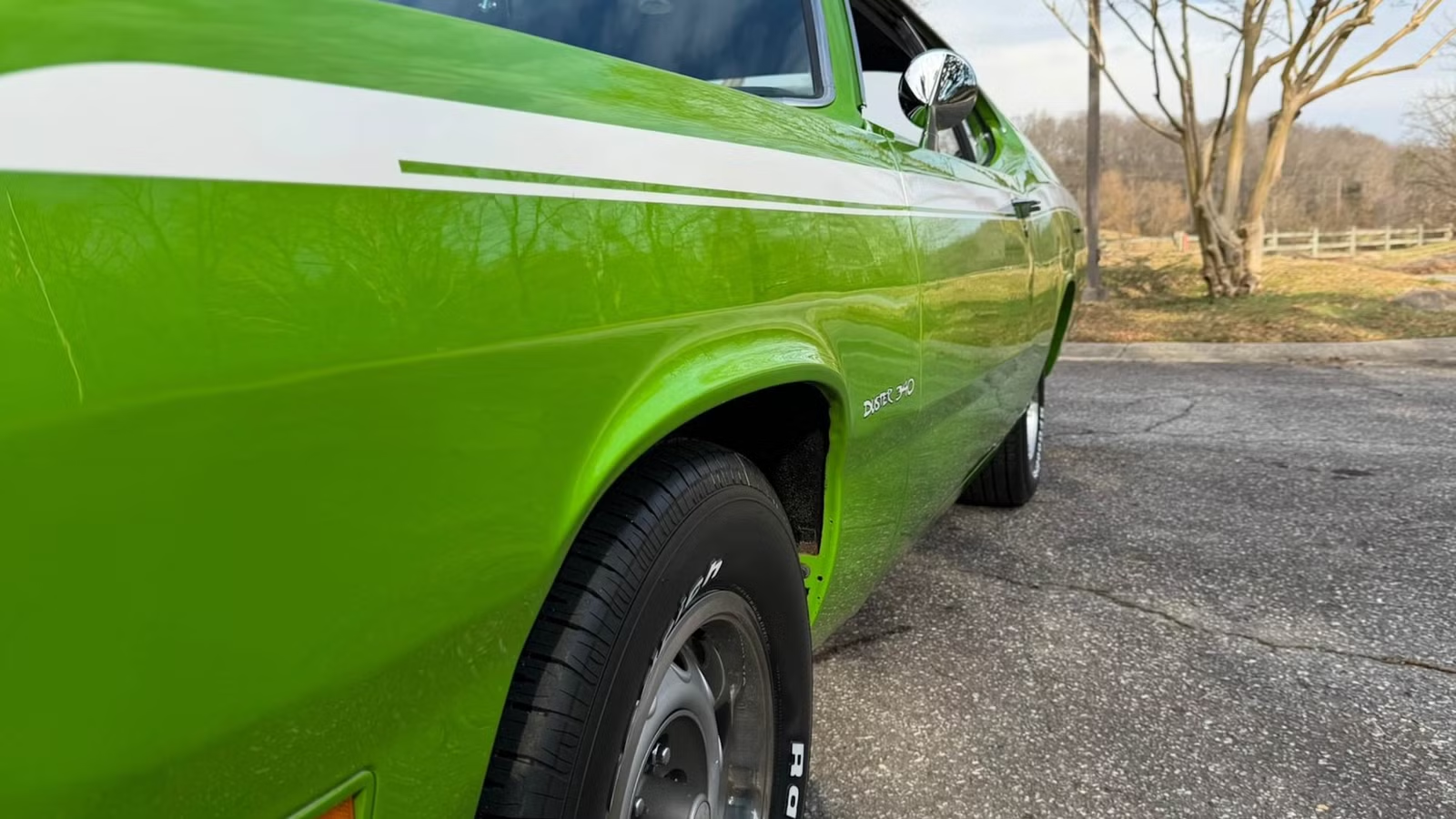
The Plymouth Duster used to be the last affordable classic Mopar muscle car, but it’s really been coming in strong lately with some stretching into the six-figure realm. A ’71 Duster 340 recently sold for $159,500 at a 2024 Mecum auction, which seemingly says this is a restorable ride, but here’s the kicker: according to the listing, the car underwent a $250,000 restoration, so maybe not. For a ’71 Duster Twister with a 318 V8, the loss on a resto isn’t quite as extreme, but it’s still a negative gain. Acquiring a project car and spiffying it up to excellent condition is, on the low-end, a $50,000+ proposition, that nets a car worth $33,700. We did find one that sold in 2024 for $48,500, but that’s still not turning a profit, so this one’s a no-go as well.
6
1973 Ford Mustang Mach 1
Excellent Condition Value: $32,800

In 1971, Ford elongated the hell out of the Mustang’s hood to accommodate the big-block engines and then basically abandoned the 428 and 429 as an option. The result was a pretty goofy-looking car in the plain base model, but with the Mach 1 appearance package, it was somehow one of the most wicked first-gen ‘Stangs. Normally, anything Mustang has value and is worth preserving, but for whatever reason, the ’73 Mach 1 just isn’t an expensive classic. This is what the “Eleanor” car from the original Gone in 60 Seconds was supposed to be, so it should carry some cachet, but doesn’t. A ’73 Mustang Mach 1 is only worth $32,800 in pristine condition and, as you already know, that’s far under what it would take to get it that way. Even with a 351 Cobra Jet V8, this slick pony car should be put out to pasture as a collectible or restoration candidate.
5
1973 Dodge Challenger
Excellent Condition Value: $31,800

The Chrysler E-body killer cousins, the Dodge Challenger and third-gen Plymouth Barracuda, hit the scene in 1971 and utterly dominated the tail end of the Golden Age of American Muscle. After ’71, when the 426 Hemi and 440 Six Pack V8s were discontinued, both cars became performance parodies of their former selves, and while the Malaise Era ‘Cuda is still quite valuable, the same can’t be said for the Challenger. A ’73 Challenger R/T in excellent condition is barely worth more than $30,000, and that’s with the more desirable 340 engine option. Even as a resto mod, these cars still aren’t worth much, as the highest we found for a custom was $66,000, and it’s a guarantee that the car had more than $100,000 worth of work. The most we found a numbers-matching ’73 Challenger 340 sell for at auction was in the low-$30k range in 2024.
4
1974 Dodge Charger SE
Excellent Condition Value: $28,100

The Dodge Charger is another classic Mopar muscle car whose value bottomed out with the loss of the Hemi and Six Pack engine options. A 1974 Charger, the final year for the third-gen, looks just as awesome as a ’71 Hemi R/T, one of which sold for over a half-million bucks, but isn’t even a $30k ride in excellent condition. The ’74 Charger SE, the luxury version, was still available with the 440 V8, albeit in 275 horsepower detuned mode, which actually makes this car a coin-flip restoration candidate. The Hagerty value is actually contradicted by a single $71,500 auction sale in 2025, but several other SE 440s have sold for significantly less, including a $10,450 bummer of a gavel drop in 2017. Even if the upper limit was anything but an anomaly, it would probably cost more than $70,000 to restore a ’74 Charger 440 SE, unless it was already in pretty damn good condition.
3
1972 Ford Gran Torino Sport
Excellent Condition Value: $28,300

The Ford Torino never got the recognition that the GM and Mopar Golden Age muscle cars did, and is even more forgotten today by collectors. In 1972, Ford replaced the GT with the Gran Torino Sport, and it’s one of the most aggressive, yet forgotten classic rides. With a distinctive grille, revised body lines and a bold stance, this really is one of the coolest cars most enthusiasts don’t even know about. Due to that anonymity, a ’72 Gran Torino Sport with a 351 V8 struggles to sell for even $30,000. In fact, we found quite a few auction sales that were under the Hagerty value, including one in great shape that went for just $12,900 in 2019. There are also a couple of overachievers that crossed the block for more, with a high sale of $40,700, but even that can’t make sense out of dumping $50,000 or more into a restoration.
2
1972 AMC Javelin SST
Excellent Condition Value: $26,000

AMC muscle cars, while seriously underrated and cool, don’t have the value of Big Three Golden Age street brawlers. There are a few models like the Rebel Machine and select years of the Javelin and AMX that are worth a $40,000 rehab, but the ’72 Javelin SST isn’t one of them. With an excellent condition value of $26,000, all of this car’s sexy Coke bottle curves and sleek styling can’t save it from the auto graveyard. It’s a shame really, because the second-gen Javelin was supremely cool-looking and still came with an optional 401 V8. ’72 Javelin SSTs are hard to come by, but that isn’t reflected in their price, as the biggest auction payday for one was just $14,300, with a high bid of $26,000 on another that failed to hit the reserve and didn’t sell.
1
1969 Buick GS 400
Excellent Condition Value: $22,000

Most of the cars on this list are from off-years and/or don’t have the top engine options, but the 1969 Buick GS 400 comes from the heart of the Golden Age, which makes it quite shocking that it’s the one with the least amount of restoration value. The GS 400 was one of the baddest non-Mopar muscle cars on the street in ’69 in terms of both performance and appearance. Just take a look at that beauty pictured above and try to wrap your head around the fact that it’s only worth $22,000 in pristine condition. It doesn’t make any sense. This is another with a wrinkle, because 1969 Buick GS 400s with the Stage 1 performance upgrade are a little more valuable, with some selling for around $50,000, but that’s still not enough to justify a pricey refresh, and most are down in the $30,000 range. For a base GS 400, owners are practically giving them away with auction sales as low as $17,600 for a documented car in terrific shape.
Sources: Hagerty

Related posts



Latest Post



No Comments