
Subaru’s 265-HP Japan-Only SUV Out-Accelerated A Base Porsche Cayman
Japan loves to hoard the best and brightest of its domestic auto manufacturing for itself. To that end, it’s fair to say nobody did that better than Subaru. To this day, Americans still aren’t over having to wait 25 years to get their hands on the Impreza 22B and the Legacy B4 RSK. But what if we told you there was another JDM-exclusive Subie that punched so far above its weight, it gave base Porsche Caymans and other similar fare a run for their money? Of course, the platform it rode on was pretty mundane, helping it slide under the radar.
The Mid-2000s Forester: Subaru’s Bread and Butter

The Forester was never Subaru’s flashiest product. It wasn’t back when it was a large wagon teetering on the compact SUV class, and certainly isn’t now that it’s a mid-sized crossover. But what the second-generation Forester of the early-to-mid 2000s provided Subaru most of all was consistency. It delivered a practical, and reliable family hauling experience with plenty of ground clearance and cargo space, plus a range of peppy boxer engines that lasted eons so long as the oil changes were kept up on.
In North America, the Forester was a straight-up utilitarian force to be reckoned with, appealing to soccer moms, college professors, the students they taught, and occasional weekend camping enjoyers. Under the hood, the mildly spicy XT trim packed a 2.5-liter turbocharged EJ four-cylinder engine making 210 horsepower, which most who drove it described as pretty darn fun. Everything below made do with naturally aspirated EJs that were fairly reliable, but barely faster than riding the bus.

This generation of Forester was sold all over the world, everywhere from North America to Australia, China, and even India where, bizarrely, it was sold as a Chevrolet. Still, in Japan, where Subaru was allowed to engineer with an almost unrestricted zeal, the Forester was allowed to tap into some of that WRC-winning pedigree that made the brand a household name. Of course, to get there, it needed an engine unlike anything a Forester used in the US.

A Porsche-Hunting Monster

Where most American Foresters apart from the peppy XT were pedestrian in almost every way, what Subaru had in store for a JDM-exclusive performance variant was the entry ticket to its rallying heritage. While it shared the same 2.5-liter displacement, the revamped EJ packed a heavy dose of STI engineering integrated into the block.
The turbocharger boost was upped to between 14.5 and 15.9 PSI, and the turbo itself was swapped for a IHI VF41 with a larger intercooler. Paired with a bespoke factory ECU map designed specifically for Japan’s high-octane premium fuel and a freer-flowing exhaust system, power was bumped to roughly 261 to 265 horsepower and 278 lb-ft of torque. Paired with the same six-speed manual gearbox you’d find in the WRX STI, what you had was effectively that car’s powertrain shoved in the engine bay of a Forester.
If that sounds like the coolest thing you’ve heard in a while, trust us, it only scratches the surface. The resulting machine packed a sport-tuned suspension, Brembo brakes at all four corners, and Alcantara-lined STI bucket seats inside the cabin. If Subaru had the inclination to send the resulting creation to America, chances are good it would’ve sold like hot cakes. Instead, it’s another JDM-exclusive icon, one that’s just a two to three years away from being import legal.
Subaru Forester STI: Half Compact SUV, Half Rally Hero, 100 Percent Incredible

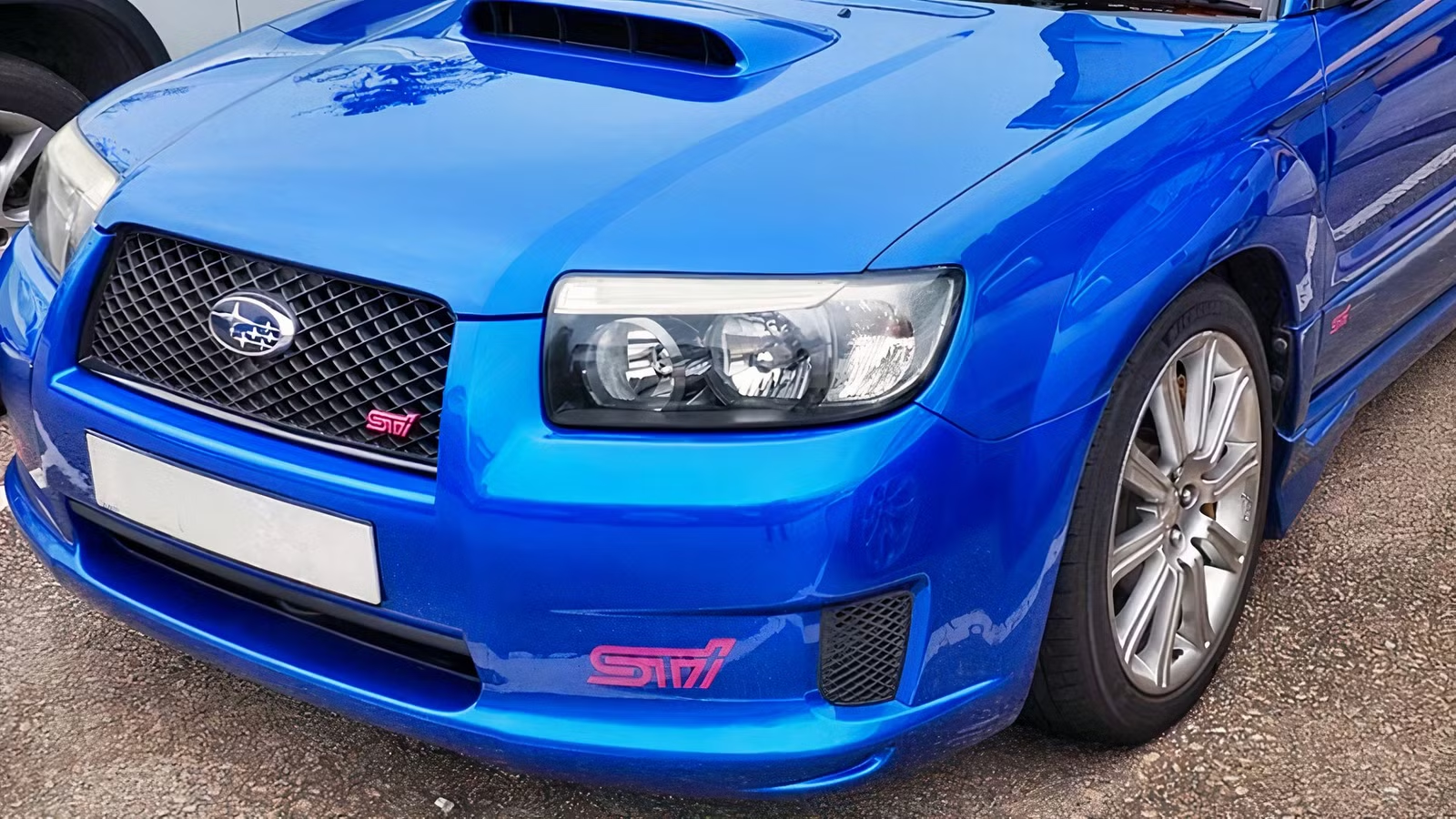
The resulting car was the SG9 Forester STI, built just for Japan between 2004 and 2008. Dropped 1.2 inches lower than a standard Forester to improve handling, it took a boring family hauler with no machismo at all and turned it into an absolute rocket ship. The combination of what’s essentially a WRX STI powertrain and a genuinely practical quasi-wagon platform would’ve made Americans drool with envy, had most of them even known it existed.
Decked out with a widened front grille, a WRX-style hood scoop, and a subtle rear spoiler with a full body kit and aggressive headlights, the Forester STI looked like nothing else on the road. Off the line, zero to 60 happened in 5.4 seconds, and the quarter-mile passed in 14.1 seconds at 97 mph. For some context, the Impreza-based WRX STI manages the same sprints in roughly 4.6 to 4.9 seconds, crossing the quarter-mile in the low-to-mid 13-second range. Considering how much larger the Forester is, the discrepancy between the two is minimal to say the least.
More amazingly, the Forester STI could even outrun dedicated sports cars. Specifically, a base 987.1 Porsche Cayman equipped with a 2.7-liter flat-six and a manual transmission needs roughly 5.8 seconds to reach 60 mph and hits the quarter-mile roughly .1 seconds slower. It’d still be a neck-and-neck race, but in more than one instance, the brick-like Forester STI takes first place. Did we mention you could lug your kids and their stuff to soccer practice and back? That’s certainly not something the base Cayman can do. The more you talk about it, the more it sounds like an American’s dream wagon. Sadly, there’s restrictions on when you can have one.
Gate Kept by Annoying Import Laws

This is usually where we tell how much it’d cost to own the car in question. Unfortunately, because of America’s strict 25-year import law, US enthusiasts are still forced to watch from the sidelines. The very first 2004 SG9 models won’t be legally permitted to cross onto US soil yet.
Though you can import older variants like the 2001 Type M on the SF chassis with 250 horsepower, Subaru only made 800 examples, most of which will remain in Japan permanently. Suffice it to say, you’re better off waiting until 2029 to import the more abundant SG9 Forester STI while they’re still a relative unknown.
Source: Subaru, JSpec Auto,

Related posts


Latest Post


No Comments