
When Australia Proved It Knew How To Make V8 Muscle Cars Better Than America
The Australian muscle car industry emerged in the late 1960s, driven by intense local motor racing rivalries and a demand for high-performance domestic sedans. Domestic manufacturers fitted powerful V-8 engines into practical, full-sized family passenger cars to homologate them for endurance racing dominance.

This unique approach birthed a distinct automotive culture centered around straight-line speed and track performance. However, media backlash over high-speed road safety, changing government regulations, rising fuel costs, and shifting consumer preferences gradually eroded the market segment. Rising production costs and dwindling sales ultimately forced the total closure of domestic automotive manufacturingby late 2017.
1973 Ford Falcon XB GT
Ford launched the Falcon XB GT in September 1973. A 351 cubic inch Cleveland V-8 engine powers the rear wheels via a four-speed Toploader manual transmission. The engine produces an official factory rating of 300 horsepower, accelerates from 0 to 60 MPH in 8.1 seconds, and completes the standing quarter mile in 15.8 seconds before reaching a 120 MPH top speed.

The 1973 Ford Falcon XB GT features an independent front suspension with wishbones, coil springs, angle-poised ball joints, shock absorbers, and an anti-roll bar. The rear utilizes a Hotchkiss-type live axle with semi-elliptic leaf springs. Fans of the Mad Max series should recognize this as the famous hero vehicle.
1988 Holden Commodore SS Group A SV

Holden launched the Commodore SS Group A SV in March 1988. This features a twin-throttle body fuel-injected 5.0-liter V-8 powering the rear wheels via a five-speed Borg-Warner T5 manual transmission. The engine produces an official factory rating of 241 hp, accelerates from 0 to 60 MPH in 6.5 seconds, and completes the standing quarter mile in 14.9 seconds before hitting a 143 MPH top speed.
The 1988 Holden Commodore SS Group A SV features MacPherson struts with double-acting gas dampers, coil springs, and an anti-roll bar up front. The rear uses a live axle with trailing arms, a Panhard rod, coil springs, and an anti-roll bar.
1992 Ford Falcon GT

Ford launched the EB-series Falcon GT in November 1992, fitting it with a 5.0-liter Windsor V-8, equipped with GT40 cylinder heads. A five-speed BTR manual transmission transfers power to the rear wheels, with a four-speed automatic available as an option. The engine produces 268 hp, allowing it to accelerate from 0 to 60 MPH in 6.8 seconds. It completes the standing quarter mile in 15.2 seconds, before reaching a 142 MPH top speed.
The 1992 Ford Falcon EB GT features a short and long arm, long spindle (SLALS) independent front suspension with coaxial twin-tube shock absorbers, single-rate coil springs, and a stabilizer bar. The rear utilizes a live axle with four trailing arms, a Watts linkage, coaxial twin-tube shocks, coil springs, and a stabilizer bar.
1996 HSV GTS-R

HSV launched the VS-series GTS-R in March 1996, featuring a 5.7-liter stroked Holden V-8 with a six-speed Tremec T56 manual transmission powering the rear wheels. The engine produces 288 hp, with an optional HRT blueprint package increasing output to 303 hp. The GTS-R accelerates from 0 to 60 MPH in 6.2 seconds, completing the standing quarter mile in 14.4 seconds. The sedan achieves a top speed of 154 MPH.
The 1996 HSV VS GTS-R features MacPherson struts with progressive-rate coil springs, twin-tube gas dampers, and an anti-roll bar up front. The rear uses an independent setup with semi-trailing arms, progressive-rate coil springs, gas dampers, and an anti-roll bar.
2001 Ford Falcon Tickford TE50

Tickford is the predecessor to Ford Performance Vehicles in the Australian and UK regions. It launched the AU III-series Falcon TE50 in November 2001, featuring a hand-built 5.6-liter Windsor V-8 and a five-speed Tremec TR-3650 manual transmission powering the rear wheels.
A four-speed automatic featuring sequential shift control was available as an option. The engine produces 335 hp, accelerating from 0 to 60 MPH in 5.7 seconds. It completes the standing quarter mile in 14.1 seconds and achieves a top speed of 152 MPH.
The 2001 Ford Falcon Tickford TE50 features double wishbone front suspension with coil springs, gas dampers, and a thickened anti-roll bar. The rear retains an independent suspension setup with upper and lower wishbones, a transverse toe-control arm, and an anti-roll bar.
2004 Holden VZ Monaro

Holden launched the VZ-series Monaro CV8 in September 2004. It features a 5.7-liter Generation III High-Output Gen III V-8 with a Tremec T56 six-speed manual transmission with rear-wheel drive. A heavy-duty 4L65-E four-speed automatic was available as an option. The engine produces a factory rating of 349 hp, affording it a 0 to 60 MPH time of 5.2 seconds. It completes the standing quarter mile in 13.6 seconds, and reaches a top speed of 170 MPH.
The 2004 Holden VZ Monaro features MacPherson struts with progressive-rate coil springs and a stabilizer bar up front. The rear uses control-link semi-trailing arms with progressive-rate coil springs and a stabilizer bar. Pontiac also sourced this platform for its reinterpretation of the GTO.
2006 Holden Commodore SS-V

Holden launched the VE-series Commodore SS-V in August 2006. A 6.0-liter Generation IV L98 V-8 engine drives the rear wheels via a six-speed Tremec T56 manual transmission. The engine produces 362 hp, resulting in a 0 to 60 MPH acceleration time of 5.3 seconds. It completes the standing quarter mile in 13.8 seconds before reaching a 155 MPH top speed.
The 2006 VE Holden Commodore SS-V features a linear control multi-link double-pivot MacPherson strut front suspension with a direct-acting anti-roll bar. The rear utilizes an all-new Linear Control Suspension setup with a four-link independent design and coil-over shock absorbers.
2013 Holden Commodore SS

Holden launched the VF-series Commodore SS in May 2013. A 6.0-liter Generation IV L98 V-8 engine powers manual models, while automatic variants utilize the L77 V-8 engine. A six-speed Tremec TR-6060 manual transmission transfers power to the rear wheels. The engine produces a factory rating of 362 hp. This gets it from 0 to 60 MPH in 4.9 seconds with a standing quarter mile time 13.3 seconds. The sedan achieves an electronically limited top speed of 155 MPH.
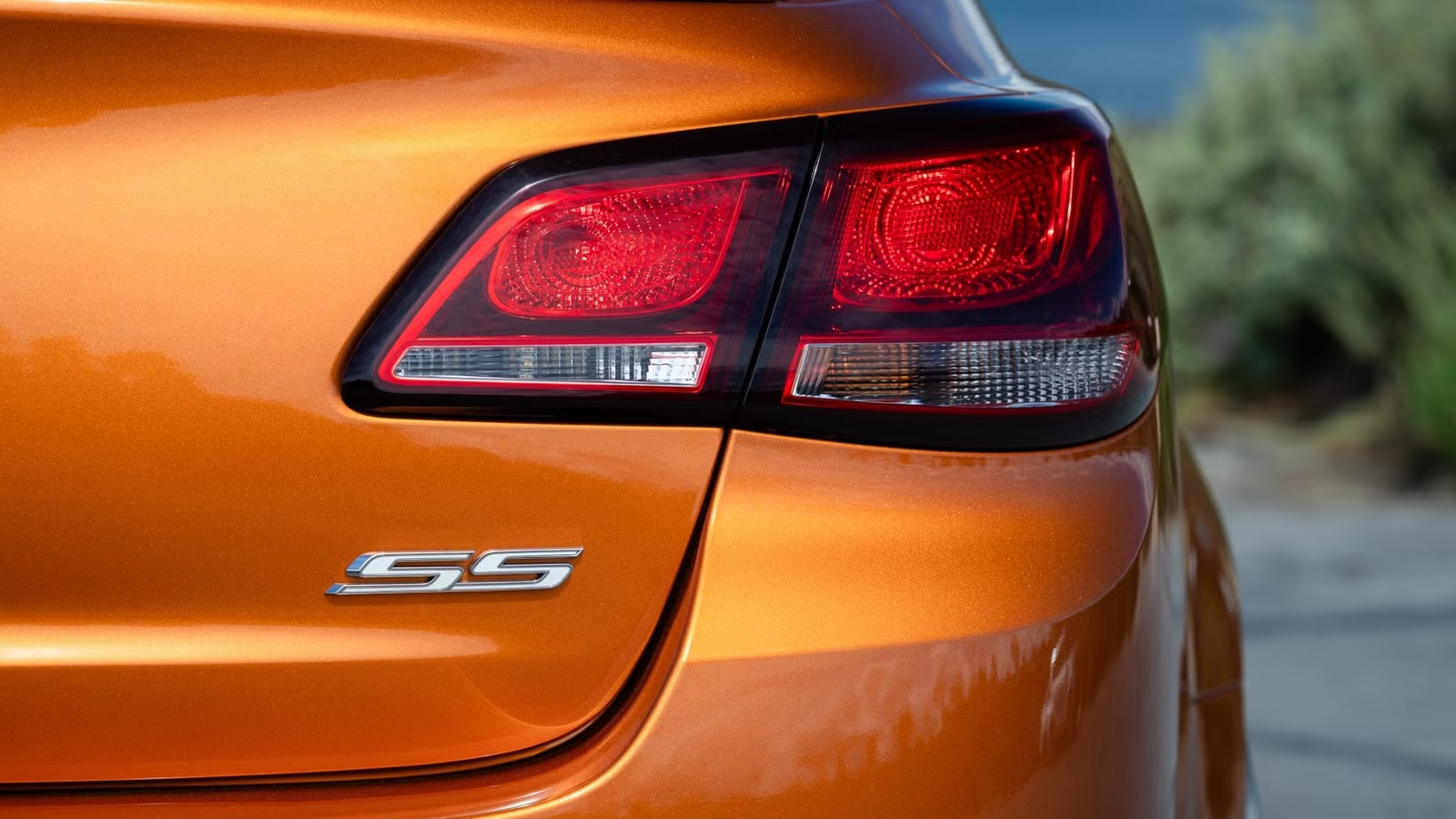
The 2013 VF Holden Commodore SS features a MacPherson strut front suspension with a direct-acting stabilizer bar and aluminum control arms. The rear utilizes a multi-link independent suspension with coil-over shock absorbers and a stabilizer bar. GM also repurposed this for its Chevrolet SS Sedan, which has gained significant cult status in recent years.
2014 FPV GT F 351

Ford Performance Vehicles (FPV) launched the FG-series GT F 351 in June 2014. A supercharged 5.0-liter Miami V-8 powers rear wheels via a six-speed Tremec TR-6060 manual transmission. A ZF six-speed automatic was available as an option. The engine produces an official factory rating of 471 hp, though an overboost function briefly increases output under wide-open throttle.
The sedan accelerates from 0 to 60 MPH in 4.5 seconds, completes the standing quarter mile in 12.5 seconds, and reaches an electronically limited top speed of 155 MPH. It benefits from an unrestricted potential top speed of 185 MPH.
The 2014 FPV GT F 351 utilizes Ford’s R-Spec suspension package. Up front, it features double wishbones with retuned dampers, stiffer springs, and upper strut mounts. The rear retains a Control-Blade independent suspension with higher spring rates and a thicker anti-roll bar.
2017 HSV GTS-R

HSV launched the GEN-F2 GTS-R in February 2017. A 6.2-liter supercharged LSA Generation IV V-8 engine powers the rear wheels using a six-speed Tremec TR-6060 manual transmission. The engine produces 583 hp, resulting in a 0 to 60 MPH time of 4.2 seconds. It completes the standing quarter mile in 12.3 seconds. The sedan achieves an electronically limited top speed of 155 MPH.
The 2017 Gen-F2 HSV GTS-R features an HiPer MacPherson strut on the front suspension with coil springs and a stabilizer bar. The rear utilizes a multi-link independent suspension with progressive-rate coil springs and a stabilizer bar, tuned with Magnetic Ride Control dampers.

Related posts



Latest Post


No Comments