
The Pontiac Muscle Car That Ditched The Stripped-Down Formula For A TV And Phone
Order codes have long meant something to car enthusiasts, and that was especially true in the 1960s and 1970s. A combination of letters and numbers that seemed random to the uninitiated could be the difference between a car having the model’s most powerful available engine or just some gold trim around the headlights.

One of those codes, 50-012, was available on a certain General Motors model in the 1970–1972 model years, and anyone who selected it would end up with a unique car that straddled the line between factory and aftermarket. Dealers sold the car, an aftermarket company performed a transformation, and owners had something unique in their garage. A car that didn’t fit into either the luxury or performance categories. The inspiration involved was interesting, too.
A Custom Car Becomes A Production Special
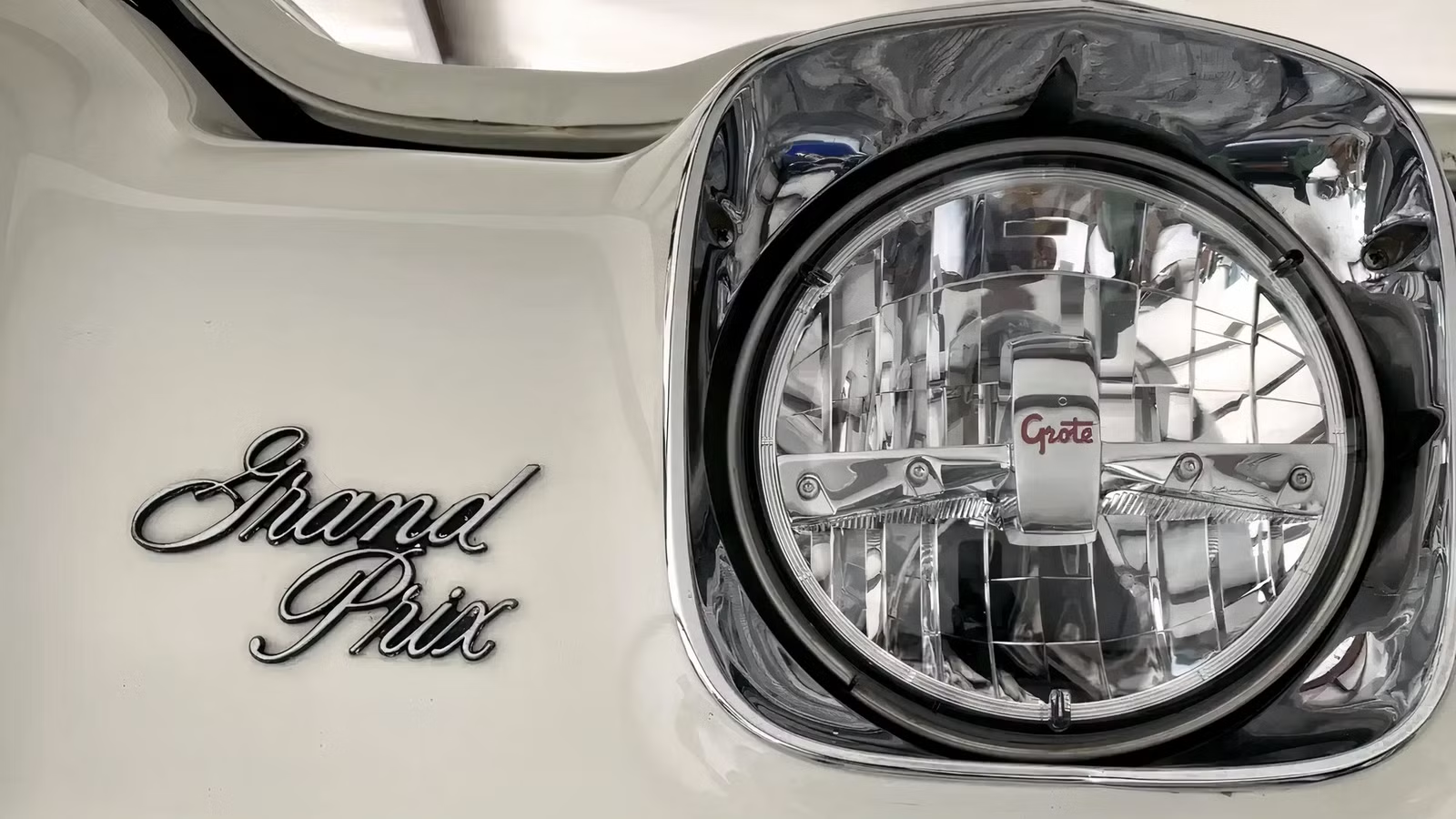
It all started with a custom Pontiac Grand Prix “J”, and it ended with the Pontiac Grand Prix SSJ.

Pontiac advertising executive Jim Wagner drove a custom white-and-gold Grand Prix. George Hurst, the influential aftermarket innovator, bought the car and turned that custom one-off into a commercially available performance-luxury package.
In order to get that package for their car, a customer ordered a base Grand Prix through a dealership, and then the car was sent to Hurst’s facility in Roseville, Michigan, to get the SSJ treatment. This was not just a paint-and-trim package. Instead, the SSJ occupied an unusual space between a factory-built special edition and a conversion built by an aftermarket specialist.
Executive Muscle: Luxury Instead of a Stripped-Down Performance Formula

The Pontiac Grand Prix SSJ was hard to miss, visually speaking. It came in either Polar White (sometimes called Cameo Ivory) or Starlight Black with Fire Frost Gold accents. It also had a padded Landau half-vinyl roof, gold-accented wheels with either American Racing 200S or Pontiac Rally II designs, and an available electric sliding sunroof. The sunroof was installed by Hurst and ASC.
That styling—the unique use of gold accents and the use of only two paint colors—set the SSJ apart from other Grand Prixs, but none of the styling changes affected the car’s overall shape. But what really set the SSJ apart from the typical car from the late muscle car era was the technology. That included a mobile phone, a television, and an electronic trip computer, although it’s unclear if those features were on every SSJ.
This was at a time when most muscle cars were minimizing weight to improve performance, by avoiding the use of extraneous luxury features like a phone and TV. Here, though, the use of those features showed that luxury and power could be combined. That shows that the SSJ was an ambitious—and unusual—idea for the time.
The Price of Exclusivity: What Buyers Got for Their Money

At the time, a base Grand Prix ran around $4,000 — a little under $35,000 in today’s money. To get the SSJ conversion from Hurst, one would have to spend another $1,200, which is about $10,360 today. That’s enough money to be a big investment. It certainly wasn’t a small sum tossed at an appearance package.
Style and features mattered, but performance was not forgotten. The base engine was a standard 400 cubic-inch V8, while buyers could also choose to get a 455 cubic-inch V8. In 1970, that optional H.O. V8 made 370 horsepower and a stout 500 lb-ft of torque.
Those engines meant the car was a blend of performance and luxury.
One caveat: There is some confusion over whether the SSJ was a performance-luxury car or whether Hurst took the performance even further with computer upgrades. Reports differ on the subject.
How Rare Is Rare? Untangling the Production Numbers

The SSJ was offered for the 1970, 1971, and 1972 model years. Reported production numbers sit at 272 for 1970, 157 for 1971, and somewhere between 52 and 60 for 1972. That makes for somewhere between 481 and 489. That’s an estimate that is commonly cited, not a certified production number. The 1970 numbers are the most corroborated.
That lack of certification matters, because production numbers affect how rare a car is, historical expectations, and the collector/classic-car market.The unusual production arrangement likely made it harder to track numbers.
How to Identify an Authentic SSJ

Styling alone cannot tell you if you’re dealing with a true 50-012 order-code SSJ. Original paperwork from the dealership, plus help from Pontiac Historical Services, can help with verification. You can also check the “shipped to” designation to see if the car was shipped to Hurst.
That documentation will be what you need to distinguish a true SSJ from one that looks like one. Which matters — you don’t want to overpay for a car that isn’t a true Pontiac Grand Prix SSJ.
Not just because no one likes a fake, but because the story behind the car matters as much as the car itself.
Legacy: A Different Kind of Performance Car

Combining V8 power, luxury technology features, and bespoke styling, Pontiac built a different type of vehicle. It was also an alternative within General Motors to the Hurst Oldsmobiles, which were more truly performance-oriented vehicles.
Hurst Olds buyers were looking for true performance from their car, even with the Oldsmobile reputation for entry-level luxury. SSJ buyers were looking for luxury with some performance.
The Pontiac Grand Prix SSJ indirectly paved the way for today’s subbranded performance luxury cars, such as Mercedes-Benz models that bear an AMG badge. That’s not to say there’s a direct link, but rather that the idea of blending luxury, technology, and performance was already on automakers’ minds in the ’70s. Pontiac just anticipated modern desires.
Who Gets Credit for the SSJ?

Is the SSJ a Pontiac or a Hurst? The truth is, it’s both. Pontiac provided the car and Hurst transformed it.
Its appeal changed how people thought about what a performance car could be, and even today, the 50-012 order code will make Pontiac fans smile.
Sources: Mac’s Motor City Garage, Pontiac

Related posts



Latest Post


No Comments