
A Yamaha Loyalist Switched To Kawasaki And Hit 318 MPH With Two Turbo KZ1000s
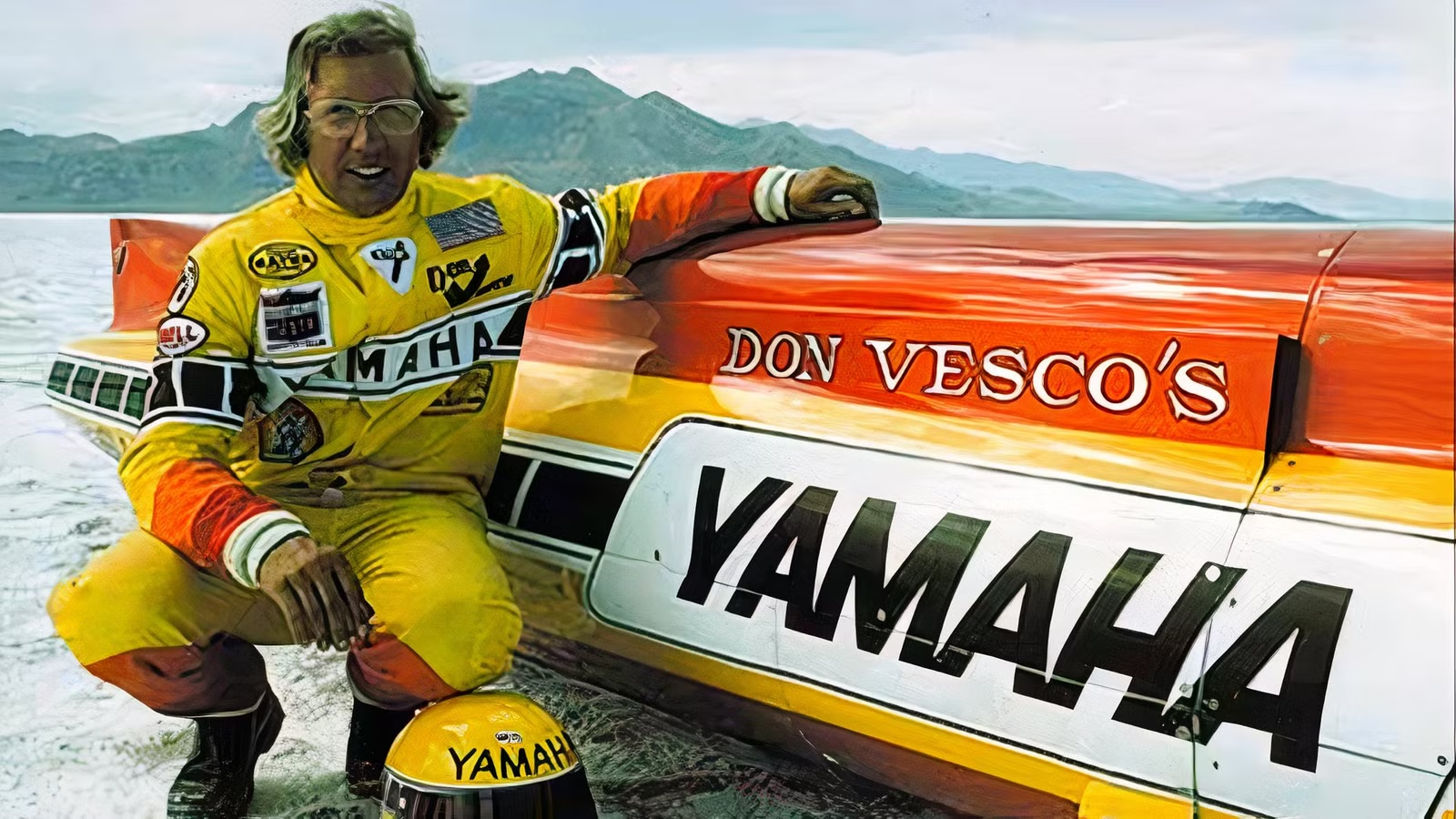
Don Vesco had spent years making Yamahas go faster, but the machines he took to Bonneville looked nothing like the bikes in his dealership. Aerodynamics had improved, and these machines, known as streamliners, were purpose-built motorcycles that enclosed the rider and engine(s) within a long, narrow aerodynamic shell to reduce drag at extreme speeds. By 1978, the Yamaha dealer was preparing to beat a record he already owned, this time with Kawasaki backing the attempt. The new engines supplied plenty of power, but keeping them from destroying the machinery connecting them would prove much harder.
Don Vesco Had Already Broken The 300-MPH Barrier With Yamaha

Vesco built his Yamaha reputation as a dealer, racer, and sponsor, supporting riders like Kel Carruthers and Gene Romero. He also won the 1963 U.S. Grand Prix at Daytona before turning his attention to Bonneville.
After handling issues in 1969 and a blown rear tire in 1970, Vesco finally broke through two weeks later, setting a 251.924-mph record using two 350cc Yamaha engines. Motorcycling had its first record above 250 mph, and Vesco had a reason to keep developing the combination.
The Silver Bird Used Two Yamaha TZ750 Racing Engines

The later Silver Bird carried two Yamaha TZ750 racing engines, giving Vesco a pair of liquid-cooled, four-cylinder two-strokes for a total of eight cylinders. Its appearance looked nothing like the factory version of the TZ750 that won on its 1974 Daytona 200 debut with Giacomo Agostini aboard. Rather, the rider sat enclosed within a long, claustrophobic shell.

On September 28, 1975, Silver Bird became the first motorcycle to break the 300-mph barrier. Mecum’s historical account identifies two records from that attempt. The AMA National Flying Mile figure was 303.812 mph, while the FIM International Flying Mile mark was 302.928 mph. Both belong to the Yamaha-powered chapter, before Kawasaki supplied the next engine combination.
Kawasaki Power Transformed Vesco’s Streamliner Into The Lightning Bolt
Kawasaki sponsorship brought a different engine combination in 1978. Vesco refitted Silver Bird with two turbocharged KZ1000 engines, and the repainted machine became Lightning Bolt. The 21-foot streamliner now carried turbocharged four-strokes in place of the Yamaha two-strokes. Toothed belts linked the engines, with their combined power passing through the rear engine’s transmission.
Using a single transmission became a recurring problem. Reporting at the time notes that five gearboxes were consumed during the campaign, including failures with specially hardened gears. Drive belts also broke or shed their teeth. The crew increased the distance between the engines and went back to belts used with the Yamahas, finding that supposedly stronger replacements weren’t necessarily better.
Two Turbocharged KZ1000 Engines Produced More Than 500 Horsepower

The two turbocharged engines displaced 1,016cc apiece and ran 27 psi of boost during the record attempt. Kawasaki estimates their combined output at 600 horsepower, although contemporary reports put it lower. Both engines sent their power through the rear engine’s gearbox. Repeated transmission failures made that arrangement one of the team’s biggest obstacles.
Vesco also needed to control how hard the turbochargers worked during a run. Because his harness prevented him from reaching the boost-adjustment screw, he connected it to a rubber hose that extended to the handlebars. Twisting the hose let him adjust boost pressure from the cockpit. He would start with little boost, then increase it once Lightning Bolt reached fifth gear.
The Lightning Bolt Set A 318.598-MPH World Record In 1978

On August 28, 1978, Vesco completed the opposing runs needed to establish a new world record. Between passes, the team turned Lightning Bolt around, refueled it, and repacked its parachutes. His two-way average was 318.598 mph. Three years after taking Yamaha beyond 300 mph, Vesco had beaten his own benchmark with Kawasaki power.
Getting back down from those speeds required more than conventional motorcycle brakes. Twin parachutes slowed Lightning Bolt to approximately 150 mph, after which a rear disc brake handled further deceleration. The streamliner ran on special high-speed Goodyear tires and weighed approximately 1,100 pounds with Vesco aboard. Inside its narrow bodywork, a steel roll cage surrounded the rider.
An Even Faster 333-MPH Run Never Entered The Record Books

Vesco returned for September’s Bonneville National Speed Trials and recorded a 333.117-mph pass. The speed was officially timed, exceeding his August record average by more than 14 mph. However, Cycle News’ account explains that the course was a mile shorter than usual, leaving insufficient room for the required return run. Without that second pass, the faster figure couldn’t become the official land-speed record.
Lightning Bolt also carried stuntwoman Marcia Holley into the record books in 1978. Vesco disconnected the front engine, leaving her to make the attempt with a single turbocharged Kawasaki KZ1000 providing power. Holley averaged 229.361 mph over two runs. That made her the fastest woman on two wheels, using the same streamliner that had taken Vesco beyond 318 mph.
Vesco’s Record Stood For 12 Years Before A Harley Finally Beat It

Vesco’s 318.598-mph record survived the rest of the 1970s and all of the 1980s. Dave Campos finally beat it in July 1990, running 322.150 mph in the Harley-powered Easyriders streamliner. After nearly 12 years, the difference was just over 3.5 mph. Campos had bettered the official record, although Vesco’s unratified 333.117-mph pass was still faster.
Silver Bird and Lightning Bolt eventually shared the same bodywork again, this time through a restoration that recreated a different paint scheme on each side. The machine sold at Mecum’s Glendale auction on March 21, 2026, for $82,500. Included were Vesco’s riding equipment, vintage photographs, and a Yamaha TZ750 engine mounted for display. The buyer took home the streamliner that had carried Vesco past 300 mph with Yamaha engines, then returned to the salt to beat that record with Kawasakis.
Source: Kawasaki, Yamaha, Team Vesco, Cycle World, Cycle News, Mecum Auctions, Motorsports Hall of Fame of America, Sturgis Motorcycle Museum & Hall of Fame

Related posts
Latest Post


No Comments