
Inside The Rotary Engine That Made Mazda A Religion
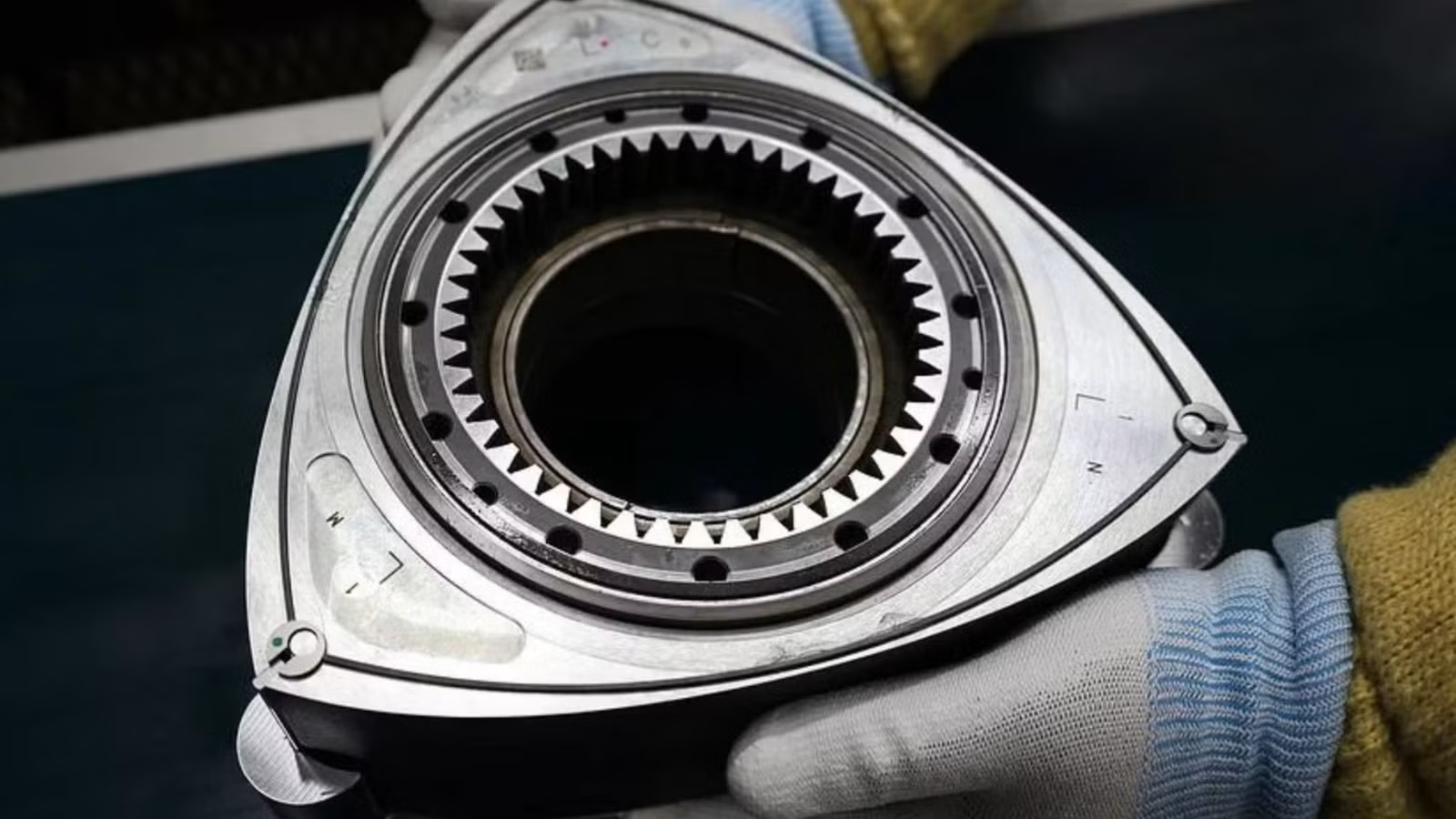
Conventional piston-engine design has been the dominant force in the automotive industry for so long that it is surprising anyone ever tried something fundamentally different and succeeded. Mazda is one of the few exceptions, achieving that success with the rotary engine. But by the late 1990s, the Japanese brand had pushed the architecture about as far as it could reasonably go in a production sports car. The FD3S Mazda RX-7 represented the pinnacle of this development, giving Mazda’s engineers the freedom to pursue unconventional engineering solutions. The rotary engine remains one of the most interesting achievements in modern automotive engineering, but it does not come without its quirks.
Mazda’s Rotary Program Was Running Out Of Room

By the late 1990s, the rotary engine had already gone through several generations of development within the RX-7 platform, with each iteration becoming more sophisticated than the last. The final generation would represent the culmination of decades of development while retaining the same fundamental architecture of Mazda’s first production rotary engine.
The Pivotal Role Of The RX-7

The FB-generation RX-7 of the late 1970s was the first RX-7 model, powered by a 100-horsepower 12A twin-rotor engine. With a curb weight of as little as 2,300 pounds, the RX-7’s primary advantage was its featherweight design, which benefited from the rotary engine’s low center of gravity and compact dimensions. With minimal engine mass positioned behind the front axle, the layout also contributed to favorable weight distribution and handling.

To create more power without increasing displacement, Mazda integrated a non-intercooled, fuel-injected turbocharger into its rotary platform for the first time in the JDM 1982 Mazda Cosmo and Mazda Luce. The resulting engine produced an impressive 160 horsepower despite its compact size and displacement, demonstrating the potential of combining the rotary’s inherent compactness with forced induction.
The 13B-T’s Introduction Of Forced Induction


Mazda would take rotary turbocharging to a new level with the 1986 RX-7 Turbo II, which featured the 13B-DEI, commonly known as the 13B-T. The 1986 model-year engine was rated at 185 horsepower and 183 pound-feet of torque, thanks to a revised four-injector fuel-injection system and a twin-scroll turbocharger. The system was further refined for the 1989 model year, when output reached 200 horsepower, marking a significant milestone for the rotary-powered sports car.
While the twin-scroll design was a step in the right direction, Mazda was still looking for ways to extract more power and improve the engine’s overall performance without abandoning the same basic architecture. The eventual solution would be one of the most interesting and innovative turbocharging systems of its era.
The 13B-REW Was Mazda’s Most Ambitious Production Rotary

That engine was the 13B-REW, the 1.3-liter twin-turbocharged rotary that powered the third-generation FD RX-7. Its sequential turbo system gave Mazda an unusually broad performance envelope, but the same complexity that made the engine special also created some of its most notorious failure points.
The Sequential Turbo Solution

The 1.3-liter 13B-REW would become the pinnacle of Mazda’s turbocharged rotary development, producing 255 horsepower in its first iteration. The defining feature was its sequential twin-turbo system, which allowed Mazda to pursue strong low-rpm response without sacrificing high-rpm power.
The system addressed a compromise Mazda had been trying to solve for years. One turbocharger handled most of the work at lower engine speeds, while the second was progressively brought into the system as engine speed and load increased. The result was a power delivery that could feel remarkably linear compared with the sudden surge of boost associated with many high-performance turbocharged engines of the period.
Sometimes Complexity Is Good

The 13B-T’s single twin-scroll turbocharger had already demonstrated how turbocharger design could broaden the rotary’s power delivery, but the REW’s approach was significantly more sophisticated and offered greater potential. The later Renesis took the rotary in a different direction, prioritizing emissions, efficiency, and drivability rather than the outright performance focus of the FD’s powertrain.
That difference in priorities is important because the Renesis was not simply a newer and therefore better version of the same engine. The REW represented the point where Mazda’s traditional rotary architecture was combined with an exceptionally sophisticated forced-induction system specifically engineered for a performance application.

By the turn of the millennium, increasingly stringent emissions standards were making the rotary architecture much more difficult to justify in mass-production vehicles. Even so, the 13B-REW remains arguably the ultimate expression of Mazda’s production turbocharged rotary: a compact two-rotor engine paired with an intricate sequential turbo system that extracted remarkable performance from an architecture already operating near the limits of its development.
Apex Seals Aren’t A Rotary’s Only Concern

The 13B-REW’s reputation for fragility is often reduced to one component, but real-world failures are more complicated than the familiar apex seal story. Heat management, lubrication, cooling-system weaknesses, turbocharger controls, exhaust temperatures, and aggressive ECU tuning can all turn an otherwise durable rotary into an expensive rebuild.
The Importance Of Heat Management

Apex seals are roughly analogous to piston rings in a conventional engine, and each of the three tips of a rotary’s triangular rotor carries an apex seal. Their job is to maintain the seal between the three combustion chambers formed around the rotor while containing combustion pressure within the appropriate chamber. When an apex seal begins to fail, compression can drop dramatically, but the underlying causes can include excessive heat, inadequate lubrication, improper clearances, detonation, and excessive boost.
A rotary engine also has a fundamentally different approach to lubrication than a conventional piston engine. The 13B-REW intentionally injects a controlled amount of engine oil into the combustion chambers, allowing the oil to lubricate the apex seals and their contact surfaces as they move across the housing. The engine’s oil metering pump (OMP) regulates this flow according to engine operating conditions, and the oil is ultimately burned during combustion and expelled through the exhaust. Because of this design, maintaining proper oil delivery is critical, and many modified 13B-REW engines receive changes to their oil-metering systems as part of a broader reliability strategy.
Factory Weak Points Can Become Expensive Problems

One of the most well-known concerns surrounding the 13B-REW’s exhaust system is the positioning of the pre-catalytic converters in the downpipes. Rotary engines produce extremely hot exhaust gases, and prolonged exposure to these temperatures can damage the pre-cats internally, potentially causing the material inside to break apart and restrict exhaust flow. A severely restricted exhaust system can create excessive backpressure and dramatically increase thermal stress throughout the engine and turbocharger system.
The pre-cats also contribute significant heat to the already crowded engine bay, exposing nearby components and turbochargers to high temperatures even after the engine has been shut down. Mazda addressed documented heat-related concerns with factory service measures, including changes to cooling-fan operation intended to reduce underhood temperatures after shutdown. These issues demonstrate why the 13B-REW’s reliability is so dependent on keeping its cooling and exhaust systems in good working order.

The engine’s complex vacuum-controlled sequential turbo system also adds another layer of potential failure points. High underhood temperatures can accelerate the deterioration of hoses, plastic components, and other parts of the cooling and control systems, while a coolant leak can quickly turn into an overheating event. On a rotary engine, severe overheating can damage the internal coolant seals and compromise the engine’s ability to maintain compression and properly contain combustion pressure.
These weaknesses are precisely why a properly maintained 13B-REW is so different from a neglected one. The engine itself is not simply waiting for an apex seal to fail; it depends on a network of cooling, lubrication, turbocharging, and control systems all functioning correctly.
Owning The Peak Rotary In 2026 Is A Financial Commitment

The engineering achievement that is the rotary engine becomes much easier to appreciate once the ownership math enters the picture. Today, buying an FD RX-7 is less about finding the cheapest running example and more about determining how much of the car’s mechanical history you are willing to inherit.
A 13B-REW Rebuild Is By No Means Cheap

If you want to own a rotary-powered FD in 2026, be prepared to spend serious money when major engine work becomes necessary. A typical rebuild can cost roughly $3,000 to $8,600 or more, depending on the shop, parts, labor, machine work, and intended use. At roughly $3,000 to $4,500, this generally covers a basic street-oriented rebuild where suitable components can be reused.
Moving into the $5,000 to $7,000 range allows for a more comprehensive street/performance build with higher-quality components and additional machine work. Once the bill exceeds $8,000, the expectation is generally a more heavily upgraded or competition-oriented build with extensive machine work, premium components, and specialized labor.

Those figures also do not tell the entire story. A rotary rebuild can expose problems elsewhere in the car, including worn turbochargers, deteriorated vacuum lines, cooling-system components, fuel-system issues, wiring problems, or other age-related failures. The final cost can therefore climb well beyond the engine itself.
The FD3S Is Only A Good Deal With A Proven Maintenance Record

The FD3S RX-7 is a dream car for many enthusiasts, but buyers should approach one with the same level of due diligence required of any decades-old performance car—and arguably more. Without someone who has significant experience with rotary engines performing or assisting with a pre-purchase inspection, it can be difficult to understand the full scope of the car’s mechanical condition.
A rotary-specific compression test is one of the most important starting points, but it should be accompanied by a thorough inspection of the cooling system, turbochargers, vacuum lines, oiling system, ECU modifications, exhaust system, and general maintenance history. Documented maintenance is also far more valuable than mileage alone, because a low-mileage FD that spent years neglected can be substantially more problematic than a higher-mileage example that was properly serviced.

That is why the cheapest FD can easily become the most expensive one to own. Paying more for a properly sorted example with a documented history can make considerably more financial sense than buying a bargain car and discovering that its previous owner deferred years of maintenance.
What Modern Turbo Engines Can’t Replace About The 13B-REW’s Character

The 13B-REW is not necessarily the most rational performance engine you can buy in 2026, but rationality was never its greatest strength. Its combination of compact dimensions, high-rpm character, distinctive exhaust note, unusual power delivery, and unconventional architecture gives it a personality that modern turbocharged engines struggle to replicate.
Modern Turbo Engines Solve Problems The REW Never Could

Modern turbocharged four-cylinder and six-cylinder engines are generally more efficient, easier to diagnose, less maintenance-intensive, and supported by a much larger network of technicians and replacement parts. They can produce substantially more power while meeting emissions standards that effectively pushed the production rotary out of the mainstream.
But that technological progress also removed much of what made the 13B-REW unusual. Few modern engines combine such a compact physical package with a high-revving two-rotor design and a sequential twin-turbo system engineered specifically for a lightweight sports car.
A Properly Maintained REW Still Delivers What No Modern Engine Can

The 13B-REW remains significant not because every aspect of its design was perfect, but because it represents the point where Mazda’s rotary engineering ambition, turbocharging technology, and sports-car development converged. Mazda had spent decades refining the Wankel architecture, and the FD3S RX-7 gave its engineers an opportunity to push that formula further than almost anyone else had managed with a production car.
That makes the 13B-REW’s reputation easier to understand. Its weaknesses are real, and maintaining one properly in 2026 could require significant money, knowledge, and patience. But when its cooling, lubrication, turbocharging, and control systems are all functioning as intended, the result is an engine with a character that modern alternatives simply don’t reproduce.
Sources: Mazda, RepairPal

Related posts




Latest Post


No Comments