
Forget The Bonneville—This Japanese Retro Bike Delivers The Same Charm For Less
Anyone who has spent a Saturday morning on a good back road knows a certain feeling. There are no lap times to beat and nowhere you need to be, and the best company is a warm engine and a road that bends the right way. Classic motorcycles were built around this feeling long before anyone put a number on horsepower, and the best of them still deliver it better than almost any modern motorcycle.

For a lot of riders, that world starts and ends with the Triumph Bonneville. With good reason, too, as that motorcycle is a legend. But it isn’t the only way into classic motorcycling. For riders who care more about feel than a badge, there’s a Japanese alternative that gets remarkably close for less money.
Retro Charm Is Felt Long Before It’s Seen
For a motorcycle manufacturer, retro styling is easy to copy. Add a round headlight, some chrome, and a tank with a gentle curve, and a motorcycle looks the part from across the parking lot. What’s harder to fake is how it feels once you’re moving. A genuine classic motorcycle makes its presence felt through the soles of your boots, the note coming off the exhaust, and the way the engine pulses through the bars at a stoplight.

None of these things show up at a glance. That’s why the modern retro class of motorcycles has become such an uneven bunch. Some bikes wear vintage clothes over thoroughly modern sensibilities, while others commit to the whole experience. Riders can usually tell within a few blocks whether the bike they are riding is a poser or the real deal.
The Joy Of A Bike You Can Understand At A Glance

Motorcycles that don’t ask you to decode them before you ride them are the best kind. There are no ride modes to scroll through, no menus, no screen to pair with your phone. You can see the engine, the frame, the shocks, and the chain, and everything is exactly where you expect it to be.
Simplicity also changes how you ride the motorcycle. With fewer distractions, your attention goes to the road, the sound and the small conversation between your hands and the controls. A classic motorcycle might be slow compared to its modern peers, but in a good way, and plenty of riders find that ten relaxing miles on a bike like that leaves them more refreshed than a hundred on something far more capable.
The Kawasaki W800 Wears Its Heritage Without Putting On An Act

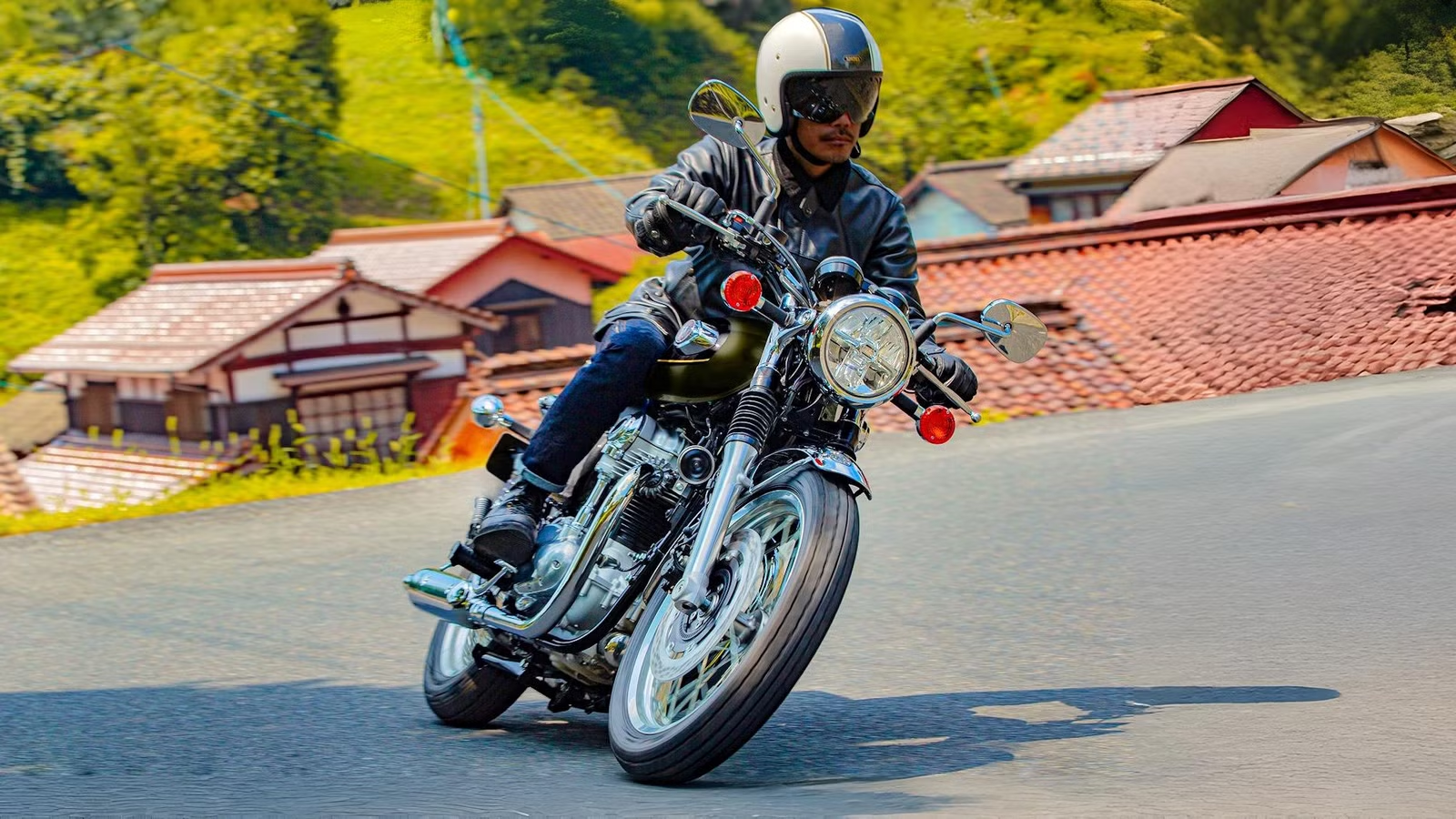
The Kawasaki W800 is the second kind of bike. Its roots go back to the W1, a big vertical twin from the 1960s, and the current model carries that spirit forward with obvious affection. The 2026 W800 has a round headlight, chrome-plated steel fenders, large round turn signals and a sculpted fuel tank that looks right from pretty much any angle. It’s only available in Pearl Crystal White, which suits its classic demeanor.
Kawasaki describes the W800 as a bike built to preserve a 1960s look, sound, and feel, and the traditional exhaust is part of that promise. The result is a low, relaxed note that matches the styling instead of fighting it. At an MSRP of $10,699, that heritage comes in a very accessible package—around $1,000 cheaper than the Triumph Bonneville.
Why The W800’s Air-Cooled Twin Never Needs To Raise Its Voice

The engine is the heart of the W800 and the biggest reason why the motorcycle feels so different from newer rivals. It’s a 773 cc air-cooled parallel twin with a single overhead cam and two valves per cylinder, fed by electronic fuel injection through a pair of 34 mm throttle bodies. Kawasaki quotes 51 horsepower at 6,500 rpm and 46.5 lb-ft of torque at 4,800 rpm. Those numbers seem rather modest by modern standards. However, they describe an engine tuned for easy, usable power low in the rev range.
Torque That Arrives Without The Drama

With a long-stroke layout for the engine, the W800 builds its pull early and keeps it smooth. You don’t have to wring it out to make progress. Roll on the throttle and the bike simply moves, with a steady push that suits two-lane roads and city streets alike. The W800 feels most at home at 50 mph on a country road, and the engine seems happiest when you’re relaxed.
A Throttle And Gearbox Made For Unhurried Miles

The rest of the drivetrain follows the same easygoing logic. The five-speed gearbox uses a return shift pattern, and a sealed chain sends power to the rear wheel. Kawasaki also offers an assist and slipper clutch as standard, a modern touch that keeps the lever light and calms the bike down on hurried downshifts. You’d never guess it was there from the way the W800 behaves, though. The throttle is smooth and predictable, which matters, because the real charm of this engine lies in how unhurried it feels rather than in the speed it can reach.
How The W800 Keeps Its Classic Manners On The Road

A bike this simple could easily feel crude, but the W800’s chassis is better than its looks suggest. A double-cradle high-tensile steel frame holds everything together on a 57.7-inch wheelbase. The bike isn’t light, but the weight sits low, and the low seat helps shorter riders put a foot down with confidence.
Suspension is traditional. A 41 mm telescopic fork with 5.1 inches of travel handles the front, and twin shocks with spring preload adjustment provide 4.2 inches at the rear. There’s no electronic wizardry, just an old-school ride that soaks up bumps nicely on a 19-inch front wheel and an 18-inch rear. Braking comes from a 320 mm front disc with a two-piston caliper and a 270 mm rear disc, both equipped with ABS.
Simple Hardware With Quiet Modern Safety Net

ABS is the only electronic rider aid on the W800, and that fits the bike’s character. It works quietly in the background and never gets in the way of the ride. Fuel injection makes starting and running trouble-free, which the carbureted classics this bike is modeled after couldn’t always claim. The 4.0-gallon fuel tank is a sensible size for a day of riding. All of it adds up to a bike that respects the past without making you live with its inconveniences.
The Bonneville Math Gets Harder To Ignore Once You Ride The W800

The 2026 Bonneville T100 starts at $11,495, and the T120 starts at $13,995. The W800 lists for about $800 less than a T100 and roughly $3,300 less than a T120. So the gap is real. Ownership counts too. An air-cooled, fuel-injected twin with a sealed chain is about as uncomplicated as a modern motorcycle gets, which should mean less to fuss over and more time simply riding. Put the money you save toward a good helmet, proper riding gear or a set of luggage, and the W800 starts to look like the more complete package for the price.

The W800 delivers what most buyers in this segment are really shopping for: a relaxed twin, authentic styling, an upright seating position and a bike that’s easy to live with. If you want maximum performance, the Bonneville has the edge. If you want classic charm at a friendlier price, the W800 is hard to argue with. For riders who care more about how a bike makes them feel than where it ranks on a spec sheet, the Kawasaki W800 offers the same kind of charm for less money.
Source: Kawasaki

Related posts


Latest Post


No Comments