
AMC’s Rarest Muscle Car Was Faster Than Any Corvette

Most car fans can name the usual kings of speed – Corvette, Mustang, Camaro. Maybe a Hemi badge if someone feels spicy. Those cars earned their fame the loud way – big ads, big sales, big wins, and big crowds around them at every cruise night. But speed does not care about popularity, but only about numbers. Weight, gearing, traction, air, and how hard an engine can pull before the driver has to lift – that’s what really matters.

That reality creates a fun problem for the muscle car world. The cars everyone knows are not always the cars everyone should fear. In the late 1960s, a smaller brand with less money than Chevrolet, Ford, and Chrysler picked a fight anyway. American Motors Corporation, the company most folks linked with Ramblers, built a tiny batch of muscle meant for one place – the drag strip. It did it without much money and somehow managed to produce a real drag beast that taught basically every muscle car at the time a lesson or two.
The 1969 AMC Hurst Super Stock AMX Was A Corvette Killer Nobody Talks About
|
Model |
 54 autotech Engine |
Factory Rating |
Compression |
Weight |
1/4 Mile |
|
1969 Hurst S/S AMX |
390 V8, dual Holleys |
340 hp, 417 lb-ft |
12.3:1 |
3,050 lbs |
11.08 @ 127.11 MPH |
|
1971 Corvette LS5 |
454 V8 |
365 hp, 465 lb-ft |
8.5:1 |
N/A |
N/A |
|
1971 Corvette LS6 |
454 V8 |
425 hp, 475 lb-ft |
9.0:1 |
N/A |
13.72 @ 102.04 MPH |
AMC’s surprise punch had a long name and a short temper – the 1969 AMC Hurst Super Stock AMX 390. AMC and Hurst built it for NHRA Super Stock, and NHRA rules forced the project to exist in public, not just in a race shop. NHRA mandated at least 50 cars to be produced, and AMC ended up building 52 and pushed the idea hard at the dealer level.
The firm introduced the SS/AMX in February 1969 at a dealer meeting at Riverside, and drag racer Shirley Shahan made demonstration runs to prove the point. Hurst didn’t show up as a random helper, either – the same people who helped make the Hemi A-body cars famous now had AMC’s keys.
The results didn’t need much sales talk. Hot Rod period testing mentions an AHRA record of 11.08 seconds at 127.11 mph. Those 11-second quarter-mile runs are also confirmed by other independent tests. Hemmings even points out that the Alaska-based “American Dream” SS/AMX ran consistent 10.50s in cool northern air. In the wild, at least one documented Super Stock AMX has been credited with a 10.73-second pass at 128 mph, showing how far the combo could go when everything lined up. For context, those times sat in “serious race car” territory in 1969, not “street hero with a warm engine.”
Car and Driver tested a big-block 454 LS6 Corvette from the same era in their January 1969 issue and recorded a 13.8-second quarter-mile at 106.8 mph. MotorTrend’s feature on the 1969 L88 Corvette cites a L88 model that managed 14.101 at 106.89 mph on street tires. Corvette fans can fairly argue that tires and gearing held the L88 back in magazine tests, and MotorTrend even notes an owner-reported 11.14 at 123 mph with the right setup. Still, in the “as-tested” world that most buyers actually lived in, the SS/AMX played two whole seconds ahead, which is a long time when a race lasts around twelve.
The funniest part is how many people underestimated it. The SS/AMX looked like an AMX with attitude, not a factory-backed program built to chew up trophies. Some cars left Hurst in plain white for dealers to paint, while others wore the loud corporate red-white-and-blue scheme, so the look didn’t always give away the mission. That meant an SS/AMX could show up looking calm, then leave looking like it stole someone’s lunch money.

The AMC Muscle Car That Made The Big Three Sweat In 1968
This unhinged muscle car proved AMC was anything but boring.
How Did AMC Build Something This Fast With Almost No Money?

That’s what made the Hurst SS/AMX so impressive in the first place. AMC wasn’t operating with Chevrolet, Ford, or Chrysler money, and it definitely wasn’t working with their level of dealer support or racing budgets. The company couldn’t afford to overwhelm rivals with massive production numbers or endless factory development, so it focused on one thing instead: building the lightest, nastiest drag package it could get away with under NHRA rules. Instead of chasing luxury, comfort, or broad market appeal, AMC and Hurst stripped the formula down to exactly what mattered at the drag strip. Lightweight body prep, aggressive gearing, race-ready suspension pieces, a trunk-mounted battery, dual Holleys sitting on a cross-ram intake, and a brutally high-compression V8 all combined into something that behaved more like a factory-backed race car than a normal muscle car.
AMC basically skipped the expensive part of trying to out-market Detroit and went straight to outrunning it instead. That’s why the SS/AMX feels less like a traditional muscle car today and more like an early version of modern factory drag specials like the Demon 170, where the entire vehicle exists for one purpose: humiliating much bigger names in a quarter-mile sprint.
This Was Basically A Factory Drag Car

The SS/AMX started life as a normal-looking AMX, then Hurst turned it into a checklist of racer wishes. Compared with a standard 390 AMX, the Hurst SS/AMX came from the factory as a purpose-built Super Stock package, not a warmed-over street option. Hurst added drag-first hardware like 4.44 gears, Doug Thorley headers, a Hurst Super Shifter, trunk-mounted battery, and an oil-pan-friendly crossmember meant for quick between-rounds service.
It also cut “street” weight and comfort (no warranty, minimal equipment), and its 390 got serious race parts like an Edelbrock cross-ram intake with dual Holleys and a high-compression bottom end. The engine also ran forged JE 12.3:1 pistons for strength under race loads, while Crane modified the cylinder heads with port work and larger valves to improve airflow. Combined with the STR-11 cross-ram and twin Holleys, it produced far more power than AMC’s conservative rating suggested.
Shipping weight sat around 3,050 pounds, helped in part by lightweight prep work including acid-dipped body panels to shave mass wherever possible. Compared to a 1971 Corvette’s roughly 3,446-pound curb weight, that difference was important once the lights dropped.
AMC underrated it at about 340 hp on paper, but NHRA bumped the rating to as much as 420 hp after tech inspection, which helped explain why these cars ran deep into the 11s when most showroom muscle still lived in the 13s and 14s.

AMC delivered the cars with a standard passenger-car camshaft and skipped engine blueprinting on purpose. Racers often had favorite cams or sponsorship deals, so AMC left that final choice to the owner. That choice sounds odd to street-car buyers, but it makes perfect sense for a class racer. It also meant the SS/AMX didn’t chase a single “perfect” combo and instead focused on flexibility, so racers could tune the car to local tracks, weather, and class rules. The SS/AMX also ditched comfort like it was ballast, because it was. The Super Stock AMX lacked comfort equipment, such as a heater, and also lacked a factory warranty.
What The AMC Is Like Against Modern Muscle Cars

|
AMC Hurst SS/AMX |
2023 Dodge Challenger SRT Hellcat Redeye |
2022 Ford Mustang Shelby GT500 |
Chevrolet Camaro ZL1 |
|
|
Engine |
6.4-liter V8 |
6.2-liter Supercharged HEMI V8 |
5.2-liter Supercharged “Predator” V8 |
6.2-liter Supercharged LT4 V8 |
|
Horsepower |
340 hp claimed (420 hp NHRA) |
797 hp |
760 hp |
650 hp |
|
Torque |
430 lb/ft |
707 lb-ft |
625 lb-ft |
650 lb-ft |
|
Quarter Mile |
10.73 seconds @ 128 mph |
10.8 seconds @ 131 mph |
10.7 seconds @ 132 mph |
11.4 seconds @ 127 mph |
Can a fifty-year-old dragster go toe-to-toe with Detroit’s current supercharged elite? If it is the legendary Hurst SS/AMX, absolutely. Its 10.7 ET is just as fast today as it was decades ago, and some of the fastest muscle cars of the last few years would still struggle to beat it despite having advanced aerodynamics, launch control systems, sophisticated independent suspensions, and massive top-end supercharger boost.
The Hurst SS/AMX’s secret sauce is its power-to-weight simplicity versus modern creature comforts, as it only weighs a featherlight 3,050 pounds. While a Challenger Hellcat needs nearly 800 horsepower to push its massive two-ton curb weight down the strip, the stripped-down, lightweight SS/AMX utilizes a 420-hp powerhouse, optimized drag suspension, and vintage slicks to run neck-and-neck with today’s computer-controlled showroom kings.

This Forgotten AMC Is One Of America’s Best Muscle Wagons
With enough power to embarrass muscle cars, this rare AMC wagon is a silent assassin waiting to surprise you.
The Market Still Hasn’t Fully Caught On

The SS/AMX sits in a rare sweet spot – tiny production, real racing intent, and big results. Hemmings ties the run to 52 cars built in total to satisfy NHRA rules. The survival pool is smaller than 52 because drag racing rarely treats sheetmetal with kindness. The SSAMX registry site actually lists 39 cars “currently listed,” which gives a sense of how tight the known group is. That leaves a handful still missing, still hiding, or still wearing a disguise that only a die-hard AMC person would notice. For collectors, that mystery adds spice. For restorers, it adds late-night forum threads.
Some of the best stories come from cars that disappeared and came back. Hot Rod covered the last-built SS/AMX resurfacing after decades stored in a shipping container in Alaska. The same story describes an AMC “conversion kit” that updated some SS/AMXs with 1970-style pieces, even though the cars were never meant to live as normal street machines. That Alaska car changed hands only a few times across decades, which is common with halo AMCs – owners tend to keep them.
The original price explains why the cars still feel a little outlaw. Street Muscle reports a $5,994 asking price and no warranty back in the day. The high sticker meant some SS/AMXs sat on showroom floors for months while dealers waited for the right buyer. Meanwhile, Hurst handled the red-white-and-blue paint option for a $79 surcharge when the ordering dealer specified it.
Even If You Find One Today, You’ll Pay A Lot For It
Modern pricing reflects the same blunt reality – real ones bring real money, and the public record stays thin. A documented SS/AMX sold at Mecum Indy on May 20, 2022, for $181,500. More recently, in October 2025, YouTube channel Backyard Barn Finds covered a one-owner SS/AMX barn find with an asking price of $211,000, and it described the car as number four out of 52.
Recent market trends add context for anyone tracking prices. Hagerty’s February 2025 market report describes “sleepy” conditions overall and notes its American Muscle Car Index sat flat to start 2025 after a year-long skid – the report says the index sat down 10 percent year-over-year while still up 32 percent from 2020. Hagerty’s valuation tool also shows how guide values can move, listing a “1969 American Motors AMX SS” with a #3 (“good”) value around $77,700 and a one-year change shown as -8.2%.
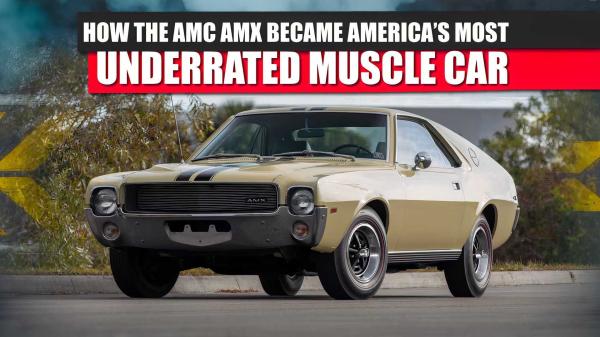
AMC Built America’s Most Underrated Muscle Car
The AMC AMX was smaller, faster, and arguably bolder than its rivals, yet it never got the recognition it truly deserved. That’s finally changing.
The SS/AMX Still Feels Like A Secret

AMC never had the budget, reputation, or production numbers of Detroit’s biggest muscle car brands, which is exactly what makes the Hurst SS/AMX so fascinating decades later. While Chevrolet, Ford, and Chrysler were fighting for showroom dominance, AMC built a lightweight factory-backed drag car that could outrun machines carrying far bigger names and far bigger marketing budgets. And somehow, most people still barely know it exists. That’s part of the appeal now. The SS/AMX still feels like a secret hidden inside muscle car history, a car that spent its entire life punching above its weight and embarrassing competitors that were supposed to be untouchable. Looking back now, it feels less like AMC accidentally built a fast car and more like the company briefly figured out the exact formula modern factory drag specials still chase today.
Source: AMC, MotorTrend, HotRod, Classic.com, Mecum, Hagerty.

Related posts


Latest Post


No Comments