
Ford Torino King Cobra: The 200 MPH NASCAR Prototype
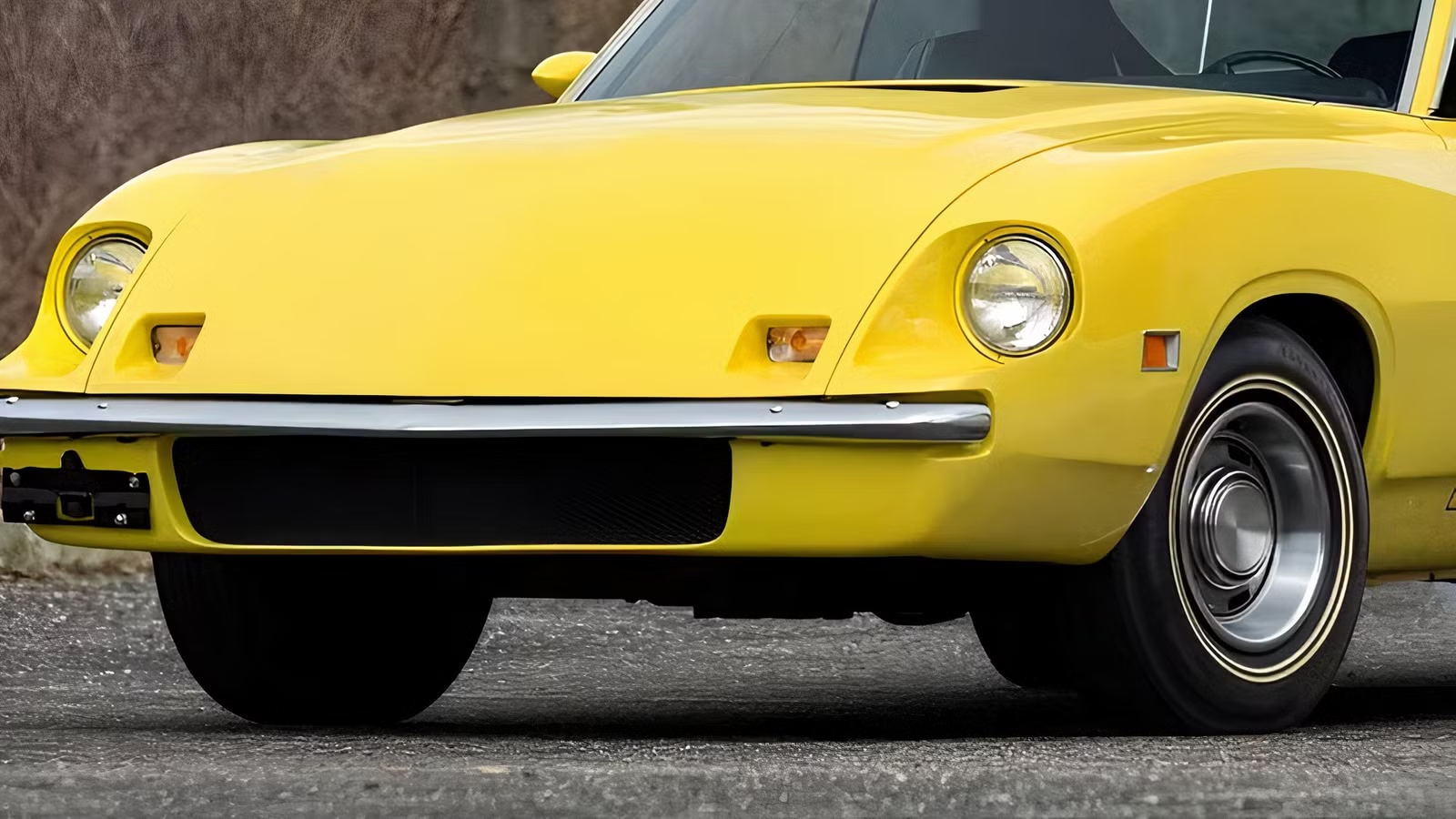
When you think of the aerodynamic nose cones and giant wings of late ‘60s NASCAR racing, you automatically think of Mopar. Be it the Dodge or Plymouth flavor, the Charger Daytona and Superbird are global enduring figures of late 1960s racing, not just at home in the US. And yet, Chrysler was far from the only factor involved in what’s widely seen as the most exciting era in American stock car racing. Little do some know, Ford took part as well. If anything, half of the story routinely gets left out, oftentimes by the very company that made it.
NASCAR in the ‘60s: A Changing Paradigm

NASCAR’s transition from a bunch of rag-tag ex-bootleggers into certified sanctioned racers hurling 200 mph-capable machines down super speedways didn’t happen all at once. Rather, it was a steady arms race between the Big 3 automakers in Detroit, plus a gaggle of smaller competitors at various times. Back when stock car racing really did mean “strictly stock,” the same model you won with on Sunday could ditch the roll cage and sponsor decals and get sold off the dealer lot on a Monday. It was just as much an advertising ploy as it was a means for liquor runners to go legit, and it meant advancements came from racing tech intended to trickle down to the consumer side.
Engine displacement progressively rose through the late 1940s and through the ‘50s, into the hyper-competitive and cut-throat 1960s. By this time, OEMs weren’t just slapping mods on top of street cars anymore. They were purpose-built track weapons which more or less resembled street machines they advertised, but were moving rapidly towards heavily-modified half-chassis vehicles that grafted factory front clips onto tube chassis and integrated roll cages. Engines were similarly beefed up, with each OEM manufacturing special race variants of gigantic factory V8s. Chevy unleashed its iconic big-block, starting at 409-cubic-inches and working its way up to 427 by the end of the decade.

Mopar similarly brought race-tuned “Elephant” Hemis to the table, and Ford? Well, their FE-series V8 might’ve been designed for the Edsel brand the decade prior, but with a high-lift single-overhead cam, dual four-barrel carburetors, and high-riser manifolds, the engine was so good, NASCAR founder Bill France Sr. had to ban it while the normal pushrod 427 wedge engine stuck around. By this stage, blocky, aerodynamic Cup cars were powerful enough to push the knife’s edge of 200 mph while losing the fight against the harsh mistress that is aerodynamics. To reach that next level of racing excellence, at least two of NASCAR’s biggest OEMs took the initiative to lean into aero in a big way.

The Aero Wars: By Most Accounts, Peak NASCAR

For a number of reasons, only Ford and Chrysler were able to compete in the race to build the most aerodynamic vehicle in racing history to that point. Introduced late in the 1969 season, Mopar contracted former NASA scientist Gary Romberg, a contributing member of the Apollo program, to help develop an aerodynamic nose cone and massive rear wing capable of being fitted on the B-body Dodge Charger and Plymouth Superbird. Further support was brought on by John Herlitz, father of the Plymouth Barracuda program, and the original Dodge Copperhead concept.
With a drag coefficient of 0.29 and 0.31 for the Charger and Superbird respectively, this was a number almost unheard of in the American auto industry of the day, let alone in racing. For some context, some modern supercars with similar figures include the McLaren Speedtail, Koenigsegg Jesko Absolut, and Rimac Nevera. Paired with a race-tuned 426-cubic-inch Hemi V8 making anywhere from 500 to 650 horsepower depending on the track, these rigs could finally smash the proverbial glass ceiling of 200 mph. They were lound, they were brash, and in some cases, had utter lunatics in the best way possible behind the wheel.

With famous drivers like Pete Hamilton, Buddy Baker, and of course, Richard Petty behind the wheel, Mopar racked up no less than 14 wins in Grand National competition between 1969 and 1970. It was one of the most prolific and storied periods for any one type of car in the history of global auto racing. In the annals of history, the spoils are overwhelmingly set upon Chrysler. Yet, that doesn’t tell the whole story, not even by a long shot. The truth is far more interesting, and rooted in Mopar’s cross-town rivals at Ford. Little does anyone remember, but then again, the truth was smothered just a bit.
1970 Ford Torino King Cobra: Ford’s Yin to Mopar’s Yang

Let’s shift focus from one end of the Detroit spectrum to the other, because it’s at the Ford end of things where we find the other end of the aero wars’ iconic story. If you’re curious where the heck GM is in all of this, well, it swore off factory-backed racing back in 1963 citing antitrust concerns. Though back-door parts sharing and a handful of independent operations kept Chevrolet in particular in NASCAR Cup competition, this stark lack of factory support meant GM was left out of the aero wars entirely. With this in mind, let’s set our sights on a man who helped define Ford’s design prowess at the turn of the 1970s, a man named Larry Shinoda.
Born in LA to Japanese immigrant parents, Shinoda not only collaborated with Zora Arkus-Duntov at GM to pen the C2 Corvette, and even laid the groundwork for the C3 follow-up with the Mako Shark concept. Moving to Ford in 1968, Shinoda had already established himself as a force to be reckoned with by designing the Mustang Boss 302 and Boss 429 out of the existing Mustang Fastback. Yet, even by those standards, Shinoda’s ambitions in the aero wars were nothing short of ambitious. In response to Mopar’s moves with the Superbird and Charger Daytona, Shinoda took the underpinnings of the then brand-new 1970 Ford Torino SportsRoof, and smoothed out its blocky fastback design until it had the silhouette of a supersonic aircraft.

Dubbed the King Cobra, the resulting car pre-dated Mopar’s efforts in the aero wars by a touch over six months via its predecessor, the more conventional Torino Talladega. The King Cobra didn’t have the same enormous rear wing as Mopar’s aero cars. Shinoda and his design team reckoned the sleeker front end, paired with the Torino’s natural fastback shape, would suffice at reducing drag, making a big wing unnecessary in their eyes. Besides, with the ability to accommodate a race-tuned Boss 429 V8, a wingless silhouette seemed almost like a limiting factor. Had it made it to race production, this engine had a theoretical upper horsepower limit somewhere in the low-to-mid 700s. It was a monstrous figure in those days, even by the standards of the Charger Daytona and Superbird the Torino King Cobra was supposed to compete with. Yet, as should be self-evident by now, Ford’s aero warrior never made it that far.
Sabotaged From Within, But Why?

Automotive executives are fickle creatures. One minute, they sing the praises of a factory-backed racing program, the next, they slash its budget and leave the dev team high and dry. That’s exactly what happened to Larry Shinoda’s King Cobra program after NASCAR raised its homologation production requirements from 500 cars to 3,000, or one car per every two US dealerships. Suddenly, a relatively safe investment with reasonable overhead saw its costs shoot into the stratosphere. Ford executive and known racing supporter Semon “Bunkie” Knudsen was subsequently fired by Henry Ford II himself around this time, eliminating the company’s racing backbone.
A similar folly befell the Mopar side as well, sticking around through the 1970 season on the back of Richard Petty’s star power. Even then, Bill France Sr. established new rules for aero cars effective the following season that limited cubic displacement to 305 cubic inches. In effect, it was the death knell for the aero wars, and all the while, the stark lack of a rear wing turned out to be a huge detriment for the Torino King Cobra. Before testing was halted, Ford’s test drivers discovered the rear tires started to float as the car approached that 200 mph barrier. Without some manner of horizontal stabilizer keeping things tidy, such a setup was bound to kill somebody. It wound up being a moot point, as a mere three prototypes sporting street-grade V8 drivetrains were built before the program was shelved for good.

In the end, Ford assumed an official stance similar to GM on the racing side, pulling support away from factory-backed track efforts of old. More broadly, cubic displacement was capped at 350 cubic inches across the board for smaller stock cars, or, alternatively, increased weight penalties for teams running big blocks. In the span of a year, the NASCAR Cup series had turned into a very different paradigm, and there simply wasn’t a place left for 25-inch wings or nose cones anymore. It left the Torino King Cobra as one of the biggest what-ifs in global racing history, and today, those three prototypes are multi-million-dollar collector’s items. They’re the last living vestiges of what might’ve happened had affairs gone even slightly differently.
Source: Hagerty, Mecum, Ford

Related posts



Latest Post




No Comments