
The Japanese Sport Bike That Quietly Became A Modern Performance Bargain
The term middleweight was an uncomplicated category among motorcycles before current times when anything from 500cc to 900cc now defines a bike that falls into this space. Middleweight sport bikes were even simpler. 600cc was the norm and the Japanese manufacturers dominated the market. The formula for the bike was easy too. Take a 600cc four-cylinder engine, give it enough revs to upset the neighbors, bolt it into an aluminum chassis, and worry about comfort after the lap timer stops.

This formula has largely disappeared, giving way to parallel-twins thanks to modern emissions requirements and changing buyer priorities. Prices have moved upward as well, as electronics and more sophisticated hardware have joined the modern sport bike package. Curiously, that shift has made one of the remaining traditional Japanese supersports look considerably more attractive than it ever did when the segment was packed with similar motorcycles.
Middleweight Sport Bikes No Longer Need Four-Cylinder Screamers
The old 600cc supersport category was once among motorcycling’s most competitive battlegrounds as support races to the big 1000s. Honda, Kawasaki, Suzuki, and Yamaha all built screaming inline-fours around track-focused chassis, while Triumph offered its three-cylinder Daytona. Engine development concentrated heavily on breathing efficiency and high-rpm power because racing regulations kept displacement tightly controlled.


The road-bike market has since moved elsewhere. Yamaha’s latest YZF-R9 uses an 890cc three-cylinder engine, and Ducati’s Panigale V2 has an 890cc V-twin, stretching the definition of a traditional supersport even further. Larger displacement makes useful torque easier to produce lower in the rev range, which makes these motorcycles friendlier to ride away from a circuit.

This transition has also changed what buyers get for their money. Sophisticated electronics, IMU-based traction control systems, and swanky TFT displays are increasingly expected on premium middleweights nowadays. The mechanical simplicity of the old 600 class has therefore become less fashionable even though its performance hasn’t suddenly become irrelevant.

There are remarkably few opportunities left to buy a genuinely high-revving Japanese four-cylinder supersport as brand new from a showroom floor. What used to be one option among many is now almost a specialty product dwindling down to less than a handful of manufacturers, and the pricing landscape around it has changed enough to make the traditional approach unexpectedly compelling.
The Kawasaki Ninja ZX-6R Makes 127 Horsepower For $11,599

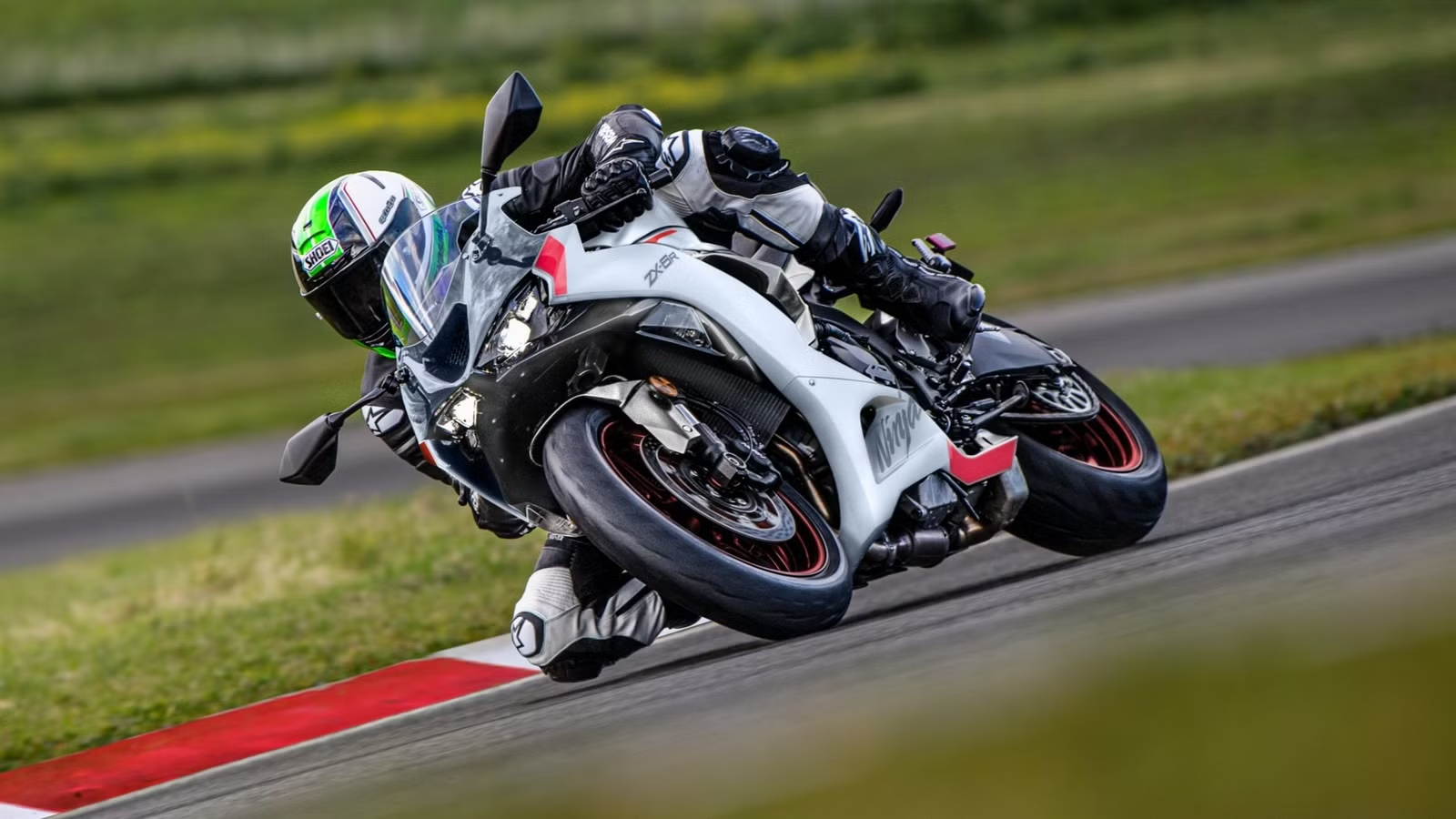
One such remaining example is the 2027 Kawasaki Ninja ZX-6R. The non-ABS model starts at $11,599 in the U.S., while adding Kawasaki’s KIBS anti-lock braking system takes the MSRP to $12,599, the same as the 2026 model year price. Its basic architecture remains recognizable to anyone who remembers the peak of the 600cc supersport wars, but Kawasaki’s decision to keep the 636cc version alive gives it performance that now looks unusually strong against considerably newer machinery.
The 636cc Inline-Four Still Loves Making Use Of The Full Tachometer

Kawasaki’s 636cc liquid-cooled DOHC inline-four produces a claimed 127 horsepower at 13,000 rpm and 52.1 pound-feet of torque at 10,800 rpm. The numbers alone make it easy to explain the motorcycle’s character immediately. It doesn’t attempt to imitate the thick midrange of today’s larger twins and triples. Instead, the engine still expects its rider to use revs, lots of them, in conjunction with the gears to extract the best from it.

The extra 37cc over a regulation-style 599cc supersport engine is a bit meaningful for regular road riding. Kawasaki returned to the 636cc displacement for the 2013 generation specifically to improve performance throughout the rev range. More than a decade later, with the ZX-6R now competing against much larger engines designed around accessible midrange torque, that decision becomes all the more important. The Kawi still needs revs, but it isn’t quite as hollow below the powerband as more traditional 600s inline-fours can be.
The Chassis Remains Proper Supersport Hardware

The 2027 ZX-6R retains an aluminum perimeter frame, a 41mm Showa Separate Function Fork-Big Piston fork, and a bottom-link Uni-Trak rear suspension setup. Both ends offer substantial adjustability, including compression and rebound damping, with spring preload adjustment at the front and rear. Its 55.1-inch wheelbase and 23.5-degree rake keep the geometry firmly in supersport territory rather than turning the motorcycle into a softly tuned road bike wearing fairings.

Braking is handled by dual 310mm front discs and radial-mounted four-piston monobloc calipers. The non-ABS model weighs a claimed 432.2 pounds ready to ride, which isn’t exceptionally light by modern standards. But the narrow focus of the chassis remains one of the reasons the ZX-6R still makes sense to riders who actually want supersport aggressiveness rather than just the styling.
Kawasaki Added Just Enough Tech Without Turning The ZX-6R Into A Rolling Computer

The current ZX-6R isn’t completely frozen in the 2010s. Kawasaki gives it selectable Full and Low power modes, three-level KTRC traction control, an assist and slipper clutch, and a Kawasaki Quick Shifter. A 4.3-inch TFT display adds smartphone connectivity, while LED lighting brings the aesthetics and functionality reasonably up to date.
However, there is still a clear technology gap to newer bikes. The ZX-6R doesn’t use an IMU, so there’s no cornering-aware traction control and other systems that rely on that data. Even its quickshifter assists with upshifts only rather than providing the latest bidirectional system. That sounds a bit retro by today’s standards, but it also helps explain why Kawasaki can still sell a 127-horsepower supersport at this price point.
The Yamaha YZF-R9 And Ducati Panigale V2 Show Why The ZX-6R Looks Cheap

The result of the conservative electronics approach feels increasingly unusual in 2026. Kawasaki hasn’t turned the ZX-6R into a cheaper interpretation of the modern middleweight, and has instead kept refining a fundamentally different kind of motorcycle. This one is still for a decreasing breed of riders who still yearn for an inline-four that rewards with a screaming redline.

The $12,499 2026 Yamaha YZF-R9, in comparison, completely lets go of its glorious YZF-R6. The R9 now uses an 890cc CP3 inline-three producing 117 horsepower and 69 pound-feet of torque, weighing 430 pounds wet. Crucially, the R9 carries far more sophisticated electronics, including a six-axis IMU system. Its Brembo Stylema front calipers and highly adjustable KYB suspension further justify the price. Yet, a base ZX-6R costs $900 less and the 636 boasts more peak horsepower.

Ducati’s $16,995 Panigale V2 produces 120 horsepower and 69 pound-feet from its 890cc V-twin, in a substantially lighter package. It’s also more sophisticated electronically and delivers much stronger torque lower in the rev range. Those advantages are significant, but so is the $5,396 gap versus the non-ABS Kawasaki.

That doesn’t make the Kawasaki objectively quicker everywhere. Peak horsepower as a standalone metric ignores torque delivery, gearing, weight, aerodynamics, and rider aids. But a motorcycle based on one of sport bikes’ oldest surviving formulas, keeping things simple for a rider who wants to learn the art and sport through old-school techniques, now has a unique value proposition in the ZX-6R.
Source: Kawasaki

Related posts


Latest Post



No Comments