
Toyota’s Most Reliable Truck That Regularly Hits 400,000 Miles
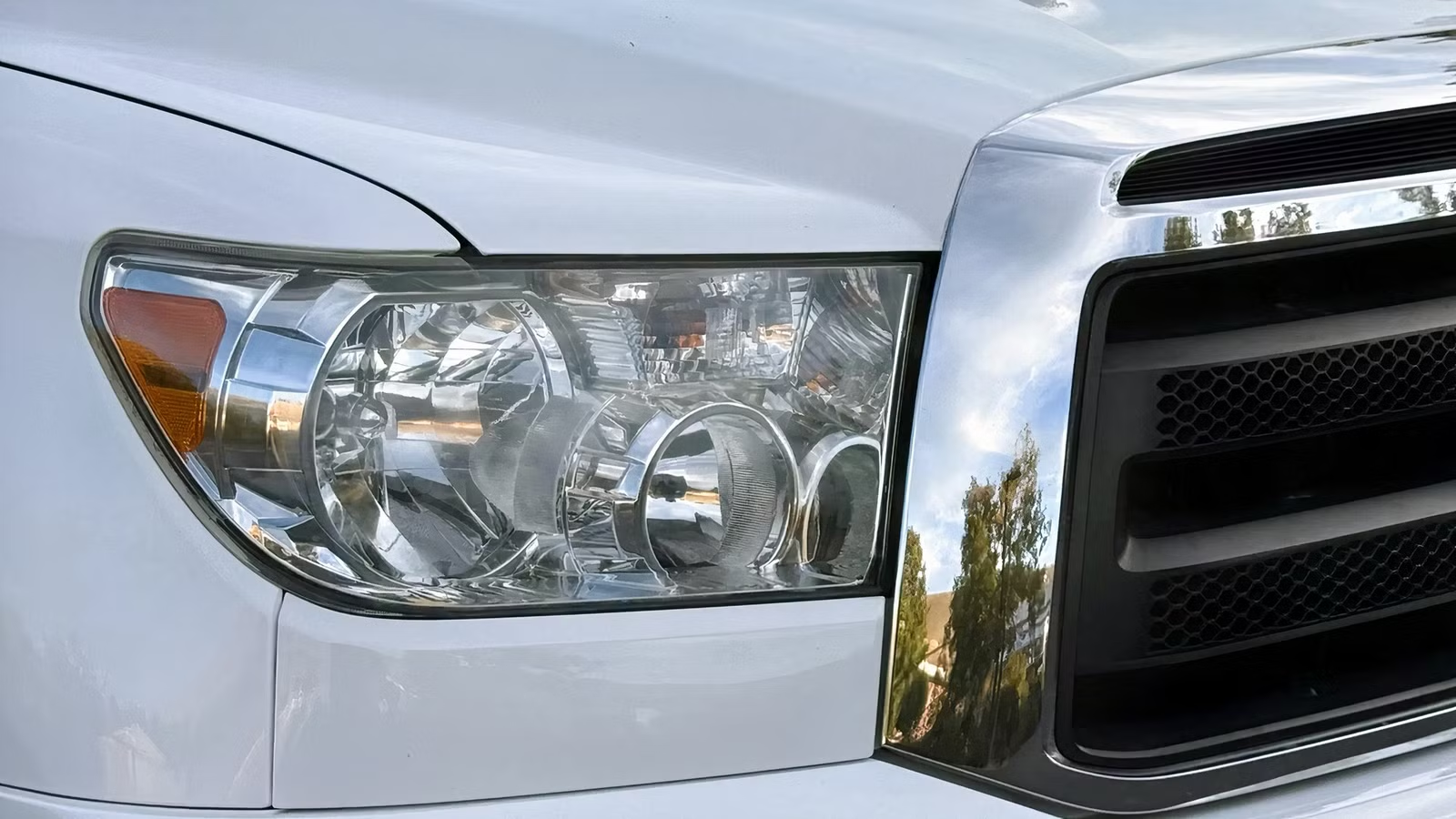
While rivals chase horsepower headlines and towing records, the Toyota Tundra has quietly built a case for something more valuable: the kind of durability that keeps a truck on the road long after the competition has been traded in. In a segment dominated by the Ford F-150 and Chevrolet Silverado, the Tundra plays a different game — one measured not in peak output, but in how many miles it can rack up before anything serious goes wrong. The answer, as it turns out, is a lot.

The Toyota Tundra regularly enjoys the title of being the most reliable and durable truck in the U.S., one that is the most likely to pass 300k and even 400k miles without a full drivetrain rebuild. This reputation isn’t a result of marketing. It is the result of fleet data, owner records, and teardown inspections going back decades. It’s the result of an engineering choice with a focus on long-lasting operation instead of headline numbers, and here’s how it paid off for the Tundra.
Toyota Tundra’s High-Mileage Reliability Is Undeniable
|
Average Lifespan |
 69 autotech Typical Miles Driven Per Year |
Probability Of Reaching 200k Miles |
|---|---|---|
|
15.1 years / 208,285 miles |
12,926 miles |
55.4% |
The Toyota Tundra may not be the most powerful or capable full-size pickup truck out there, but if there’s one area where it beats every other rival, it’s dependability. A well-maintained Tundra can easily last anywhere from 150k to 250k miles with just routine maintenance. Take care of it, and it can exceed 400k miles, too. Just browse the online forums and you’ll find plenty of Tundras with over 400k miles on the odometer. Perhaps the most famous example is Victor Sheppard’s 2007 Tundra, which crossed a whopping one million-mile mark back in 2016.

You don’t need to rely on anecdotal reports for this, either. iSeeCars also shows that a Tundra can last a very long time. In its ‘Longest-Lasting Cars 2025’ report, the Tundra ranks at the top for pickup trucks. The portal says that the Tundra has a 30 percent chance of reaching 250k miles, which is 6.3 times the average. And it has an average lifespan of 208k miles or 15.1 years, which easily makes it the most reliable pickup truck in the U.S. today.
Toyota’s Old-School Philosophy Of Overengineering And Over Optimization

Since the launch of the Tundra in 1999 as the first full-size Japanese truck in the U.S., Toyota has resisted chasing peak output figures for it. Instead, the focus was always on thermal stability, mechanical margin, and repeatability under load. These qualities may not win spec-sheet battles, but they prove far more important when the truck rolls past 300,000 miles. Conservative engineering back then translates to exceptional longevity decades later, and it’s the core reason why Tundras are so dependable.
Built With Headroom, Not Just Targets

In the quest to have the truck with the performance edge over the competition, engineers design components close to their stress limits. Toyota, by contrast, has always built the Tundra’s engines and drivetrains with significant operating headroom. Everything from oil capacity to cooling systems, bearings, and rotating assemblies is engineered to handle continuous high load without fatigue. This approach is widely cited as a key reason for the Tundra’s extreme mileage potential.
The Engines That Made The Tundra Legendary

In 2022, Toyota launched the third-generation Tundra and replaced the venerable V8 with the twin-turbo 3.5-liter iForce and iForce Max hybrid. Not enough time has passed for many of these trucks to reach extreme mileage. However, the naturally aspirated V8s that powered the first two generations of the Tundra — including the 4.7-liter 2UZ-FE and the 5.7-liter 3UR-FE — are consistently cited as benchmarks of long-term durability.
4.7-Liter 2UZ-FE: The Original Marathon Runner

The original Tundra came with a V6 and the exceptional 4.7L V8 (2UZ-FE). The latter is widely seen as one of the most durable truck engines ever produced. Toyota is a global brand, and this V8 had to be able to operate in areas with poor fuel quality, rough terrain, and punishing duty cycles. The solution was a focus on low stress, thick castings, and simple valvetrain geometry. The result is an engine that’s still going strong in thousands of older Tundras today.
5.7-Liter 3UR-FE: The Gold Standard Of Modern Truck V8s

The 4.7-liter V8 was replaced by the 5.7-liter V8 (3UR-FE), and this engine carried the Tundra for the next 15 years. While later trims made 381 horsepower, the engine still used old-school port fuel injection, a forged crankshaft, and conservative cam profiles. This allowed Toyota to sidestep the complexity that often plagues other trucks as they age, resulting in significantly better long-term durability.
iForce And iForce Max Hybrid Engines Aim To Uphold The Tundra’s Reliable Reputation

Toyota has replaced the V8 with the 3.5-liter twin-turbo iForce and the same engine paired with a hybrid drive called the iForce Max. The latter is a hybrid designed for more power, not necessarily fuel efficiency. While the V6 engines haven’t been in service long enough to generate meaningful high-mileage data, early reports on the iForce Max hybrid are encouraging. Despite some early reliability and recall concerns, it has improved consistently, with reliability scores reflecting a growing level of quality as initial issues are resolved.

It produces more power and torque than the gas iForce — 437 horsepower and 583 pound-feet of torque vs. 389 horsepower and 479 pound-feet — which means there is more reserve power for any given task, placing less stress on the engine. The hybrid components also carry much of the workload, reducing the burden on the combustion side. That said, Toyota has an excellent reputation for reliability and durability, and it would be surprising if the third-generation Tundra, gas and hybrid alike, does not carry on the high-mileage results achieved by previous generations.
Drivetrain Simplicity And Stress Management

It is not only the design of the engine internals that determines the lifespan of that engine. The way the transmission is set up is critical, as is the cooling system. Thankfully, Toyota designed the entirety of its heavy-duty models with this very ideology in mind, ensuring that the vehicle as a whole would go the distance while still being able to put in hard work day in and day out.
Transmissions Tuned For Longevity

The five- and six-speed automatic transmissions used in the second-generation Tundras (2007–2021) were biased toward smooth torque delivery rather than aggressive shift logic. This reduced clutch wear, heat buildup, and long-term internal stress — particularly important during towing. These transmissions can and do fail at high mileage, but in the Tundra, the likelihood is notably lower when maintenance schedules are followed.
Cooling System Designed To Handle Abuse

Thermal cycling kills engines over time as temperatures spike under load and then drop at rest — a concern that is especially acute in hot climates and during towing. The Tundra addresses this with an oversized cooling system. A large radiator, generous oil capacity, and conservative thermostat calibration work together to keep temperatures stable, reducing the cumulative stress that wears engines out. This philosophy carries over into Toyota’s modern, non-V8 engines, where thermal management becomes increasingly critical as mileage climbs.
Body-On-Frame, Done The Conservative Way

All full-size trucks use body-on-frame construction, but not all implementations are equal. The Tundra features thicker frame rails, a simpler structure, and proven metallurgy. Rather than reinventing the platform with each generation, Toyota has evolved it carefully over time, allowing issues to surface and then correcting them over long production runs.
Maintenance Culture: The Human Factor

Any vehicle, including the Toyota Tundra, will fail if it is neglected and does not receive regular service, consistent maintenance, and timely repair or replacement when a component eventually starts to wear. And when you own a Toyota, the maintenance bill is often lower than what you may experience with competing models, though it’s always important — regardless of make — that owners stay proactive, especially once a truck crosses six-figure mileage.
Very Low Maintenance Costs

Such high reliability also translates to very low maintenance and repair costs for the Tundra. According to CarEdge, an average Tundra should cost only $2,388 over five years in maintenance, beating the industry average by $1,863. There’s a 19.12 percent chance of a Tundra requiring a major repair, which is 10.51 percent better than its competitors. Similarly, RepairPal reports a low repair cost of just $606 per year, which is quite frugal for a full-size pickup truck.
- Average Yearly Maintenance Cost: $606 (RepairPal)
- Est. Maintenance Cost During The First 10 Years: $7,226 (CarEdge)
Frequent Oil Changes Are Crucial, Though

High-mileage Tundras almost universally share one thing in common: service records showing conservative maintenance intervals, with frequent oil changes and factory-spec fluids. This discipline is especially critical for low-revving truck engines built to last. So while the Toyota Tundra may leave the factory with considerable reliability and durability already baked in, it’s ultimately the owner’s responsibility to protect that investment. Every vehicle, including the Tundra, is only as reliable as the care it receives.
Toyota Tundra’s Best Years Of Reliability

iSeeCars ranks the Toyota Tundra as the most reliable pickup truck currently on sale in the US. Even J.D. Power gives it a high quality and reliability rating, with the MY25/MY26 Tundra earning a solid score of 83 out of 100. Despite such high rankings, the current-gen Tundra isn’t the most reliable model ever yet. This generation is still relatively new and hasn’t proved its long-term reliability just yet. Some common issues reported so far for this generation include machining debris inside the engine, chafing fuel lines, interior rattling, and related concerns.
- 2026 Toyota Tundra recalls: 0
- Best model years: 2021, 2015, 2001
- Worst model years: 2000, 2006 – 2007, 2012

So, which is the most reliable Tundra ever made? Going strictly by J.D. Power rankings, it would be the 2021 Toyota Tundra, earning an 84 out of 100 reliability score. This model year was the last of the second generation, which had been in production for over a decade with most of the common issues ironed out along the way. That’s not to say any Tundra models are necessarily unreliable; even those Tundra model years with lower reliability ratings are still pretty dependable and, most times, more so than their competitors.
Sources: Toyota, Forbes, J.D. Power, CarEdge, RepairPal

Related posts

Latest Post


No Comments