The American V6 Sedan Built For Old-School Drivers
8 minutes reading
Sunday, 27 Sep 2026 11:00 0 6 autotech
There’s a certain kind of driver who has been waiting for the industry to admit it took a wrong turn. Somewhere between the rise of dual-clutch everything and the quiet creep of driver-assistance suites that second-guess every input, something got lost. The simple, mechanical joy of a car that does exactly what you tell it to, nothing more. This performance sedan was built for that driver specifically. No apologies, no compromises, and crucially, no automatic transmission forced upon you. It’s a throwback wearing a modern badge, and it might be the last of its kind.
Under the hood sits a 3.6-liter twin-turbocharged V6, hand-built and code-named LF4, producing 472 horsepower and 445 pound-feet of torque. Those numbers alone would be enough to make this one of the quickest compact sedans money can buy, but the engineering brief went further than raw output. The goal was never to chase a bigger number on a spec sheet. It was to build a powertrain that communicates with the driver through every pedal input and every downshift, the way performance cars did before software started filtering the experience.
That distinction matters more than it sounds. Plenty of modern performance sedans are quick in a straight line and numb everywhere else, buried under layers of electronic intervention designed to protect drivers from themselves. This car’s engineers took a different approach. The twin-turbo V6 was tuned for immediate throttle response rather than peak boost, and paired with an electronic limited-slip differential that manages power delivery mechanically rather than purely through the stability control computer. The result is a car that rewards a skilled driver instead of managing around one.
CT4-V Blackwing interior close-up of front seatCadillac
With the optional 10-speed automatic, 0-60 mph arrives in as little as 3.8 seconds. That’s supercar territory from a decade ago, delivered by a sedan with a trunk and four doors. But the automatic was never really the point, which brings us to the detail that separates this car from nearly everything else on sale today.
Six Cylinders, A Manual Gearbox, And Rear-Wheel Drive Keep The Old-School Spirit Alive
Cadillac CT4-V Blackwing interiorCadillac
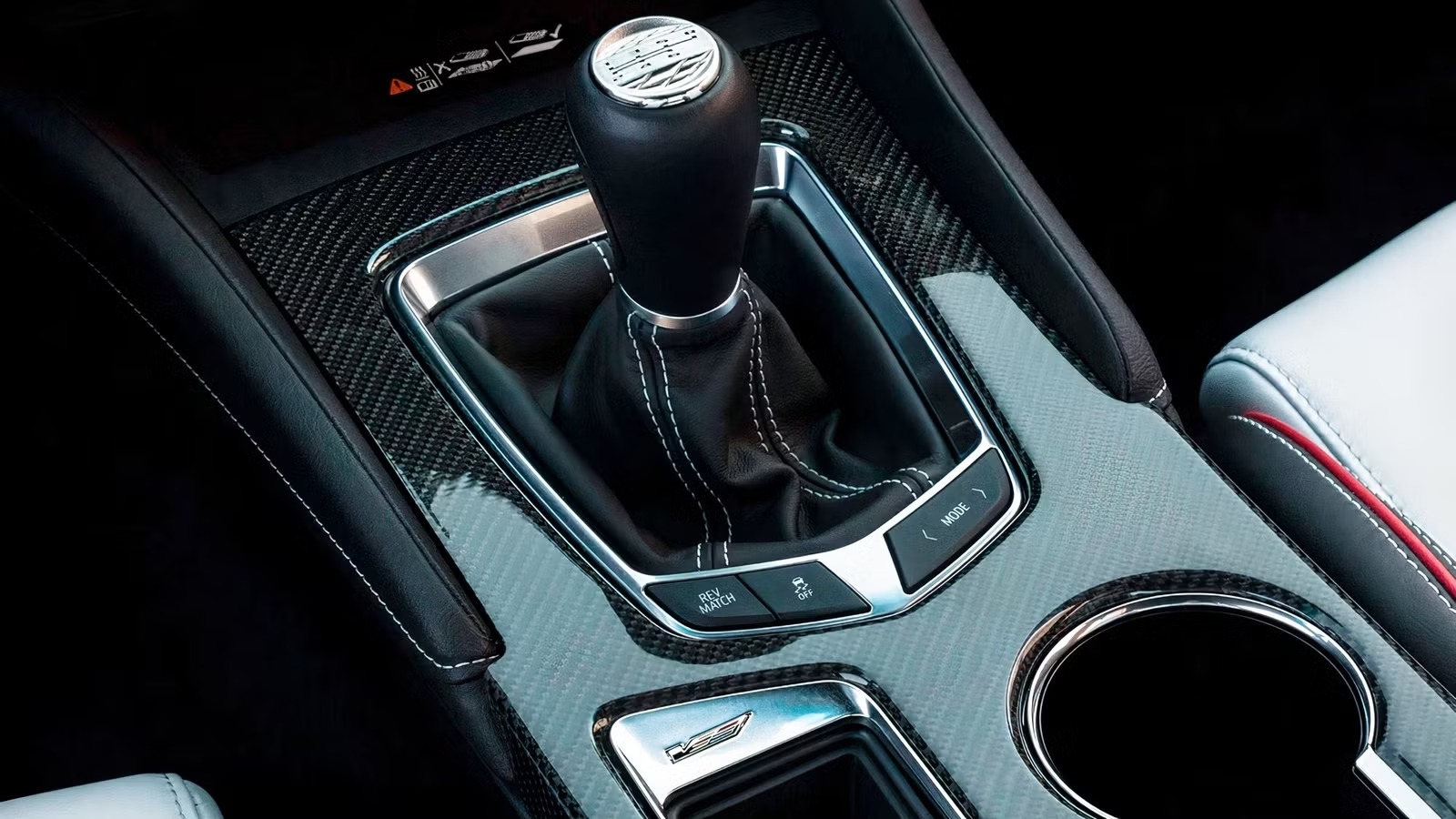
Here’s the part that will stop old-school drivers in their tracks. A six-speed manual transmission comes standard. Not offered as a token enthusiast option buried three trims deep, but standard equipment, sourced from Tremec and fitted with rev-matching that can be switched off entirely for drivers who want to heel-toe their own downshifts. In a market where most performance sedans have quietly dropped the third pedal, this car doubled down on it.
Power still goes exclusively to the rear wheels, no all-wheel-drive safety net, no torque-vectoring trickery to disguise a front-heavy chassis. It’s a formula that would have been unremarkable in 2004 and feels almost radical in 2026. Six cylinders, three pedals, and the rear tires doing all the work. Opt for the manual and 0-60 mph slows only slightly, to around 4.1 seconds, a small sacrifice for a much larger reward in engagement.
Center console in the CT4-V BlackwingCadillac
This isn’t nostalgia for its own sake, either. A manual gearbox paired with a limited-slip diff and a well-sorted rear-drive chassis gives a driver total control over weight transfer in a way no automatic, however quick its shifts, can fully replicate. On a back road or a track day, that control is the whole appeal. The car doesn’t do the work for you. It simply gets out of the way and lets you do it.
Cadillac Gave This Compact Sedan The Hardware To Challenge Germany’s Best
A front-facing shot of a Cadillac CT4-V Blackwing on the trackCadillac
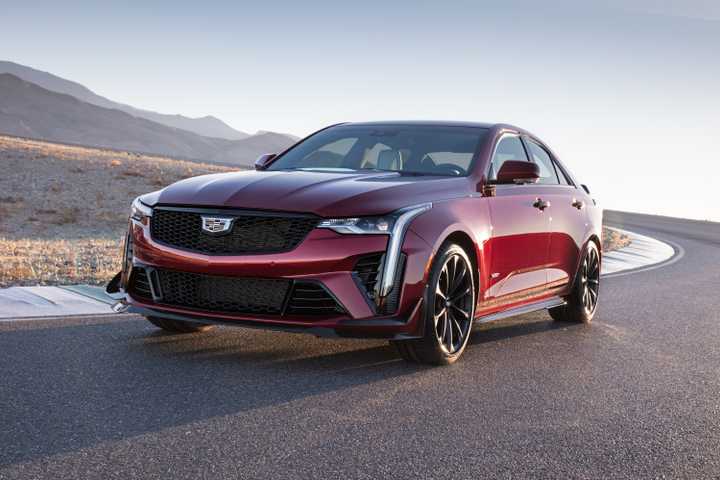
The car in question is the 2026 Cadillac CT4-V Blackwing, and Cadillac built it with one target squarely in its crosshairs: the BMW M3. Standard Brembo brakes clamp down hard at all four corners, GM’s Magnetic Ride Control 4.0 adaptive dampers read the road 1,000 times per second, and the whole package rides on staggered Michelin Pilot Sport 4S tires developed specifically for this car.
The CT4-V Blackwing is the spiritual successor to the ATS-V, itself a car built to needle BMW’s M division, and the lineage shows. Reviewers who have driven it back-to-back with the M3 Competition have consistently noted that the Cadillac matches or beats the BMW’s acceleration numbers while offering more tactile steering feel and a chassis that talks to the driver with fewer electronic filters in the way. That’s a bold claim against a car widely regarded as the benchmark of the segment, but the CT4-V Blackwing backs it up on a stopwatch and, more importantly, from behind the wheel.
Cadillac CT4-V Blackwing on the track rearCadillac
Underneath, the car rides on GM’s Alpha platform, a chassis architecture built from the start around rear-drive balance rather than adapted from a front-drive layout. That foundation is a big part of why the Blackwing feels so composed when pushed hard. It isn’t fighting its own underpinnings to deliver a sports sedan experience. The whole car was engineered around that mission from day one, right down to the launch control calibration and the specific rear differential mounting points designed to reduce driveline lash during hard corner exits.
It Blends Everyday Sedan Comfort With Track-Ready Performance
Interior view in the CT4-V BlackwingCadillac
None of that hardcore hardware comes at the expense of daily usability, which is the part that often surprises people expecting a stripped-out track special. The CT4-V Blackwing still seats four adults, still has a usable trunk, and still offers heated seats, a head-up display, and a properly finished cabin. Switch the drive mode out of Track and into Tour, and the adaptive dampers soften considerably, turning what feels razor-sharp on a back road into a genuinely comfortable commuter.
That dual personality is the product of the same Magnetic Ride Control system that sharpens the car on a circuit. Because the dampers can adjust their firmness nearly instantaneously, Cadillac’s engineers didn’t have to split the difference between comfort and control the way a fixed-rate suspension would force them to. The result is a car that can handle a grocery run on a Tuesday and a track day on Saturday without feeling like a compromise in either direction.
Rear seats in the CT4-V BlackwingCadillac
Inside, the CT4-V Blackwing doesn’t try to overwhelm the driver with screens and menus, either. The layout is straightforward, with a digital instrument cluster that prioritizes a large, clear tachometer, exactly what a driver wants to see when running through the gears. Cadillac even gave the manual’s shifter a small but telling detail: a 3D-printed medallion on top, a nod to the fact that this transmission was built by hand for drivers who care about that kind of thing. It’s a small touch, but it signals where the priorities sit.
The CT4-V Blackwing Proves Modern Performance Cars Don’t Have To Feel Complicated
2024 Cadillac CT4-V Blackwing driving through a tunnelCadillac
A Yellow 2024 Cadillac CT4-V Blackwing DrivingCadillac
Base pricing lands in the low-$60,000s, undercutting the BMW M3 while offering comparable performance and, according to most who have driven both back-to-back, a more communicative driving experience. That value proposition matters, but it isn’t really the headline. The headline is that Cadillac built a modern performance sedan that resists every trend currently reshaping the segment.
The CT4-V Blackwing goes the other way on every count. Six cylinders instead of a hybridized four. A standard manual instead of a token option. Rear-wheel drive instead of a safety-net all-wheel-drive system. Mechanical grip from a limited-slip differential instead of purely electronic torque management. Every decision on the spec sheet points toward the same conclusion: this is a car built for people who still want to drive, not just be transported quickly.
Interior view of 2023 Cadillac CT4-V Blackwing.Garret Donahue | TopSpeed
Whether that formula survives much longer is genuinely uncertain. Cadillac has already signaled a shift toward electrification across the rest of its lineup, and the Blackwing twins exist as something of an exception, a deliberate holdout built for a shrinking but vocal audience. For now, though, the CT4-V Blackwing stands as proof that a modern performance car doesn’t need to be complicated to be brilliant. It just needs a great engine, a manual gearbox, a chassis that trusts the driver, and the confidence to leave well enough alone. For old-school drivers who thought that formula had gone extinct, this compact sedan says otherwise.








No Comments