
How Much It Costs To Replace A Toyota Camry Hybrid Battery In 2026
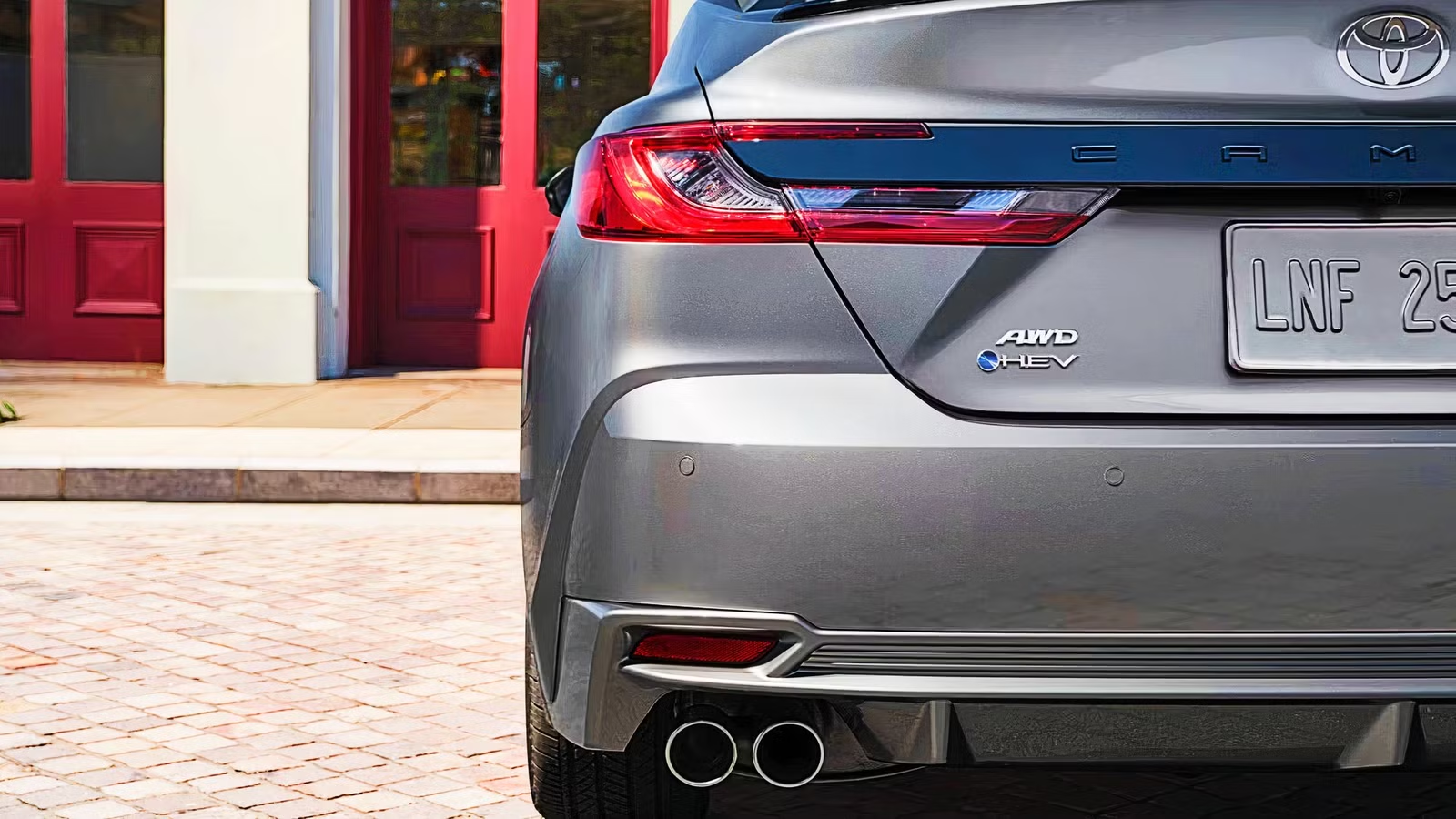
Hybrid vehicles have never been more relevant — or more scrutinized — than they are right now. As ownership numbers climb and early adopters push their cars past the 150,000-mile mark, a practical question keeps surfacing: what does long-term hybrid ownership actually cost, and what breaks first? The hybrid car battery is almost always the answer to that second part. HEVs are generally more reliable than conventional ICE vehicles because their engines share the workload with an electric motor courtesy of the integrated electric motor, reducing powertrain stress and improving longevity. The electrical system in a typical HEV runs off compact lithium-ion or nickel-metal hydride battery packs with much lower capacities compared to PHEVs or fully electric vehicles, which is why hybrids cannot operate on electricity alone.

Despite their improved reliability standards, HEVs are still subject to wear, with the battery pack being the most expensive component that you’ll find yourself replacing, typically after 200,000 miles. One meaningful advantage of modern hybrids is that replacement battery technology has become substantially more affordable compared to when these vehicles first arrived on the U.S. market — and that holds true even after accounting for inflation. Most brands that have focused on electrification in recent years have incorporated their electrification and battery technology down into their hybrids, resulting in better efficiency, reliability, and combined performance. If you own a hybrid and have surpassed the 200,000-mile threshold, these are some issues you may encounter.
Why Hybrid Batteries Don’t Stand The Test Of Time
A hybrid vehicle’s battery capacity gradually declines due to a combination of chemical degradation and usage patterns. This degradation depends entirely on the vehicle and how many miles it has covered, but the symptoms remain consistent across the segment. Over time, the lithium-ion or nickel-metal hydride cells within the battery pack experience wear from repeated charging and discharging cycles, causing the electrodes to deteriorate and the electrolyte to break down. Factors like high temperatures, aggressive acceleration, and frequent deep discharges accelerate this process.

An HEV’s battery management system helps regulate voltage and temperature, but as the cells age, it becomes less effective at balancing the charge between individual cells, leading to uneven wear. After 200,000 miles, a hybrid battery typically loses between 20 and 30 percent of its original capacity, depending on driving habits and environmental conditions.
Toyota’s Industry-Leading Hybrid Strategy

When it comes to gasoline-hybrid technology, it’s very difficult not to think of Toyota first. While Honda technically introduced the technology with the first-generation Insight, Toyota led the way in its development and long-term refinement. The Japanese brand has always maintained a strong commitment to hybrids, led by the Prius, but popularized by models like the Corolla, Camry, and RAV4.
Toyota’s philosophy has always been to incorporate multiple fueling methods, including hydrogen, diesel, and electricity. Hybrid models have increasingly become the driving force of its modern lineup, with the 2026 Camry and RAV4 now available exclusively with new-generation HEV drivetrains. Toyota backs its technology with a comprehensive warranty covering all hybrid components for eight years and the battery for 10 years. Consumers have recognized the brand’s dedication to efficient drivetrain technology and responded favorably — over the last several quarters, Toyota has reported strong interest in its hybrid models as more car owners look to reduce their monthly fuel costs.
How Much A New Camry Hybrid Battery Costs

Toyota offers a comprehensive online parts catalog for all of its models, but it does not list the 2026 Camry’s replacement battery pack, so there’s no way to confirm the manufacturer’s direct cost. Based on owner testimonials and information provided by dealers, you can expect to pay somewhere around $3,000 to have the HEV battery pack replaced when the time comes.
Bear in mind that Toyota’s HEV systems are built to last, with some owners reporting their packs are still going strong after well over 15 years or 150,000 miles of driving. Toyota covers the Camry’s entire HEV battery pack for any manufacturer-related defects over a 120-month or 150,000-mile period, while all related systems are covered for 96 months or 100,000 miles — a clear reflection of the brand’s confidence in its tried-and-tested gasoline-electric drivetrain.
The Choice Between OEM And A Refurbished Pack

While we mentioned an average price of around $3,000 for a replacement, that figure can vary widely depending on whether you choose a new OEM pack or a refurbished one. OEM packs can cost significantly more, while refurbished packs can swing in the opposite direction — though there are a few things buyers should consider before going that route. Chief among them is the warranty.
Some re-manufacturers, like Hybrid Battery 911 and Green Bean Hybrid, offer warranties on their refurbished packs (often ranging from 12 months to three years), but not all suppliers do. An OEM pack will come with a warranty, though if your Camry has accumulated a significant number of miles and the mechanicals have been well worked over the years, spending more on an OEM pack may not be the most cost-effective decision given the service life remaining in the vehicle.
On the other hand, a cheap replacement that hasn’t been properly balanced and tested may lead to an even larger bill when it eventually fails or develops complications. The key takeaway when shopping for a replacement battery is to weigh the usable life left in the vehicle, consider the warranty offered on the replacement pack, and source the part from a reputable supplier like those mentioned above. Doing so could save you money at the time of replacement, as well as further down the road.
The Camry’s Low Ownership Costs

According to Edmunds‘ True Cost To Own calculator, you can expect a new base front-wheel-drive 2026 Toyota Camry LE to cost $37,987 over the course of five years. This includes $10,239 worth of depreciation, $7,631 on insurance, $3,196 on maintenance, and just $773 on repairs. Taxes and fees are also notably low, with the calculator projecting approximately $3,617. If you opt to finance the base 2026 Camry, this adds $5,336 to your ownership costs, while fuel is estimated at $7,195 based on average U.S. driving distances.
According to CarEdge, you can expect to spend $36,433 on your Camry over the same period, which includes $14,274 on depreciation, $4,530 on fuel, and $1,512 on maintenance.
Toyota’s Incredible Aftersales Reputation

iSeeCars gives the Camry range an 8.2/10 overall score, including 8.1/10 for reliability, 8.6/10 for retained value, and 8.0/10 for safety. The publication indicates that the model will run for 13.1 years or 171,785 miles without encountering any noteworthy mechanical issues, along with a 31.7 percent probability of reaching 200,000 miles.
In terms of depreciation, iSeeCars indicates that the model will lose $10,829 or 37.7 percent of its initial sale value after five years or 60,000 miles, which is slightly better than the average competitor in the midsize hybrid sedan segment.
J.D. Power gives the 2026 Toyota Camry an 82/100 consumer-verified overall score, including 80/100 for quality and reliability, 82/100 for the driving experience, 92/100 for resale, and 76/100 for the dealership experience.
Balancing Performance And Reliability

All 2026 Toyota Camry models feature the trusty naturally aspirated 2.5-liter four-cylinder Atkinson-cycle engine, which produces 184 horsepower and 163 pound-feet of torque. The front-wheel-drive model pairs this engine with two electric motors generating a combined 134 horsepower and 153 pound-feet.
Toyota doesn’t publish a combined torque figure, but confirms that peak system output is limited to 225 horsepower. All-wheel-drive models produce 232 horsepower. Toyota doesn’t quote official performance figures for the Camry range, but MotorTrend‘s testing reveals that the front-wheel-drive configuration covers the 0–60 mph sprint in 7.1 seconds. Top speed is limited to 115 mph.
Exceptional Fuel Consumption Returns

According to the EPA’s official fuel consumption estimates for the 2026 Toyota Camry, the front-wheel-drive LE is the standout choice for efficiency, rated at 53/50/51 MPG on the city/highway/combined cycle. With a 13-gallon tank and compact battery pack, that translates to roughly 663 miles between fill-ups. Over five years, this is projected to save $3,750 in fuel costs, with an annual refueling cost of $950, approximately $1.54 per 25 miles driven, and around $41 to fill the tank.
Upgrading to the all-wheel-drive configuration reduces efficiency to 51/49/50 MPG and range to 650 miles per tank — still a strong set of numbers. Fuel savings and annual costs remain largely comparable.

Opting for the SE, XLE, or XSE trims brings consumption to 48/47/47 MPG and an estimated 611-mile range. This trim saves $3,500 in fuel costs over five years, costs approximately $1,000 to refuel annually, and works out to $1.68 per 25 miles. The all-wheel-drive SE and XSE models return 46/46/46 MPG and cover 598 miles on a tank, with savings of $3,250 over five years, roughly $1,050 in annual fuel spend, and $1.71 per 25 miles.
The top-of-the-range XSE with the optional all-wheel-drive configuration returns the least efficient numbers in the lineup, though they remain impressive at 44/43/44 MPG with a 572-mile range between fill-ups. Fuel savings and expenses don’t shift dramatically compared to lower-specification models.
Toyota’s Market-Leading Pricing

Toyota kicks the range off at $29,100 for the base LE front-wheel-drive model, making it one of the most competitively priced hybrid vehicles in the segment. A strong entry-level price point is always a compelling strategy, and that is clearly reflected in the Camry’s sales performance.
The most expensive Camry option is the XSE, which starts at $35,500. Toyota offers the all-wheel-drive system across all trims for an additional $1,525. All prices exclude the brand’s $1,195 destination fee. Optional extras are available across all trims but are limited in number, as Toyota favors a straightforward five-trim pricing structure.
Low Ownership Costs, High Reliability, And A Long Warranty Strengthen Used Options


While it’s unlikely anyone driving a 2026 Camry will need to deal with replacing the battery — or much maintenance at all — those shopping for a used Camry Hybrid will find this information particularly useful. The low costs across the board make a used example less of a gamble and more of a sound choice compared to many used cars, hybrid or otherwise. That’s primarily due to the long, transferable battery warranty, combined with the model’s strong reliability and longevity. Models only a few years old still have considerable service life remaining, along with the bulk of their battery warranty intact.
Take the 2023 Camry Hybrid. It arrived a few years before the ninth generation’s hybrid-only shift and represents one of the final model years of the eighth generation. It earns high reliability marks from J.D. Power, and its average used price ranges from $23,400 to $28,100, according to KBB. Notably, the 2023 model also edges out the 2026 on fuel economy, rated at 51 city, 53 highway, and 52 combined MPG. According to Fueleconomy.gov, the 2023 Camry Hybrid costs less to fuel annually, saves more money over five years, and offers greater range than the 2026 Camry. For buyers seeking a used Camry with plenty left to give, the 2023 model is a strong candidate for years of trouble-free service.
Sources: The EPA, iSeeCars, Edmunds, CarEdge, and J.D. Power.

Related posts






Latest Post


No Comments