
The V-Twin Riders Never Seem To Outgrow
V-twins have been an integral part of motorcycling, having evolved just as much as the motorcycles they’ve adorned over a century. They appear in everything from approachable cruisers to superbikes, adventure motorcycles, and some genuinely unhinged naked machines. Their versatility has also seen them sized from tiny displacements to ones rivaling bigger car engines. The performance changes dramatically along the spectrum, of course, but the appeal is remarkably consistent.

In a hyper-naked motorcycle market increasingly dominated by inline-fours and V4s making spectacular power and chasing ever-higher outputs, they haven’t eliminated the appeal of two large cylinders. A properly developed V-twin can deliver serious top-end performance while retaining the low and midrange grunt that makes them entertaining on ordinary roads. So if a rider chooses to have one over the others, there is now a KTM V-twin sitting near the absolute ceiling of modern naked-bike performance.
Big V-Twins Have Been Growing Up With Their Riders
Mostly synonymous with big cruisers this side of the Atlantic, large V-twins once had a much bigger presence among serious performance motorcycles. Buell had spearheaded the performance segment for a while, even Indian primed its V-twin for the FTR, while Arch continues to develop it in racing. Across the pond, Ducati has built generations of superbikes around the layout; Aprilia used one in the original RSV Mille and Tuono, while various Japanese manufacturers took their own swings at the formula.


Today, the upper end of the performance market looks rather different. Ducati’s Streetfighter flagship now uses a V4. So does Aprilia’s Tuono V4, while others, like BMW, resorted to seeking performance from four cylinders inline. And the developments in modern electronics and chassis have made 200-horsepower naked bikes perfectly feasible, making outright engine output an increasingly difficult fight for a twin.

Yet outright output tells only part of the story. Two big pistons can provide the thick torque delivery riders associate with a large V-twin without requiring the engine to constantly live near its redline. The trick is maintaining that response while generating enough airflow at higher revs to compete with more cylinder-rich machinery. And that’s exactly where the latest generation of one long-running Austrian naked hooligan comes in.
The 2026 KTM 1390 Super Duke R EVO Dials The V-Twin To Eleven

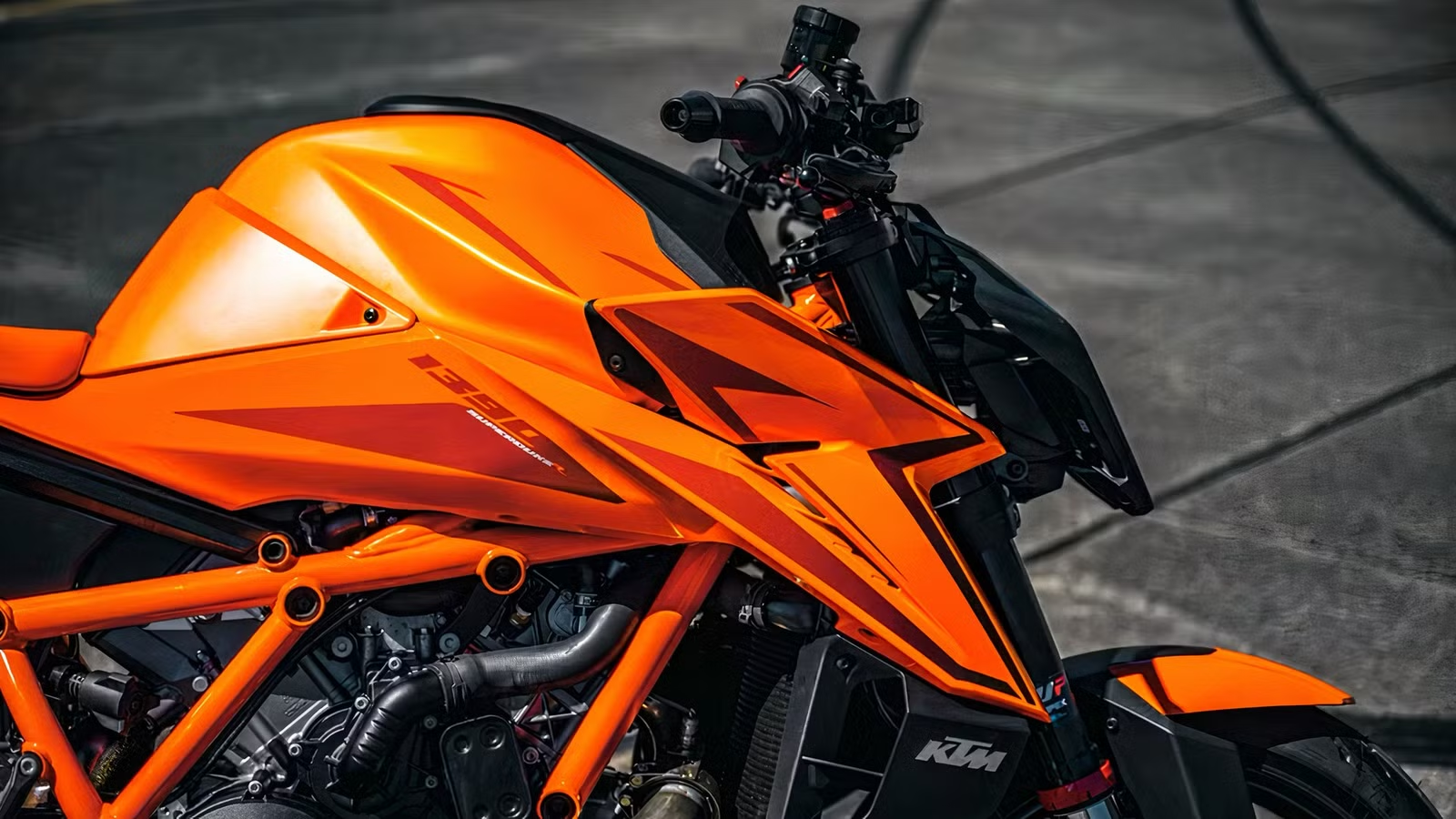
The KTM 1390 Super Duke R EVO is what happens when a manufacturer truly believes in its engineering potential. The Super Duke name originally came about in 2005 with the 990 Super Duke and its LC8 V-twin. Nearly a decade later, the 1,301cc 1290 Super Duke R followed in 2014, and KTM has continued refining that architecture rather than choosing to abandon it for a four-cylinder layout. For 2026, $22,149 buys the top-end version of the Super Duke R, distinguished primarily by its third-generation WP semi-active suspension. The base R trim isn’t available in the US.

Merely calling it a big-engined hyper-naked bike undersells the hardware it boasts. KTM lists a 441-pound weight without fuel, a 32.8-inch seat, a 4.62-gallon fuel tank, Brembo Stylema front brakes, and Michelin Power GP tires. Its chromium-molybdenum steel trellis frame also uses the engine as a stressed structural element. So, this very large V-twin is surrounded by equipment intended to let riders actually exploit it.
The LC8 V-Twin Now Makes 187 Horsepower

Displacement has grown to 1,350cc, courtesy of a 110mm bore and a 71mm stroke. KTM claims 187 horsepower at 10,000 rpm and 107 pound-feet of torque at 8,000 rpm, numbers that put the latest LC8 firmly into the modern hyper-naked territory. But simply increasing the displacement wasn’t enough. The 1390 Super Duke introduced Camshift technology, which gives the intake camshafts two different profiles. At lower engine speeds, the motor uses reduced valve lift and duration to improve combustion and preserve torque and drivability. At higher revs, the cams shift to a more aggressive profile that increases valve opening and airflow.

That solves an old high-performance V-twin compromise rather neatly. Tuning aggressively for peak horsepower can hurt lower-speed behavior, while conservative cam timing can strangle the engine near the top of the rev range. Camshift allows the LC8 to change its priorities as engine speed rises. The breathing hardware was upgraded accordingly as well, with 60 mm throttle bodies along with a redesigned ram-air system and an airbox of roughly 10 liters. The result is an engine capable of producing superbike-level horsepower without sacrificing the broad delivery that gives a big V-twin much of its appeal.
The Chassis Manages The Wild Engine’s Stats

A 107-pound-foot naked bike has more pressing chassis responsibilities than simply looking aggressive as a hyper-naked should. Up front are twin 320mm discs with Brembo Stylema four-piston radial calipers and an adjustable Brembo MCS master cylinder. A 240mm rear disc works with a twin-piston Brembo caliper. KTM also gives the 1390 a comprehensive electronics package. Street, Sport, and Rain riding modes are standard, with Rain reducing output to 130 hp. Performance and Track modes are optional, adding deeper adjustment and track-specific functions such as launch control.

Adjustable wheelie control can regulate how much the front wheel rises for true KTM hooliganism rather than the electronics being used to sanitize a wild motorcycle. In practice, these deep electronic systems are what allow a motorcycle with this much performance to remain usable beyond a racetrack. Having a 190 horsepower beast is one thing, but metering it onto imperfect pavement while leaned over is the considerably more useful talent that the 1390 Super Duke shares with an experienced rider.
The EVO’s Semi-Active Suspension Makes The Power More Usable

The defining difference between the R EVO and the standard 1390 Super Duke R is its third-generation WP Apex Semi-Active suspension. The 48 mm fork uses an open-cartridge design with electronically controlled damping, while the rear WP Apex shock also adjusts itself using electronic valves. Sensors allow the system to react to road conditions, suspension movement, and rider inputs instead of leaving the rider with one fixed compromise between comfort and chassis control.

The rear shock goes further by measuring suspension travel and acceleration, while electronic preload adjustment can account for changes in load. That gives the EVO an unusually broad operating window with a suspension setting suited to broken street pavement as well as the ability to be used when hard braking and cornering load demands on a track session. KTM’s optional Suspension Pro package expands the system with Track and Pro damping settings, automatic preload options, switchable anti-dive, and Factory Start. The latter reduces rear preload when stationary before restoring to the normal setting after launch.
The Ducati Streetfighter V4 S Is Faster But Costs Considerably More

The KTM finds its natural rival in the Ducati Streetfighter V4 S, another premium European hyper-naked equipped with electronically controlled suspension. Ducati currently asks $30,995 for the V4 S, putting a substantial price gap between it and the $22,149 1390 Super Duke R EVO. The Ducati counters with 205 horsepower from its 1,103cc Desmosedici Stradale V4 and a lighter 417-pound wet weight without fuel. Its Öhlins Smart EC 3.0 package includes an electronically controlled NIX fork, TTX shock, and steering damper. If outright power, reduced mass, and superbike-derived hardware take priority, the Streetfighter has the obvious ammo.
But torque changes the conversation as the Streetfighter V4 S’ 88.3 pound-feet at 11,500 rpm falls short of the Super Duke’s 107 pound-feet developed at a lower 8,000 rpm. And unlike the adverts showing high-strung performance antics, its torque makes the KTM much more usable on the road and day-to-day riding. That, in essence, is what makes riders like it so much, finding it incredibly hard to grow out of its V-twin experience.
Source: KTM

Related posts
Latest Post


No Comments