
Before Muscle Wagons Had a Name, Plymouth Built a V8 Family Hauler
When we think of V8 power and load-lugging ability, we probably think of modern, fast, expensive German wagons. But way back in the ’50s, an American company quietly launched a huge grocery getter that, if you scanned the options list, could be bought with more power than a Corvette. This wagon has somehow been lost in time, but today it is a practical classic with a great backstory to tell…you just need to find one.
Power Wagons Are A Recent Phenomenon…Right?

Ask most people to name a powerful wagon, and they will probably say the frankly bonkers Audi RS2 or Volvo T-5R. These cars came from a time before SUVs ruled the earth (it was called the ’90s) and had a lot in common. Firstly, they were from upmarket brands that wanted to inject a bit of sizzle into the marque. Secondly, they were both developed with help from Porsche, and thirdly, they were instrumental in making people realize you could have a family/ dog/ driving fun, all rolled into the same vehicle. But there will also be a lot of people who remember the muscle wagons that preceded this pair (and the RS6s, RS4s, E552, E63s, M3 Tourings, etc.), by a good two decades.
Muscle Wagons Always Seemed Like A Fun Afterthought

During the muscle car golden age of the mid to late ’60s, American manufacturers were also doing a good trade in huge land-yacht wagons. Whereas muscle cars tapped into the rock n’ roll rebel spirit of the time, the nine- and ten-seat wagons catered to the Baby Boom generation, when post war families got larger. Throw in a healthy economy and new trends in traveling and exploring, and you have cars that could whisk the family away on a camping trip on Friday and have you safely back at the desk job on Monday.
But sometimes these two worlds would collide, with manufacturers often offering the most potent muscle car engines they had on hand to a few brave souls who saw the need to have them under the hood of their grocery getter. The result was crazy creations like the Olds Vista Cruiser 455, a giant weekend warrior with 365 hp and around 500 lb-ft of torque. But what if we told you the muscular wagon goes back even further, with one model that predates even the muscle car era itself? And the better news is they are affordable, unique, and you can take the whole family along to car meets. I’m sure they will be thrilled.

The 301 Plymouth Suburban Was The Original Muscle Wagon
The 1957 Plymouth Suburban featured a forward-thinking restyling that was deemed so futuristic it was accompanied by the slogan, “Suddenly it’s 1960.” The wagons were available in two- or four-door bodystyles, with space for up to nine people, and were less blingy than the previous models, with the emphasis on being lower, longer, and wider, and more finned. Plymouth even regained third place in industry sales with the dramatic Exner ‘Flite-Sweep’ styling, the second-generation ‘Forward Look’.
But most people probably wouldn’t need their Suburban for driving from, you guessed it, the suburbs, to work in the city, so the base 230 cubic-inch flathead six (or perhaps the 276 ci V8 with 197 hp) would suffice. But Plymouth wanted to add just a little spice to proceedings, so offered a 301 ci V8 for the Savoy, Plaza, and Belvedere Suburban wagons, in both two- and four-door versions.
A Fury Spec Engine Was On Grandpa’s Option List
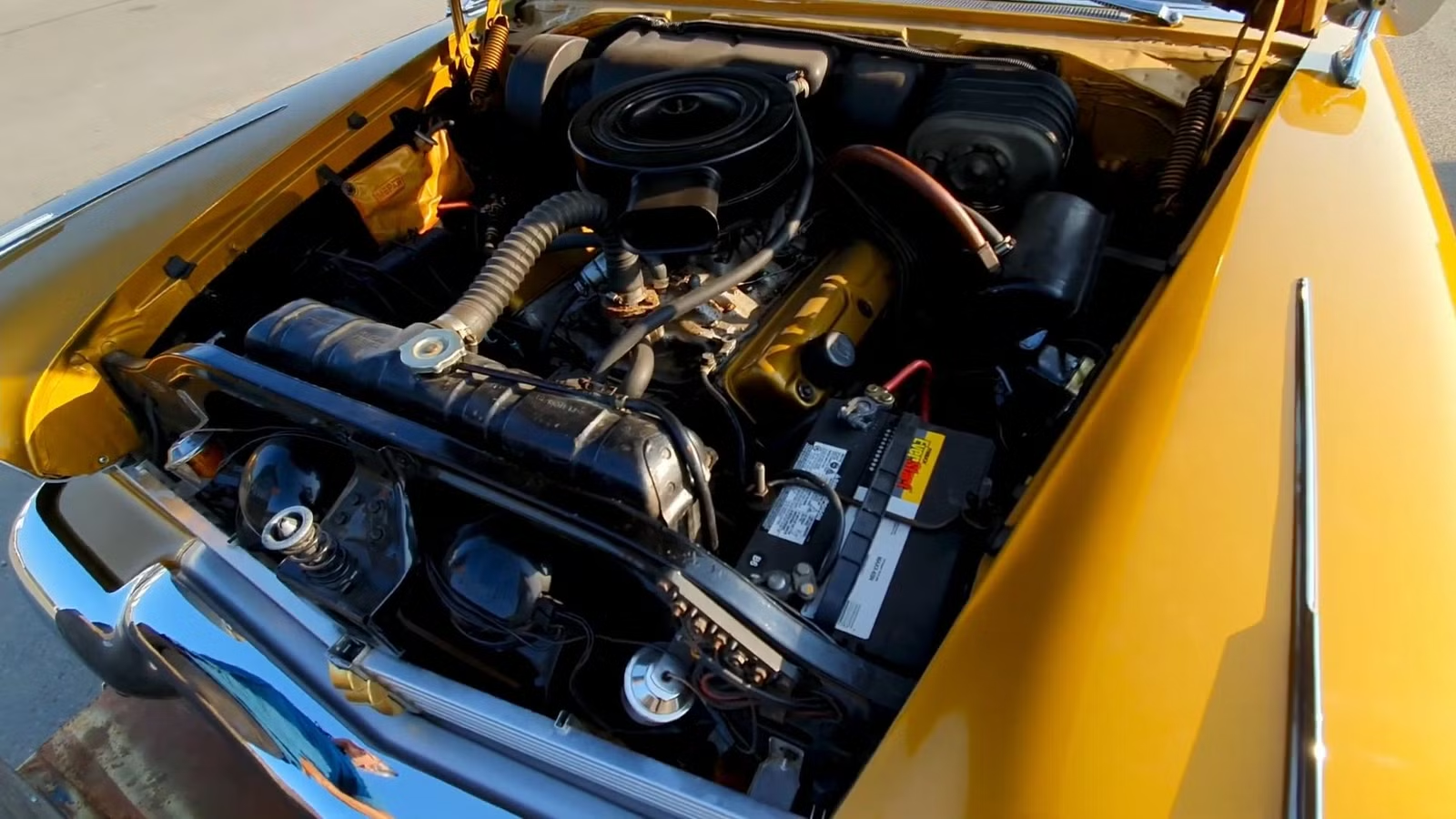
The 4.9-liter (Fury 301) overhead-valve V8 has a 3.91-inch bore and 3.13-inch stroke, with 215 hp at 4400 rpm and 285 lb-ft of torque at 2800 rpm — pretty healthy for the late ’50s. There was also the option of a Power Pack made up of dual exhausts and a single four-barrel carburetor, taking output up to 235 hp at 4,400 rpm and 305 lb-ft of torque at 2,800 rpm.
To put this into perspective, the small-block Chevy V8 in a Corvette made 220 hp, with a choice of 245 hp or 290 hp variants. So, in reality, it would be similar to putting a 6.2-liter naturally aspirated LT2 V8 from a Corvette Stingray into a wagon — that’s how potent the 301 Suburban was. The 301 engine itself was something of an oddball, created by combining the new 318 block with leftover 277 crankshafts, making it a rare slice of Chrysler engine history. It was replaced by the 318 cubic-inch polyspherical V8 for 1958.
The 301 Suburban Wasn’t Just About The Engine
The 1957 Suburban benefited from Chrysler’s highly praised new “Torsion-Aire” torsion bar front suspension, which was launched that year. This setup was said to have greatly improved the handling over earlier cars. With the 301 unit linked to the new push-button PowerFlite or TorqueFlite automatics, these Plymouth wagons were the latest in fast, capable load luggers. Not only did this powerful (for the time) wagon have true performance chops, there wasn’t much to differentiate its “Forward Look” styling from lesser Suburbans.
The Suburban Was A Sleeper Before They Existed
So, not only was it a precursor to the muscle wagon era, but it was also something of a sleeper. Few people pulling up next to one of these large Suburbans, with their 122-inch wheelbase, would suspect that there were Corvette levels of power underneath. What made the 301 even more of a sleeper was quite how ubiquitous these cars were — you would see them everywhere.
Plymouth was said to account for over half of Chrysler Corporation’s 1957 sales, with 762,771 Plymouths sold during the model year, including 105,293 Suburban station wagon models of various trim levels. The idea that you could buy a 301 and that few people would know you had a decent bit of power under your right foot must have appealed to the same people who would buy an Audi RS6 today.
The Plymouth 301 Suburban Is The Perfect Leftfield Muscle Wagon Choice

If you want something unique, practical, and interesting to take to a car show, the Suburban with a 301 under the hood seems like a good choice. Even better is that these cars are fairly affordable too. A 1957 Plymouth Savoy Custom Suburban with the 215 hp 301 is the cheapest entry point into this market, says Hagerty Valuation Tools, costing just $16,500 in good condition. A 1957 Plaza DeLuxe Suburban with the same engine will cost $17,200, while a Belvedere Sport Suburban will set you back $22,300.
Interestingly, the 235-hp 301 won’t cost very much more at all. A Plaza DeLuxe Suburban with a 235-hp 301 costs $18,100 — so less than a grand more — and the Belvedere Sport Suburban comes in at $23,600. Few cars can claim to have had a hand in both the muscle car and sleeper wagon genres, and probably work well as a daily classic too. The problem is that these cars seem to be very hard to find these days — probably with many having been driven into the ground and unloved. But if you can find one, it’s a wonderful slice of ’50s pre-muscle car muscle.
Sources: Hagerty.com

Related posts




Latest Post



No Comments