
Why Japanese Bikes Still Dominate Everyday Riding
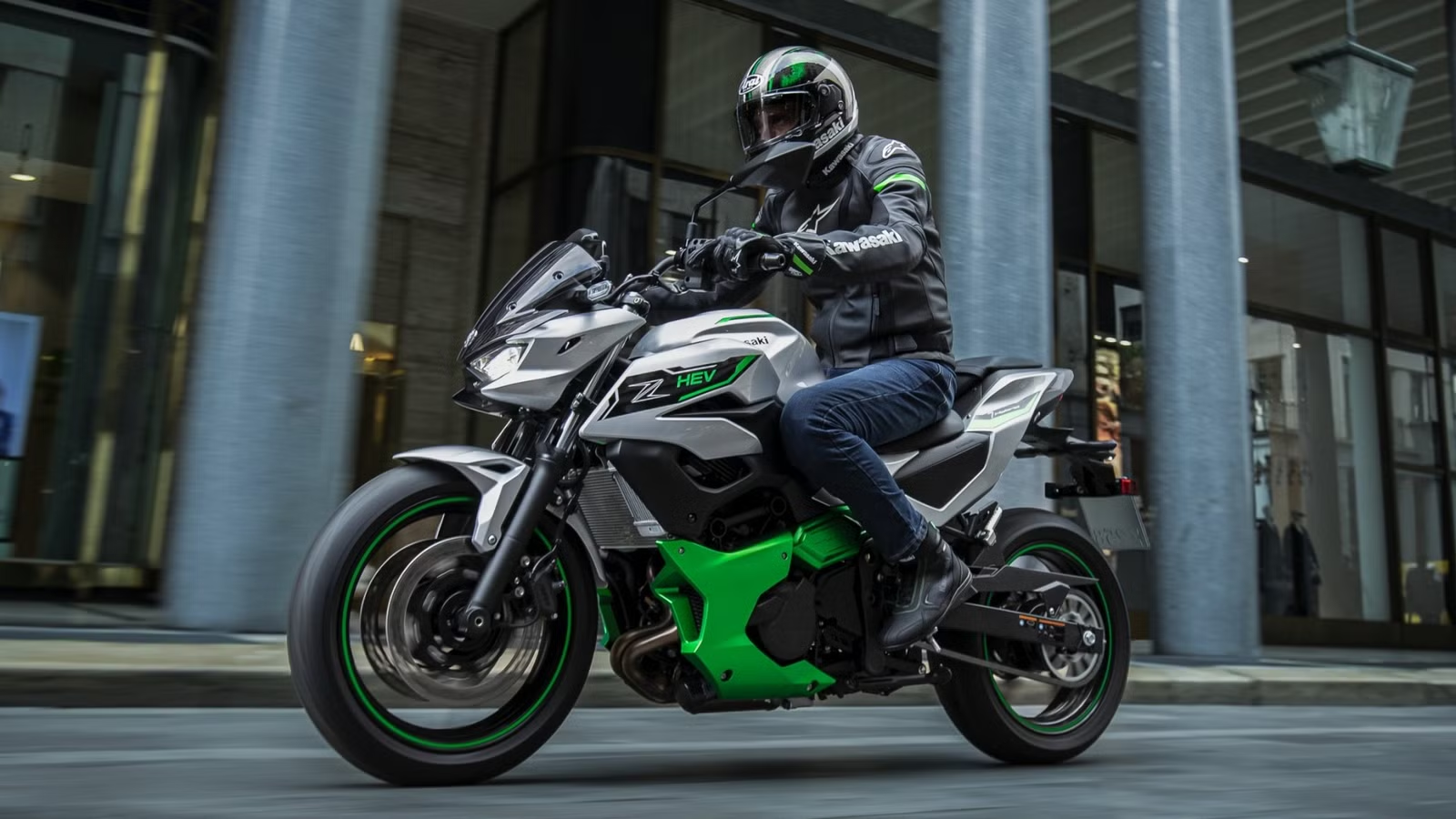
Click on any article that talks about the most reliable motorcycles, whether in the past or present and across segments. It’s not hard to guess that the top bike on that list is most likely of Japanese origin. That’s the reputation Japanese manufacturers have built over the years, and a reason why Japanese motorcycles still dominate everyday riding.

However, simply crediting reliability is taking a shortcut. There’s more to Japanese motorcycles than you’d think, which helps them become excellent everyday motorcycles. From manufacturing processes to principles that lead the Japanese Big Four: Kawasaki, Honda, Yamaha, and Suzuki, here is the reason why Japanese motorcycles still dominate everyday riding.
Why Most Riders Would Choose A Honda Over A Ducati

Imagine this: you can have only one bike in your garage, and your options are limited to a Ducati Streetfighter V4 and a Honda CB1000 Hornet SP. Unless you’re a teenager drooling over posters of Ducatis on your bedroom wall, chances are you’ll pick the Honda over the exotic Ducati. That’s down to one reason: the Honda will be the easier bike to live with. It will run cooler, demand cheaper maintenance, and start up every morning.

That’s the distinction between Japanese motorcycles versus their rivals from other parts of the world. Japanese motorcycles have earned a reputation for reliability, easy ownership, and real-world performance. And that’s not accidental. Japanese manufacturers care more about how the bikes perform in the real world than chasing spec sheet figures or lap times on the circuit. That’s why even serious liter-class sport bikes, like the Suzuki GSX-R1000 and Honda Fireblade, are known as well-rounded machines.
Four Forces That Gave Japanese Manufacturers An Unfair Advantage

Now, we won’t go into the history of Japanese manufacturers, though that is an equally fascinating subject. That’s for another day. What you need to know to understand why Japanese bikes dominate everyday riding is this: the Japanese Big Four were the result of local necessities, macroeconomics, geopolitics, and culture. All of these combined to give the Big Four an advantage that’s not enjoyed by any other manufacturer out there. And this advantage has allowed them to produce bikes that work better than their rivals in the real world. Let’s get into it.
The Secret Behind Japanese Bikes’ Survival Is Hidden In Plain Sight


One of the things that matters for a manufacturer is production momentum. Lose it, and it can quickly lose the race against its rivals. Momentum is maintaining a continuous production and development cycle, which lets the manufacturer keep building bikes year after year. It also lets the company refine existing models, improve its manufacturing processes, and respond to competitors’ actions while adapting to changing market conditions.
Once a manufacturer loses this momentum, getting it back becomes incredibly difficult. While it is trying to get the factories running again, rebuild the supply chain, and develop new bikes, its rivals would have jumped a generation or two with their products. That’s why simply being capable of building incredible motorcycles isn’t enough to make the bikes good for the real world. Or else, we’d all be riding Moto Guzzis and MV Agustas.
European Manufacturers, Especially The Smaller Ones, Are The Most Vulnerable

We’ve seen several examples of this, including with brands like Norton and BSA. Both showed that a manufacturer can still produce a genuinely good motorcycle after years of disruption, but that doesn’t automatically guarantee that the bike will actually work in the real world. Things like reliability, ease of ownership, parts availability, and service network become the real hurdles to turning these amazing machines into good everyday motorcycles.
The same challenge is also faced by major European manufacturers that have repeatedly changed ownership or come close to bankruptcy. We’re looking at you, KTM, Ducati, and Aprilia. Here, the problem isn’t lack of engineering; Euro manufacturers nail the engineering and development aspects. The problem is that instability makes it harder for such manufacturers to maintain production, development, and support that make for easy ownership. KTM cheesecam engines, anyone?
Japanese Big Four Are Small Parts Of Larger Conglomerates

That’s where the Big Four differ. These aren’t small, independent companies that have to worry about sustained production momentum. They belong to larger conglomerates with heavily diversified operations, which gives them a level of financial resilience and technology cross-pollination that an independent or small manufacturer can’t replicate. Kawasaki is the best example here. It’s part of the Kawasaki Heavy Industries (KHI) Group, which has its toes in industrial operations, heavy machinery, railways, ships, aerospace, defense, and robotics.
And the H2 R is the perfect example of what happens when a group pulls its full weight on a motorcycle. The bike was jointly developed by Kawasaki Motorcycles and KHI Group, with its Aerospace Division helping produce the wild aero for the bike, while Gas Turbine and Machinery Company helped develop the centrifugal supercharger. That’s why the Kawasaki H2 R stands alone in the world of superbikes, and why it is much harder for other manufacturers to make any real rivals to the H2 hyperbike, H2 SX sports tourer, and the Z H2 hypernaked.
Performance That’s Actually Useful On The Road

The whole bit about the uninterrupted momentum makes a massive difference in how the Big Four design their bikes. To start with, they take a pragmatic approach to motorcycling. Unlike European and American manufacturers, Japanese manufacturers have always focused on producing motorcycles that actually work in the real world. That’s not to say performance isn’t still a priority; some of the fastest and highest performing bikes are Japanese. The only difference is that they can actually be used every day.
Put simply, Japanese motorcycles are good at being just motorcycles. A bike can be fast, exotic, and technologically impressive and still be hard to live with. Instead, an easy-to-live-with bike offers zero drama. It works in traffic, is easy to ride, doesn’t overheat your leg in traffic, returns reasonable fuel economy, and remains comfortable after hours in the saddle. Even the high-performance models should offer linear, predictable throttle response and sensible ergonomics that don’t require a bone-and-joint sacrifice on every ride.
Why Breadth Of Lineup Is A Competitive Weapon, Not Just A Statistic
That’s exactly where Japanese motorcycles excel. Take any motorcycle made by the Big Four, and chances are, it will be more versatile and easier to live with than a comparable European motorcycle. The Africa Twin versus the Multistrada V4, the YZF-R1 vs the RSV4 Factory, the CRF450RL vs the Desmo450 EDS… you get the gist. Even Japanese cruisers, while slightly imitative of American big twins, are easier to live with on a day-to-day basis compared to big, burly Harley-Davidsons.
And that advantage only extends further when you consider just how many bikes the Big Four offer. For example, Honda alone offers 40 street-legal motorcycles in the US, whereas combined, the Big Four sell well over 100 motorcycles across every major and minor segment. From small dual-sports to liter-class superbikes, and from middleweight adventure bikes to hyperbikes, there’s a Japanese motorcycle for every kind of rider out there. And usually, they will offer performance that matters in the real world, even if it’s something as unconventional as a supercharged naked bike with nearly 200 horsepower on tap.
Backed By Proven Engineering And Exceptional Reliability

Check out any of TopSpeed’s stories about a reliable motorcycle, and it will usually feature a Japanese motorcycle. If it doesn’t, the bike in question will be benchmarked against a Japanese rival. That’s the next bit of brilliance in Japanese bikes that makes them such good everyday motorcycles. Again, production momentum helps significantly here, allowing the Big Four to refine their models over time and bake reliability into the bike’s very blueprint. Reliability is also closely tied to the culture deeply embedded in Japanese manufacturing: Kaizen, Monozukuri, and Genchi Genbutsu.
Kaizen, Monozukuri, Genchi Genbutsu — The Three Japanese Principles Behind Every Reliable Bike

Without going into much detail, Kaizen means continuous development and refinement over time rather than completely reinventing a product every year. Meanwhile, Monozukuri is a mindset focused on craftsmanship that goes beyond simple manufacturing; it’s a drive for perfection. And Genchi Genbutsu is the principle that translates to “go and see for yourself.” Here, instead of relying on reports passed along by the company’s paper pushers, people solving an issue are encouraged to go directly to the source and understand what’s happening.
The results are evident in reliability reports. European motorcycles, as reliable as they are today, still fall behind their Japanese rivals. To be clear, Japanese bikes aren’t immune to failures; there have been recalls, failed products, and catastrophic failures, but the broader track record is hard to ignore. It’s not unusual to encounter Honda, Yamaha, Suzuki, or Kawasaki bikes with six-digit mileage still used as daily drivers.
The Price Of Reliability: Japanese Bikes Often Run A Generation Behind On New Tech

Such sheer focus on overengineering products for reliability comes at the cost of being cutting-edge. Japanese manufacturers are often slower than their European rivals to introduce new technologies. While European companies are often willing to push new tech and platforms to market earlier, Japanese companies are more conservative, allowing the tech to mature before implementing it on their motorcycles. That’s why Japanese motorcycles often appear a generation behind compared to their European rivals. Something about the wise learning from the mistakes of others.
Low Cost Of Ownership And Unparalleled Value

That brings us to the final nail in the coffin that makes Japanese motorcycles good everyday bikes: low cost of ownership and value. The already excellent reliability feels even better when you don’t have to pay premium money for it. Japanese motorcycles have historically offered an exceptional amount of motorcycle for the money, whether you consider their sticker price or long-term ownership costs. That’s made even better by widely available parts, an established service network, and a vast, mature aftermarket support network.
The Big Four Offer What Actually Matters In The Real World

There’s a certain thrill to riding demanding motorcycles; it’s why KTMs are still popular despite being high-maintenance and temperamental on the road. But that quickly gets old once you realize how tedious and expensive it is to own a bike that is moody, requires costly repairs, and is hard to ride on the road.
That’s where Japanese motorcycles come into action. They prioritize real-world usability and ease of ownership over outright performance. That’s why millions of motorcyclists choose Japanese motorcycles over the rest. As the saying goes, you meet the nicest people on a Honda because they are not stressed about expensive repair bills.
Source: Kawasaki, Honda, Suzuki, Yamaha

Related posts



Latest Post


No Comments