
Fixing the EV error: Straight six Dodge Charger saves the muscle car
The EV Charger bombed, so now it’s got a punchy six-pot – and it’s coming to Europe. We try it out

With most forbidden fruit in the car industry, it’s forbidden for good reason. Given the quality of some of the cars from China that have made it to the UK, just imagine the bitter taste of what hasn’t been offered for export yet.
Things get more interesting in Japan, admittedly, but culturally the likes of kei cars will never be more than a curiosity and have the novelty value of a fruit machine.
As for the US, our roads are just too small for much of the pesticide-enhanced market’s produce, and given we didn’t take to the Toyota Camry, we could do without its unripened banana rivals too.
Performance machines have long been the exception and few things sweeten the palate more than muscle cars. Having long been denied them in the UK, the arrival of the Ford Mustang a decade ago put muscle cars in the fruit and veg aisle for the first time.
Palate refreshed. And for a time, it looked like the Mustang would be not just a muscle car but the muscle car. Its great rival, the Chevrolet Camaro, went out of production in 2024 and the Dodge Charger switched to electric power for its eighth generation that same year, a move that almost killed it off for good too.

We have seen some howlers when it comes to electric cars, but a muscle car? Oh boy. Rightly or wrongly, American buyers unsurprisingly rejected it out of hand like they might a mouldy bunch of grapes, the ultimate answer to a question nobody had asked nor needed to know the answer to. Perhaps the one suitable aspect was the EV-appropriate name, Charger.
In its first full year on sale (2025), the electric Charger sold at just 10% of the rate achieved by the old V8-powered model in its last full year on sale (2023). By the middle of this year, one report suggested more than 11,000 Charger EVs sat unsold on forecourts and spent on average more than 400 days on dealer lots.
Credit to Dodge parent Stellantis in the swiftness of its response. Being based on the STLA Large architecture, which will be used for the next Alfa Romeo Giulia, the Charger is also able to accommodate petrol engines and a twin-turbo straight six was added at the end of last year. It’s outselling the EV seven to one and the EV is now a special order only.
A V8 is returning too. The mighty 6.2-litre Hemi with more than 700bhp in a top-spec SRT Hellcat model is but months away. Things are back on track, then. You had us going for a while, Dodge.
But that’s not all this Charger has squeezed into its eventful life so far: it’s officially coming to Europe as part of a limited relaunch for the Dodge brand. Both the EV version (badged Daytona) and the six-cylinder model (Sixpack) will be sold officially but only in left-hand drive on the continent. Importing one into the UK should you wish will then be immensely easier than before, albeit there won’t be right-hand drive and there won’t be official UK sales.
What are we (almost) getting then? Some car. I want one! Of the two powertrains, the Sixpack was our test vehicle of choice although curiously, given the surplus, no EVs were available to test. And this wasn’t an ordinary launch. Instead it was a case one Thursday morning of ‘here are the keys – bring it back Monday morning’. What a fun weekend that followed.
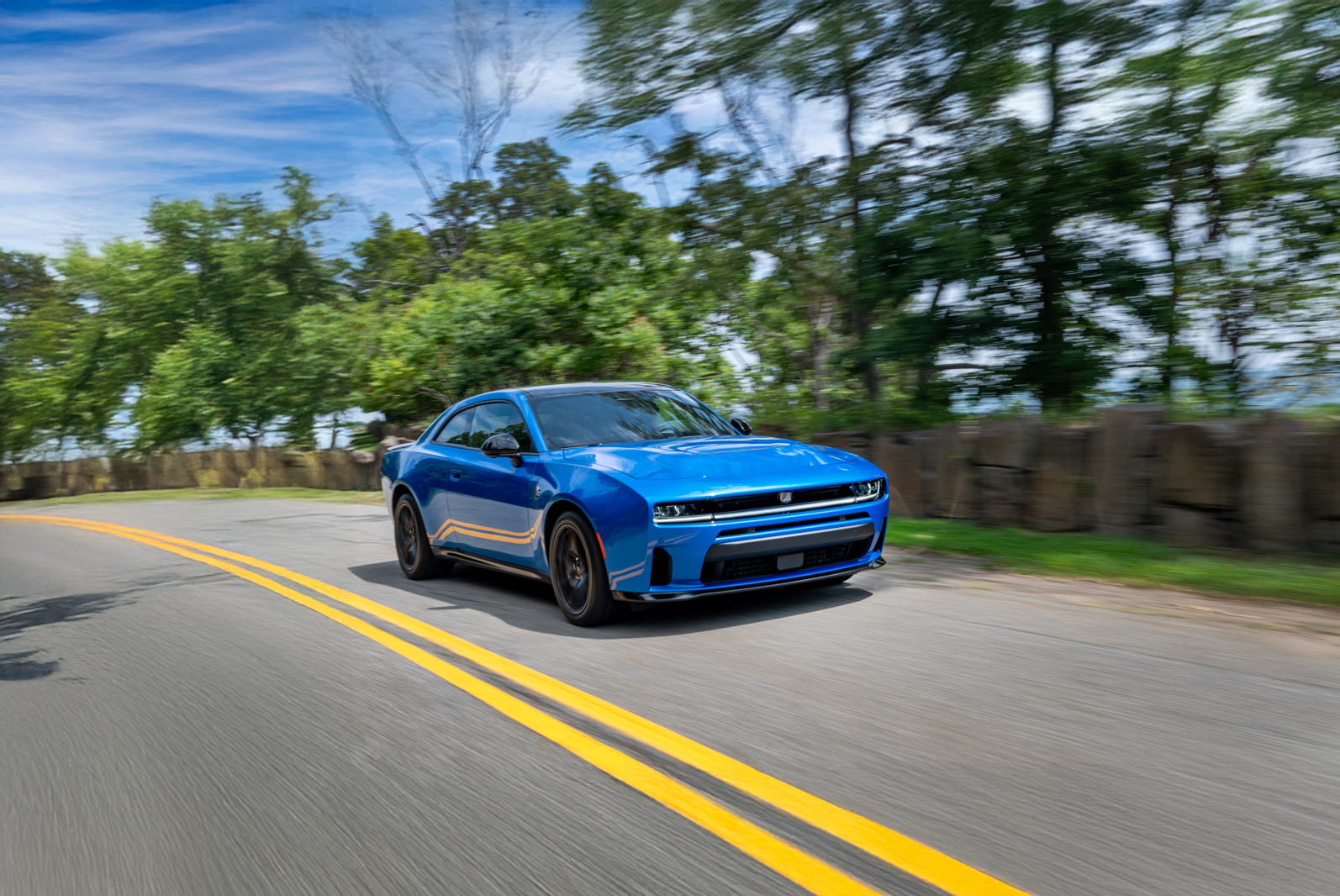
The Charger is a car that’s never really done it for me from afar. That Hemi V8 engine, yes, but the car itself? In modern times, its proportions have always seemed off and it lacks that star power and togetherness of the Mustang. The 2019 Mustang Bullitt remains a high point for me of just how coherent a muscle car can be and how many boxes it can tick. This new Charger looks great, though. Stunning in the ‘Bludicrous’ bright blue paint in the July New York sunshine.
I hear my test car before I see it when I pick it up from an indoor garage in Manhattan, where it growls rather than roars like a V8. It’s a more subtle Charger than before but beautifully proportioned, sitting low and wide and with some lovely square lines and brilliantly integrated LED light signatures.
I never get bored of looking at it. These days, I find I’m taking fewer pictures of modern cars on my phone because few are striking enough to feel like sharing that night over a drink. Not so with the Charger: for those few days in July, my camera roll of any New York sights has the Charger very much in the foreground.
Like many cars in the US, it doesn’t look as big as it actually is. At more than 5.2 metres long and two metres wide, it’s larger than a Mercedes-Benz S-Class yet somehow looks more shrink-wrapped. When you see older Chargers driving around, this new one really does feel like a step change: modern in approach yet classical in style. This shape will age well.
The recipe for muscle cars has always been simple: a big engine up front, rear-wheel drive, two doors and simple underpinnings. They’re more about drag strips than going around corners; do not mistake the likes of the Charger for a BMW M5 rival.
While the switch from a V8 to a straight six might not be as drastic as the switch to an EV, it’s still quite a dramatic change in the muscle car world. In the Charger, the 3.0-litre unit is a new ‘Hurricane’ twin-turbo offered with a standard 414bhp and 468lb ft in the H/O version or the 543bhp and 531lb ft of the Scat Pack model, my test car. The turbochargers are different in each of the models, a pair of low-inertia turbos in the H/O and two high-flow Garrett turbos in the Scat Pack. The transmission for both models is an eight-speed automatic.
Another significant mechanical change comes from the fact that the Charger is now all-wheel drive, albeit with rear bias. A Line Lock function allows for burnouts by disconnecting the front axle. Couldn’t possibly comment on how well or not it works…
It’s been a good decade since I drove anything with a Hemi V8 and all I can recall is the engine, rather than which car it was in. Pretty sure it was a Jeep Grand Cherokee, around a similar time to also testing a Chrysler 300, which is more comparable with a Charger. But ignore what this says about my memory because it’s more about how dominant the engine was in the driving experience; it was the driving experience.
Not so now with the straight six. It’s a fine engine, for sure, with lots of low-end torque and a willingness to be revved. It sounds plenty good enough too – growly rather than shouty. But it’s not quite a great engine. An extra bit of rortiness and slightly less civility would go a long way. It would have been good to have seen the current twin-turbo Alfa V6 slotted in here, for example, with that in mind. But then there’s clear space for the Hemi V8 to step into when it arrives soon.
There are two dynamic weak points to the Charger: the jerkiness of the transmission at low speed, and the steering, which is lifeless. These are frustrations, nothing more, and you can live with them. The handling is predictable enough, the chassis more sophisticated than before, with multi-link front suspension and integral-link rear with dual-valve semi-active. But this is a muscle car, remember: good enough is good enough, particularly when you consider how far from somewhere like Manhattan you have to travel to find a good road.
Poseur appeal and straight-line performance are far more significant and the Charger delivers both. This is a quick car and all-wheel drive helps it to that end. It bites and it goes. There’s still enough slip to make you smile but never so much that it feels like the car is going to overpower you.
It looks great, the engine is good and the transmission and steering are so-so: why the big ‘want one’ factor then? Where this Charger really excels is in how it makes you feel and how usable and exciting it can be every single day, and in the majority of real-world driving situations.
I did plenty of miles in it over the long weekend and in all weather conditions on all types of roads and some foul traffic as well. The smile did not leave my face. It feels special to drive as well as to look at and be in.
The interior is huge as well, including the boot. At one point, there were five adults inside for a cross-town dash and it did the job. The seats are comfy, the technology has been kept simple and a bit of theatre is always just a press of the throttle pedal away to amuse your occupants.
It amused me greatly and I loved both driving it and being in and around it. It really feels like the kind of car you’d happily keep forever, so rounded is it in its approach and ability to do the sedate as well as the sublime. Some comeback from that shakiest of starts as an EV. Imagine what it will be like with that V8…

Related posts


Latest Post


No Comments