
How Much It Costs To Replace A Kia Niro Hybrid Battery In 2026
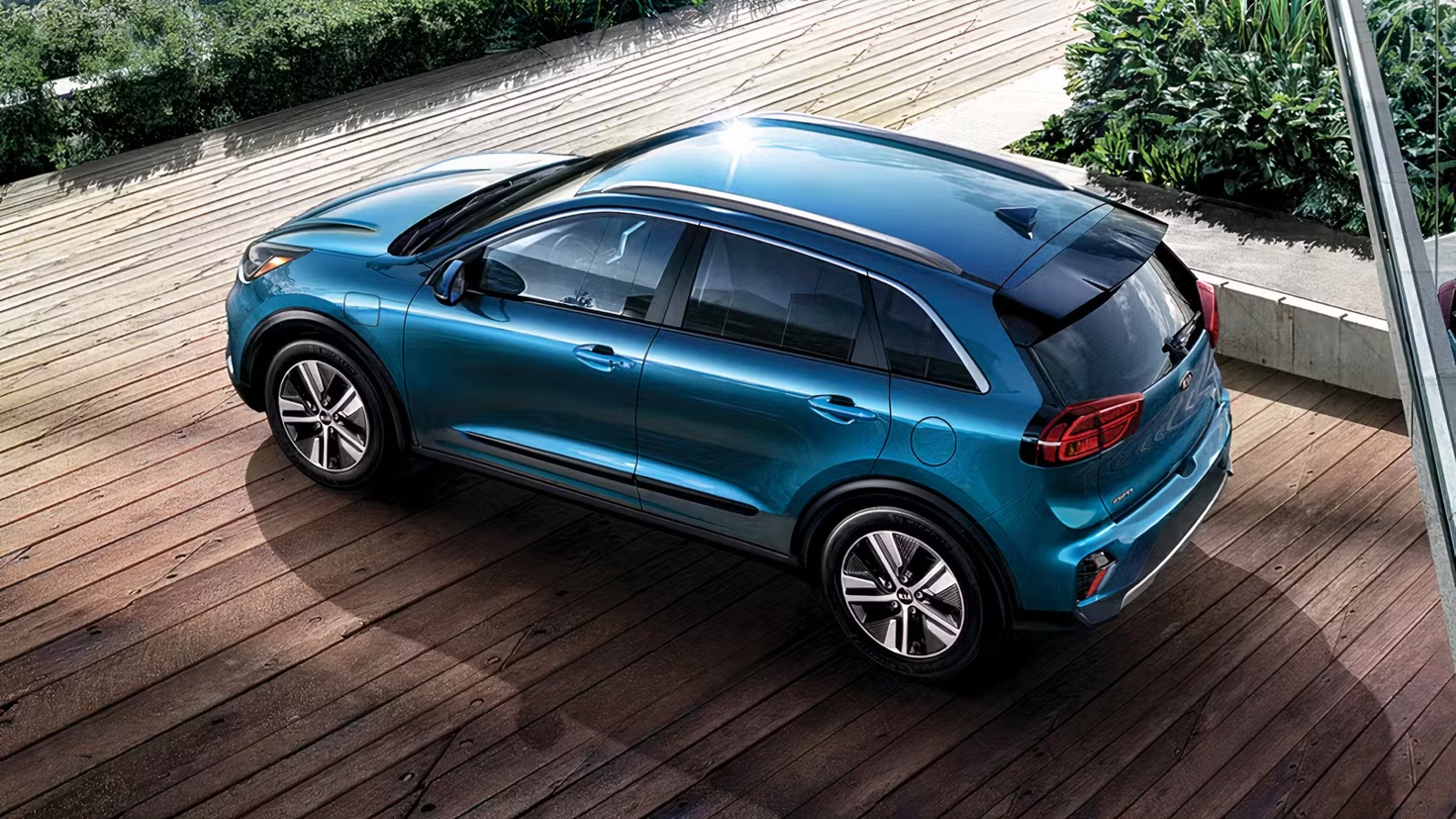
For over two decades, the personal risk-assessment blueprint for buying a used hybrid was framed entirely by Toyota. Buyers looking at a high-mileage Prius or Camry Hybrid knew exactly what to expect if the battery pack died. With the heavily populated aftermarket of cheap cells and predictable independent labor, an owner could expect an all-in bill that rarely broke $2,500.

In 2026, as first-generation Kia Niro Hybrids (2017–2022) steadily age out of their 10-year/100,000-mile factory warranties, a wave of second-generation owners is discovering that the assumption that this will be similar to a Toyota experience is a massive financial miscalculation. Sourcing a replacement battery for a Niro introduces a highly fragmented supply chain, regional pricing variances, and an engineering layout that shatters standard budgetary assumptions. If you are holding the keys to an aging Niro, or hunting for one on the used market, understanding how this market segments across OEM, independent, and remanufactured tiers could save you significant money.
Why The Niro’s Battery Bill Shatters The Toyota Blueprint
The issue is not that Kia built a bad battery. It’s that Kia built a different kind of battery, without Toyota’s enormous aftermarket safety net behind it. Toyota had the advantage of scale. Millions of hybrids created a whole ecosystem of rebuilders, used parts, replacement modules, and independent repair knowledge.

The Niro never had that kind of volume. Its high-voltage battery pack is not something every hybrid shop has sitting on a shelf, and it’s not something every mechanic wants to touch. This is where the cost starts climbing. The car may be affordable to buy used, but its battery repair path is actually closer to that of a newer niche hybrid than an old Prius.
The Component Chemistry Clash

The Niro utilizes a high-density, high-voltage Lithium-ion Polymer pack. Rather than separate individual modules that can be swapped out easily, the first-generation Niro integrates its high-voltage traction battery pack directly alongside a specialized 12V lithium accessory battery beneath the rear passenger seat. While this configuration delivers exceptional efficiency and lightweight packaging when new, it makes aftermarket replication more difficult.
Because of the difficulty in replicating these packs, there are fewer cheap modules floating around, fewer shops familiar with the layout, and less incentive for companies to flood the market with replacement parts. So when the battery fails, owners are pushed into a smaller and more expensive supply chain.
The 3-Year-Old EV That Outshines New Models In Reliability
You’ll struggle to find a more reliable EV than this South Korean compact crossover
Battery Sourcing Options And Associated Fees

In 2026, the price of replacing a Kia Niro hybrid battery depends on two things: where the battery comes from and who installs it. The difference between a dealership quote and a good independent hybrid shop can be thousands of dollars. This is not a minor “shop around and save a little” situation. This is real money.
Owners usually land in one of three lanes. There is the dealer OEM route, the independent shop route, and the remanufactured battery route. Each has a different cost, warranty, and risk level. None of them are perfect, but some make much more sense than others depending on the age and value of the car.
The Dealer Alternative: Factory OEM Pricing

The dealer route is, of course, the easiest. If a first-generation Niro is out of warranty and the hybrid battery gets flagged, the Kia service drive will usually go straight for a new OEM pack. The pack alone typically lands between $5,000 and $7,000, which is a lot for a compact hybrid that is already pretty deep into used car territory.
Unfortunately, it doesn’t even stop there. Diagnostics, high-voltage labor, cooling system service, and dealer markup can push the final bill to $6,000 or even $8,000. This is well outside the range at which most people would consider the repair worthwhile.
The Independent Path: Sourcing And Specialized Labor

Independent hybrid specialist shops are more affordable, but they are typically only found in major metropolitan hubs or hybrid-heavy markets. In rural or less EV-dense regions, independent shops often refuse the job outright due to a lack of specialized training or proper high-voltage tooling. If they are willing to take a Niro project on, independent shops generally cost between $3,000 and $5,000.
- Average Parts Markup: Independent shops typically mark up the wholesale component by 15% to 25% to cover transport risk and handling.
- Labor Rates: Expect three to five hours of highly specialized labor billing at $150 to $250 per hour.
Third-Party Remanufacturing: Refurbished Options

Outside of specialized shops, the cheapest option usually comes from third-party hybrid battery remanufacturers such as GreenTec Auto or Best Hybrid Batteries. Companies like these take used battery cores, test the cells, replace weak voltage blocks, and rebalance the pack before sending it back into service. The cost of a first-gen Niro remanufactured battery generally sits between $2,600 and $4,000 before installation (depending on model year and availability). Warranty options vary. A standard option may include a three-year/unlimited-mileage warranty, while a six-year premium warranty can add roughly $700 to $800 to the part price.
The Real World Costs To Replace A Toyota Prius Hybrid Battery In 2026
There’s some extra information you need to know about your Prius’s HEV battery replacement.
1st-Gen Vs. 2nd-Gen: What The Data Shows

The cost picture changes quite a bit depending on the generation. First-generation Niros have been around long enough for some aftermarket support to exist. Second-generation models are still too new, which means the aftermarket has not caught up yet.
|
First Generation |
Second Generation |
|
|---|---|---|
|
Remanufactured/Third-Party |
$2,600 – $4,000 (Available) |
Not Available (Thin Market) |
|
Independent Shop All-In |
$3,000 – $5,000 |
$4,500 – $6,500 (Projected) |
|
Dealer OEM Replacement |
$6,000 – $8,000 |
$7,500 – $9,500+ (Est. Parts) |
For used buyers, this is one of the most important distinctions. A 2017–2022 Niro has repair options, even if they are not as cheap as a Prius. A 2023–2026 Niro may be newer and nicer, but if the pack is damaged outside warranty, the owner is much more likely to be trapped inside the dealer network.
First-Generation (2017–2022) Degradation Profiles

Most real-world repair data in 2026 comes from the first-generation Niro. These cars have generally done well through 100,000 miles, which is exactly what owners want to hear. The concerning part begins after that, especially between 110,000 and 140,000 miles, when the original warranty is often gone. The common problems are usually cell-capacity imbalance and internal resistance buildup. While this doesn’t sound that serious, one weak section can be enough for the system to trigger a warning, limit power, or leave the owner needing a tow.
Second-Generation (2023+) Part Catalog Projections

The second-generation Niro is still too new to have generated many replacement stories. Most 2023-and-newer models remain under their 10-year factory warranties, so there just are not many normal, real-world repair invoices to study yet.
At the moment, the best clue to understanding what these costs may be is parts catalogs. Current factory component listings show higher costs due to new battery chemistry and modern thermal management. If a second-generation pack is damaged outside warranty in 2026, the part alone can exceed $6,500. After including dealer labor and diagnostics, a full replacement can reasonably range from $7,500 to over $9,500. For now, remanufactured options are basically not available.
Kia Hybrid And Plug-in Hybrid SUVs: Pricing, Specs, And Reliability In Detail
Kia’s been at the top of its game in terms of hybrid technology and performance, and here are all the models available in 2025.
Real-World Longevity, Warranties, And Owner Realities

The good news is that the Niro’s lithium-based hybrid battery has aged quite well. Many owners can see 120,000+ miles before major symptoms appear, which is fairly promising. In normal use, the Niro is not a fragile vehicle waiting to saddle its owner with catastrophic repair bills at the first sign of age.
The problem is what happens when a serious fault finally appears. A Niro does not generally fade away with slightly worse fuel economy month after month. It may throw an HEV warning, drop into low-power mode, and become difficult or impossible to drive normally. One 2018 Niro owner’s scenario illustrates the gap: 114,000 miles, an HEV warning on the highway, a $3,800 independent quote with a three-year warranty, and a $7,200 dealer quote. The hard part was finding the shop.
The 3-Year-Old Hybrid SUV With The Best Mileage For Long-Distance Travel
This hybrid gets you good fuel economy and noteworthy cargo versatility at a compelling used price.
Final Verdict: Smart Sourcing In The Post-Warranty Era

A high battery replacement cost should not automatically scare people away from the Kia Niro Hybrid. It is still a sensible used hybrid when bought carefully. But it should change how buyers think. A Niro nearing 100,000 miles needs more than a clean interior and a strong fuel economy number. It needs a battery plan.
The smart move is preparation. Before the warning light appears, owners should find out whether local independent hybrid shops work with suppliers such as GreenTec Auto or Best Hybrid Batteries. In a strong, independent market, budgeting around $3,500 can make the risk manageable. Paying $7,500 for a dealer-installed OEM battery on an older Niro rarely makes sense unless the vehicle is otherwise in excellent condition. The Niro can still be a smart long-term hybrid, but only for owners who know where the repair money is really going.
Source: Kia, Best Hybrid Batteries, GreenTec Auto, CarComplaints.com, RepairPal

Related posts




Latest Post


No Comments