
The Honda With Gold Wing Comfort And Africa Twin Reliability
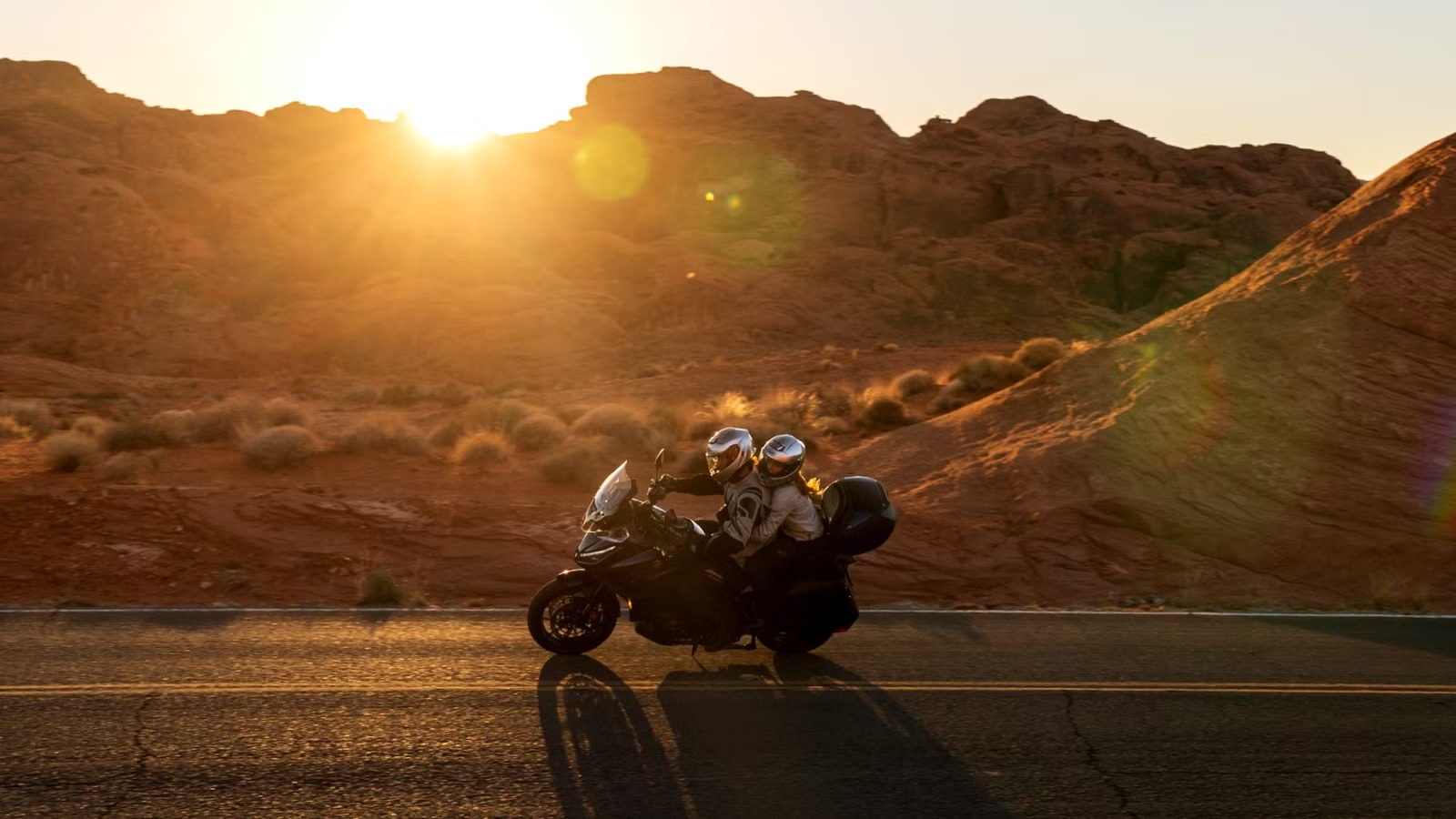
The Gold Wing and Africa Twin are two of the most celebrated bikes in their respective categories. They achieve that by promising a blend of dependability, usable performance, and flagship equipment, topped off by a competitive MSRP. Oh, and the inclusion of the game-changing dual-clutch transmission surely helps as well.

However, these are both specialized products in their niches and can still cost a fair bit in their top-drawer trims. That can leave many of us middle-class folks wanting to enjoy these similar benefits in a more attainable package. It’s hard to achieve, but hard is what Honda usually excels at. A certain NT proves that by blending Gold Wing comfort and Africa Twin reliability in a sub-$12,000 package.
Why The Gold Wing Serves As The Gold Standard In Comfort
Technically, we can just say “look at it” and wrap it up. But you’re not here for that. The Gold Wing’s comfort can be credited to Honda’s knack for solving real problems. That shows in the details. For instance, the windscreen is adjustable, the bodywork is carefully crafted to minimize resistance, and there is an army of creature comforts. This is topped with massive saddles for both occupants and ergonomics that put the feet, arms, and torso in a relaxed position.


A special shout goes to the automatic transmission. Although enthusiasts are still wary of such tech, these transmissions make a lot of sense on heavy tourers and ADVs. They let you focus on the ride and balancing the heft rather than stressing about slipping the clutch on an incline or downshifting to pass a semi. No other tourer of this kind has such a tech, so this inevitably adds to the Gold Wing’s comfort quotient.
Why The Africa Twin Serves As The Gold Standard In Reliability

Just like the Gold Wing is known for its comfort, the Africa Twin sets the standard for reliability in its class. Credit for that goes to its highly proven mechanical package. The chassis, suspension, and wheels have all been made to last decades without breaking a sweat, while also being able to take on whatever you throw at them.
The impeccable parallel-twin powerhouse takes that to the next level. This sub-1,100cc engine is largely understressed to boost reliability, and it’s known to last half a million miles with just basic maintenance. The same can be said for its six-speed DCT, which doesn’t burn the clutch or wear out the internal sprockets over years of use.
The NT1100 Is The Budget Blend Of Gold Wing’s Comfort And Africa Twin’s Reliability

As good as these are, Honda realized that not everyone wants an over-$25,000 heavyweight bagger or an over-$18,000 adventure-tourer. A budget blend of these two could serve as a more mass-appealing option, and there was a market, too, given the rise in popularity of crossover-type sport-tourers. Thus, the NT1100 came to the market in 2021.
It has the base package of the Africa Twin (comprising the engine, chassis, and suspension), topped with Honda’s comfort-oriented learnings from the Gold Wing. So you get a package that eggs you to cover thousands of miles without ever feeling uncomfortable. All that at under $12,000 only sweetens the deal for most of us.
The NT1100 Has A Highly Competitive And Well-Justified MSRP

Speaking of prices, the NT1100 starts at $11,999. That’s $100 more than the 2025 version, despite both versions being exactly the same. Even with that hike, the NT slots well in the segment, undercutting rivals like the Yamaha Tracer 9 GT, Triumph Tiger Sport 800, and BMW F 900 XR. What impresses further is the likable bit of kit you get as standard. Here’s a deep dive into that.
Ultra-Reliable 1,084cc Engine With Class-Leading Torque

Even though the NT is cheaper than its rivals, you get a bigger engine here. This is a 1,084cc, parallel-twin powerhouse seen in numerous Honda bikes, such as the Rebel 1100, Japan-only Hawk 11, and of course, the Africa Twin. It runs a 270-degree crank and 10.5:1 compression ratio to produce 100 horsepower and 82 pound-feet.
The latter is the USP here, being the highest among its peers while kicking in at just 5,500 RPM. That means immense tractability for regular usage, which in turn helps promise a claimed 48 miles per gallon. This equates to a theoretical range of around 250 miles in one tank. On the go, you’ll also appreciate the standard six-speed dual-clutch transmission.

The idea is said to be to reduce strain on the gearbox and fatigue for the rider. Thus, it lets you choose between three modes (two Auto and one Manual). Honda explains them as:
- AT D (“Drive”): Ideal for daily city and highway riding, when comfort and optimum fuel efficiency are prioritized.
- AT S (“Sport”): Suited for sportier riding, as the ECU lets the engine rev a little higher before shifting up, and shifts down sooner when decelerating, for extra engine braking. (three memorable sub-settings within S mode)
- MT (“Manual”): Full manual control for changing gears via handlebar triggers.
Adjustable Showa Suspension And Double-Cradle Chassis Bring Riding Versatility

The engine sits inside a double-cradle chassis (derived from the Africa Twin), said to help keep the wheelbase short and steering geometry sharp. This suspends on Showa 43 mm USD forks and a Showa monoshock, both of which have preload adjustability. The rear can be set remotely for extra convenience for managing varying loads on your tour. A slight bummer is the lack of the optional Showa EERA suspension in the US, even though it is available on the Africa Twin.

Adding a pinch of sportiness here is the set of 17-inch cast alloy wheels. These wear sports bike-like 120/180-section rubber, along with twin front disc brakes and radial-mount Nissin calipers. That should mean you can have serious fun in the twisties and even drag your knee if you’re into that. The dimensions back up the fun quotient, too. The curb weight is 12 pounds lighter, the wheelbase is 1.4 inches shorter, and the rake is one degree sharper than the Africa Twin Adventure Sports DCT.
Premium Features For Comfort And Safety

Finally, there’s the impressive tech package. The NT is thoroughly loaded in this regard wherever you look. On the comfort side, an adjustable windscreen, three-level heated grips, USB port, cruise control, and Apple CarPlay are standard inclusions. Whereas, on the safety side, there are five ride modes (Urban, Rain, and Tour, with two User modes), three-level traction control with integrated wheelie control, rear lift mitigation, and cornering ABS. A massive 6.5-inch TFT (plus an additional LCD below) serves as the gateway for accessing everything.
Source: Honda Powersports

Related posts



Latest Post


No Comments