
This Performance Sedan Has Porsche-Like Balance And Lexus-Style Durability
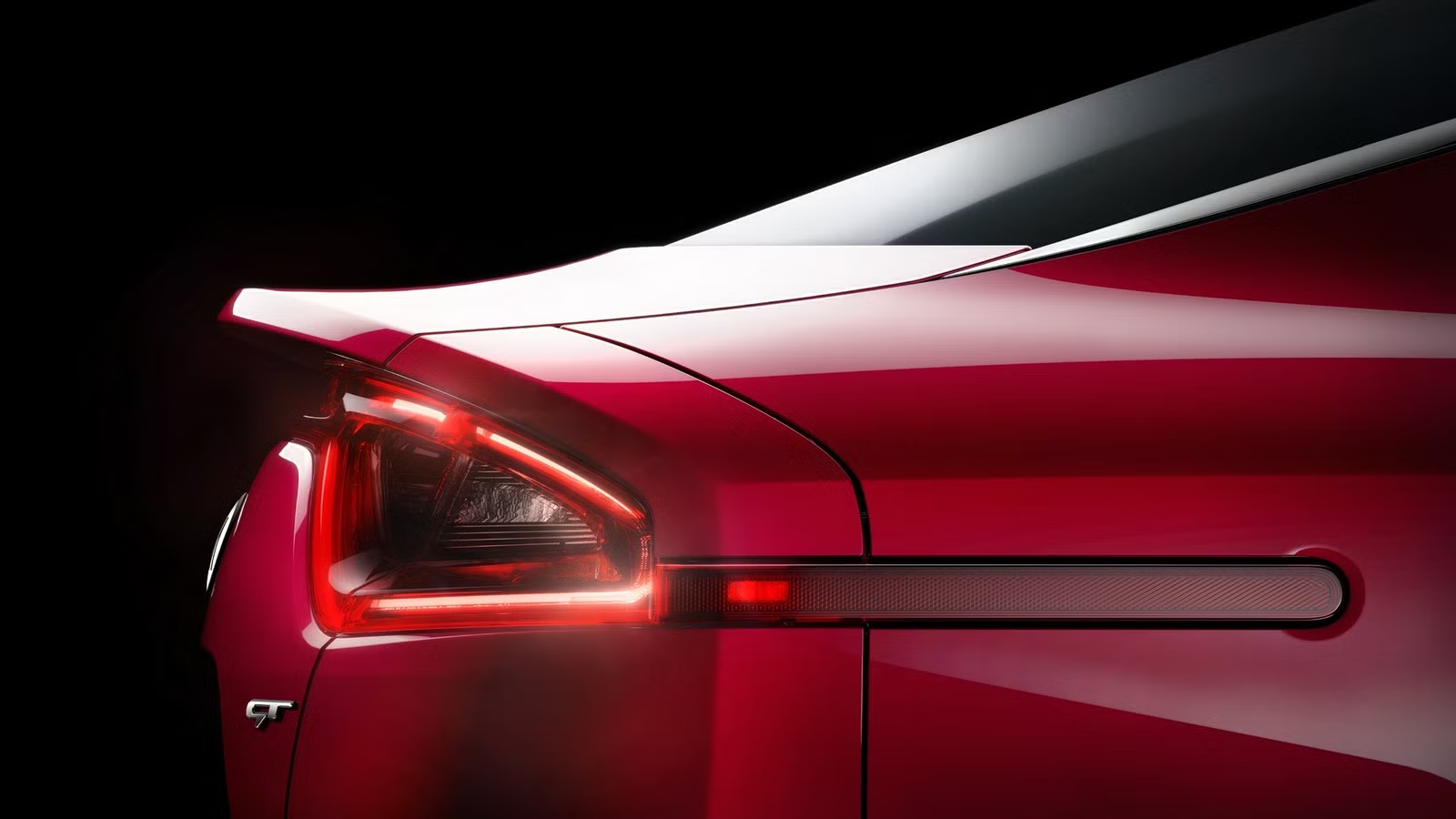
Most performance sedans still operate on the same unspoken contract: the manufacturer gives you the driving thrills, and you agree to absorb the ownership headaches once the warranty runs out. It is a deal enthusiasts have accepted for decades, quietly budgeting for dealer visits the way other people budget for vacations. The assumption has become so ingrained that a genuinely durable performance sedan barely registers as a possibility.

The Kia Stinger GT was built to break that contract. Developed under engineers recruited from European performance divisions, it was conceived as a proper driver’s car — not a badge-engineering exercise — and backed by a warranty program that signaled the company intended to stand behind it for the long haul. The result is a sedan that rewards both the weekend back-road run and the mundane daily commute, without the creeping anxiety that tends to follow high-performance German iron past the 60,000-mile mark.
It never became a mainstream status symbol, and it never quite earned cult-hero recognition. But on the used market, the Stinger GT stands out as one of the rare performance sedans that delivers speed, balance, and genuine durability — at a price that makes the whole package feel almost unfair.
The Kia Stinger GT Was Engineered As A True Performance Sedan
 11 autotech Engine |
Power |
Torque |
0-60 |
|---|---|---|---|
|
3.3-liter twin-turbo V6 |
365 hp |
376 lb-ft |
4.7 seconds |
The Stinger was never designed to feel like a compact sport sedan stretched to fit a bigger engine. Its proportions tell you everything: long hood, wide track, and low seating position. Its layout is closer to that of a grand touring car than to a city-focused performance four-door.
Under the hood, GT models use a torquey twin-turbocharged 3.3-liter V6 that became the centerpiece of Hyundai-Kia’s modern performance push. It delivers strong acceleration on par with many lighter sports cars, confident highway passing power, and effortless midrange pull. Power is sent through an eight-speed automatic transmission to either the rear wheels or all four wheels, depending on configuration.

Hardware support matches the power. Brembo brakes are standard on GT trims. Suspension tuning was developed with European benchmarks in mind. The wheelbase is longer than that of typical compact luxury sedans, giving the car stability at speed and a planted feel through sweeping corners.
Chasing Porsche-Like Balance On Real Roads
Balance is the part most manufacturers struggle to deliver. It is easy to add horsepower, but it is much harder to make a car feel predictable when weight shifts, corners tighten, and road surfaces change. The Stinger GT’s steering is tuned for confidence rather than artificial heaviness. Turn-in feels deliberate. Mid-corner stability remains consistent. There is enough feedback to trust the front tires without overwhelming the driver. It does not feel nervous. It does not feel detached.
The long wheelbase that gives the Stinger its grand touring proportions also contributes to stability at higher speeds. Highway cruising feels settled. Back-road driving feels controlled rather than chaotic. Adaptive dampers on higher trims further improve composure, keeping body movement in check without punishing ride quality.

This is where the Porsche-like comparison becomes reasonable. Of course, the Stinger is no Porsche, but its chassis prioritizes stability, predictability, and usable performance over dramatic theatrics. That same philosophy makes the Stinger easier to live with day to day. Sharp cars that constantly feel on edge can become tiring. The Stinger GT stays engaging without demanding constant attention. You can even watch it race a BMW M240i and a Porsche 718 Boxster S, which puts its performance credentials in useful perspective.
That’s Not All, Folks

To keep the comparison theme alive, a quick look at the rivals it was designed to challenge makes sense. In the segment, you’re typically looking at three main rivals: the BMW M340i, for a start, is known for its class-leading straight-line pace, thanks to its turbocharged inline-six and rapid eight-speed automatic. Next, the Audi S5 Sportback leans on all-wheel drive traction and a well-sorted dual-clutch transmission, while the Genesis G70 is the typical pick if you want a sharp handler in a smaller, more compact package with available rear-wheel drive.
Where the Stinger GT differs is in its balance and value equation. It’s larger and heavier than the G70 (4,179 lbs against the G70’s 3,913 lbs), but that longer wheelbase contributes to greater high-speed stability and a calmer ride on real roads. Compared to the M340i and S5, the Stinger trades outright acceleration for composure and predictability, especially during sustained highway driving or long sweeping corners. It may not feel as razor-edged at turn-in as the BMW, but it’s more forgiving at the limit.
Price is where the Stinger quietly pulls ahead. Even when new, it undercut those rivals by roughly $5,000–$8,000 on average, and on the used market the gap is wider still — as you’ll see later in this article.
Durability That Defies Performance Sedan Norms

Sports sedans often pay for excitement with complexity. Turbocharged engines, dual-clutch gearboxes, highly stressed cooling systems, and electronic suspensions cost a fortune when they fail. The Stinger GT takes a different approach. The 3.3-liter twin-turbo V6 is not a one-off exotic powertrain. It is part of a broader Hyundai-Kia engine family used across multiple vehicles. That shared architecture typically translates to better long-term parts availability and fewer unknown failure points.
Owner surveys and reliability scoring reflect that. While it does not match Lexus’s legendary reliability reputation, the Stinger consistently ranks in the average to above-average reliability range for its class. More importantly, long-term owner reports rarely point to widespread catastrophic mechanical issues. Most complaints revolve around minor electronic quirks rather than drivetrain failures.
Used Kia Stinger GTs Score High On Reliability

|
Model Year |
J.D. Power Quality And Reliability Score |
KBB Owner Reliability Rating |
|---|---|---|
|
2021 |
74 / 100 |
4.6 / 5 |
|
2022 |
76 / 100 |
4.6 / 5 |
|
2023 |
87 / 100 |
4.6 / 5 |
Warranty coverage also played a role in building trust. Kia’s long factory warranty set expectations that the company would stand behind its product. Even in the used market, that reputation carries weight because many examples still have remaining coverage depending on mileage and ownership history. At a time when recalls and reliability concerns dominate automotive headlines, a substantial factory warranty is no small thing.
These scores place the Stinger GT in solid territory for a performance sedan. Not bulletproof. Not fragile. Respectable, repeatable, and supported by real owner feedback. That is the core of the Lexus durability comparison. It’s not identical, but far closer than most European sports sedans that offer similar performance.
Ownership Confidence Beyond The Warranty Window
A car can post good survey scores and still fall apart when driven hard. Long-term test data and high-mileage owner stories help fill that gap. Extended road tests of the Stinger GT revealed minimal mechanical issues even under sustained, enthusiastic driving. Some reports noted transmission heat warnings during extreme track use, but once normal driving resumed, the warnings cleared. That is exactly the kind of behavior you want from a street car pushed beyond its intended environment — and it’s worth asking how often you’d actually be tracking your Stinger in the first place.
Parts and service costs also favor the Kia. Routine maintenance pricing runs well below that of German performance sedans — just $474 per year according to RepairPal. Brake and tire costs are typical for the segment, not exotic outliers. And because the engine family is shared across other Hyundai-Kia models, replacement parts are not rare unicorn components.
Inside, the Stinger GT focuses on comfort and durability rather than flashy minimalism. Heated and ventilated front seats, a wide infotainment display, and physical controls for core functions make daily driving easier than in some touch-heavy German cabins. Compared to rivals like the M340i and S5 Sportback, the Stinger’s interior feels less avant-garde and more intuitive. Materials tend to hold up well over time, and the hatchback-style cargo area adds a level of practicality that traditional sport sedans often lack.

Insurance rates are generally lower than those of comparable European sports sedans. Fuel economy is reasonable for the performance on offer, and interior materials have held up better than early critics expected. Taken together, ownership feels closer to a premium Japanese sedan experience than a high-maintenance European performance car. That is where the Lexus-style confidence comparison finds its footing.
Who The Stinger GT Is Not For

It bears mentioning at this point: the Stinger GT is not your go-to for razor-sharp track performance. Buyers who want the absolute quickest acceleration, the lightest curb weight, or a heritage performance nameplate may gravitate toward German alternatives. It also doesn’t offer the compact, tossable feel of sport sedans like the Genesis G70. The Stinger rewards smooth, confident driving — not constant aggression.
It’s honestly a pity, but the truth is that the Stinger GT remains overlooked because of timing. It arrived before buyers were ready to take Kia seriously as a performance brand, and it left the market just as enthusiast interest began to peak.
Why The Stinger GT Is A Smart Used Performance Buy Now

Depreciation did the Stinger GT a favor. New buyers never fully embraced the idea of a Kia wearing a sport-luxury price tag, and that hesitation is now an advantage for used shoppers. Late-model Stinger GT examples offer modern driver assistance technology, strong infotainment systems, ventilated seating, adaptive suspension on higher trims, and full performance hardware — at prices that remain thousands, and sometimes tens of thousands, cheaper than comparable German sedans with similar mileage.
Production has ended, which means supply is finite and enthusiast appreciation is already beginning to grow. As the market recognizes what the Stinger GT actually delivers, values are likely to stabilize. For buyers who want a sedan that can commute comfortably, attack a back road confidently, and survive daily use without drama, the Stinger GT checks rare boxes: it is quick, balanced, and not fragile. That combination is harder to find than most performance car marketing suggests.

|
2020 Kia Stinger GT2 |
$28,990 |
Dealer listing (~88k mi) (Classic) |
|
2020 Kia Stinger GT |
$23,990 |
Dealer listing (~85k mi) (Classic) |
|
2020 Kia Stinger GT |
$33,690 |
Dealer listing (~36k mi) (Classic) |
|
2020 Kia Stinger GT2 |
$31,750 |
Highest Cars & Bids auction bid (not sold) (Classic) |
|
2020 Kia Stinger GT (auction sold) |
$30,500 |
Sold at auction (lower-mile example) (Classic) |
|
2020 Kia Stinger GT (modified) |
$27,000 |
Auction attempt, not sold (modified example) (Classic) |
Used-market pricing is part of what makes this sedan so compelling. Recent listings and auction data from tracking sites like Classic.com show GT and GT2 models from the 2020–2022 range commonly trading in the mid-$20,000s to low-$30,000s, depending on mileage and condition.
Lower-mile examples tend to sit near the top of that range, while higher-mileage cars fall comfortably below it. That puts real twin-turbo performance, Brembo brakes, and a properly tuned chassis in the same price territory as ordinary midsize sedans — which is exactly why the value proposition feels almost unfair. The Kia Stinger GT never needed to pretend to be something it was not. It was engineered to be a real performance sedan, tuned to feel composed and confident when driven hard, and built with a level of durability that makes long-term ownership far less intimidating than most cars in its segment.
It does not carry a heritage badge or command collector hype. But on the used market, it stands as one of the smartest enthusiast sedan choices available: a car that delivers speed without stress, balance without fragility, and performance without punishment. That is why it earns the headline.
Sources: J.D. Power, Kelley Blue Book, Car and Driver, MotorTrend, Edmunds, Consumer Reports, What Car?, Hyundai Global, Kia Global

Related posts





Latest Post



No Comments