
The Last Carbureted Car Sold in America
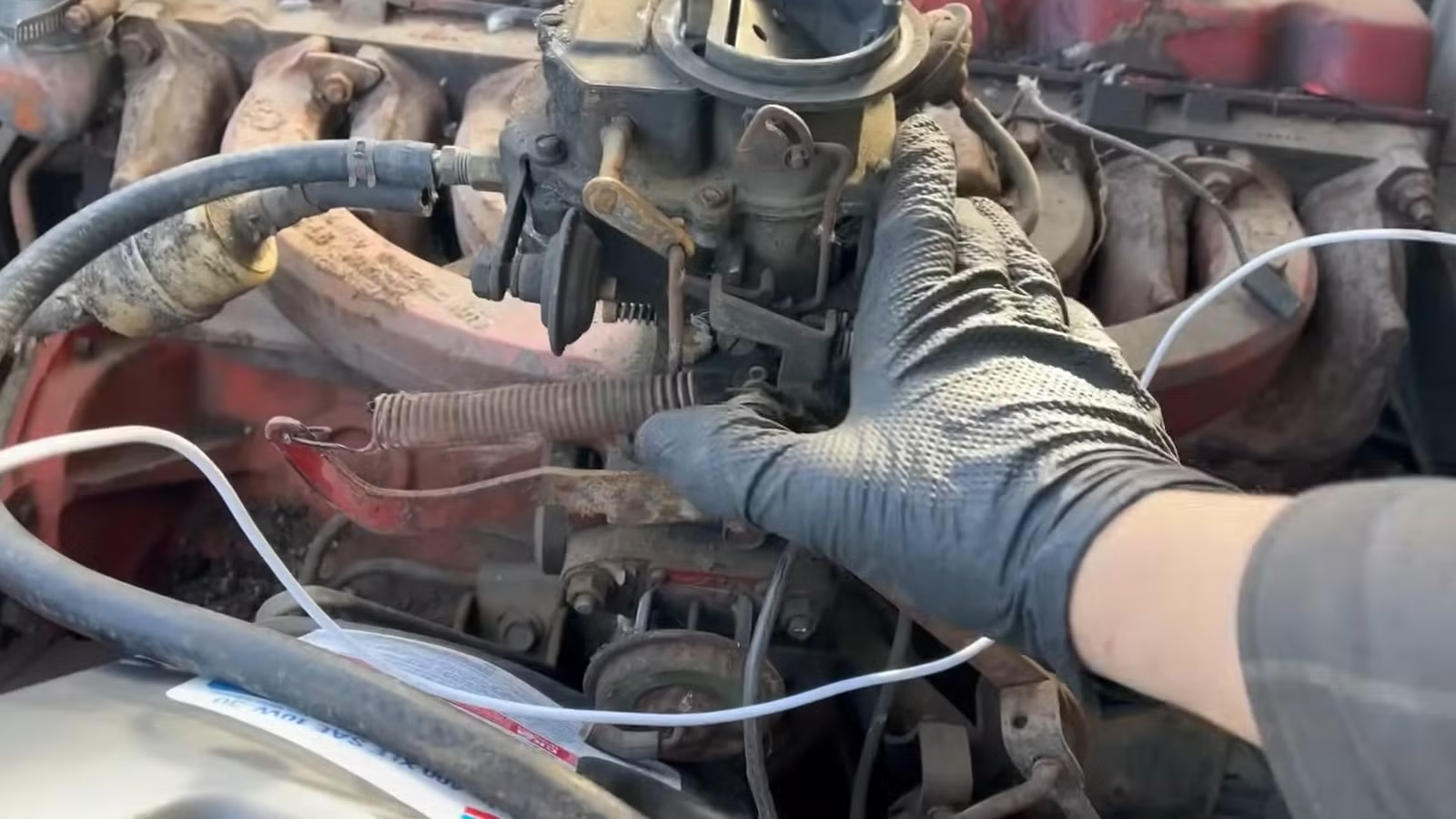
My dad and I used to clean the carburetor of our 1600cc Beetle every Saturday morning, without fail. Our basic kit was a brush, screwdriver, and fresh gasoline (for soaking and cleaning). When the timing gun came out, I knew the job was (almost) done, and we’d soon take it out for a spin. It always felt suspiciously simple for something that could make the Beetle feel noticeably better afterward. Little did I know that those were the final years of the automobile’s mechanical bartender.

Fuel injection is a more efficient, cleaner, and more precisely controlled, computer-managed successor that was fast becoming the new darling of the auto industry. Early adopters like Mercedes-Benz and Chevrolet helped demonstrate the advantages of more precise fuel delivery over traditional carburation.
The 1980s were the turning point. By 1990, only about 1.5% of light-duty passenger cars and 5% of light trucks were still carbureted. Eventually, the carbureted holdouts were reduced to an odd selection of economy cars, a fleet sedan, an SUV, and a pickup.
Carburetors Survived Surprisingly Late In American Cars

A carburetor has a straightforward job: mix fuel with the air entering an engine in the right proportion for combustion. It sounds very simple, but in the face of more stringent emissions standards, automakers upgraded to more sophisticated hardware. Regardless of the updates, the carburetor’s basic system still relied on airflow and pressure differences to meter fuel mechanically.
Electronic fuel injection offered much more control. Instead of asking a carburetor to handle changing temperatures, loads, altitude, and emissions requirements through a collection of jets, passages, vacuum controls, and adjustments, an electronically managed system could use sensor data to decide how much fuel the engine needed at a given moment. That matters for emissions, fuel economy, cold starts, altitude compensation, and everyday drivability.
In the 1970s, carburetors dominated gasoline-engine fuel delivery before their share dropped dramatically during the 1980s. Throttle-body injection, an early type of electronic fuel injection system, appeared as an important transitional technology, followed by port fuel injection as automakers gained finer control over combustion. By 1980 and 1981, passenger cars began using microprocessor-based engine controls that could account for inputs such as coolant temperature, throttle position, and oxygen content in the exhaust.
Despite newer fuel delivery systems, carburetors didn’t just go quietly into the night. Feedback carburetors, electronic controls, and increasingly complicated emissions hardware kept them viable for a while. But by the early 90s, the question wasn’t whether fuel injection would win. It was who would be the last to give the carburetor up.
The Subaru Justy Was The Last Carbureted “Consumer Car” Sold In America

It must be clearly stated that the 1991 Subaru Justy was the last carbureted consumer car sold in America. Why? Because to say otherwise would not be accurate. The Ford LTD Crown Victoria 5.8-liter was also carbureted and was available through 1991, but only for fleet sales. Then there is the 1991 Jeep Grand Wagoneer, which was also carbureted, but it’s an SUV. But the clear winner, if the term “car” is used loosely, would be the Isuzu Pickup, which stayed carbureted until its 1994 model year.
The Subaru Justy was an inexpensive hatchback available in front-wheel-drive and on-demand four-wheel-drive versions. It was small, economical, and much more concerned with getting you somewhere cheaply than getting you there quickly. The base trim level kept the carbureted version, which produced 66 horsepower and 52 lb-ft of torque.
Subaru Justy 1.2-Liter Inline-3 Specs
|
Subaru Justy |
Carbureted |
Fuel Injected |
|
Horsepower |
66 HP |
73 HP |
|
Torque |
52 lb-ft |
71 lb-ft |
|
Transmission |
5-speed manual |
5-speed manual / available ECVT |
|
Drivetrain availability |
FWD |
FWD / 4WD depending on trim |
Those aren’t exciting numbers even by early-1990s standards, but that is part of the Justy’s charm. It was simply a cheap little economy car that kept an older fuel-delivery system around after most of the market had already moved on. Technicalities aside, the Justy remains one of the strongest claimants to the passenger-car title.
Why Subaru, Ford, Jeep, And Isuzu Kept Carburetors Around

Subaru’s case is interesting because the carburetor didn’t survive across the whole Justy lineup — it survived at the very bottom. The cheapest Justy kept the lower-output carbureted 1.2-liter three-cylinder while more expensive versions adopted fuel injection. That doesn’t prove Subaru kept it solely to save money, but it suggests there was little urgency to update an entry-level engine that still did the job. The carburetor simply lingered in the cheapest Justy until Subaru finally phased it out.
Ford’s case was almost the opposite: the carburetor survived not in a bargain model, but in a tough old fleet workhorse. By 1991, regular Crown Victorias had moved to fuel injection, yet the 5.8-liter Windsor V8 was still hanging on in police and other fleet applications. Ford’s 1991 police specifications paired that engine with heavy-duty hardware, including an oil cooler and upgraded internal components, so this was an established fleet package rather than something aimed at ordinary showroom buyers.
The Jeep Grand Wagoneer was a different kind of holdout because, by 1991, the whole vehicle was already one foot into retirement. Its old SJ platform still carried the AMC 360 V8 and two-barrel carburetor even as Chrysler had newer, fuel-injected powertrains elsewhere in the lineup. There’s no definitive Chrysler statement saying the carburetor stayed simply because modernization wasn’t worth the money. But with both the engine and platform nearing the end of their run, spending heavily on modernizing them would have been a bit like fitting a brand-new set of chrome wheels to a car you are about to sell.
Isuzu kept the carburetor alive the longest, but only because it was still doing a lot of heavy lifting even at the bargain end of the lineup. The base two-wheel-drive 1994 Pickup hung onto the carbureted 2.3-liter 4ZD1 four-cylinder while other versions had already moved on to newer powertrains. Isuzu was not trying to prove the carburetor still had a future; it was simply letting the old technology run its course before finally retiring it.
The End Of Carburetors Changed Cars Forever

For drivers, the shift from carburetors meant a lot more than what’s between the air cleaner and intake manifold. Carbureted engines could be finicky about temperature, altitude, and cold starts, and some cars still expected you to work a choke or pump the accelerator before starting the engine. Get the mixture wrong, and you could flood the engine before making it out of the driveway. Fuel injection turned those little starting rituals into something most drivers no longer had to worry about.
Maintenance changed as well. Carburetors had jets, floats, mixture settings, vacuum lines, and choke mechanisms that could need cleaning, adjustment, or rebuilding when an engine started acting up. With electronic fuel injection, there is no need for all that mechanical fussing; sensors and computer-controlled fuel delivery react to coolant temperature, throttle position, exhaust oxygen levels, engine speed, and other inputs.
When electronics took over fuel delivery, there was no going back. Port injection eventually gave way to gasoline direct injection in many applications. Modern engines now combine electronic fuel control with variable valve timing, knock sensing, turbocharger control, cylinder deactivation, and a growing network of sensors. Most drivers never notice the electronic orchestra working under the hood. Carburetors haven’t disappeared, though, and their mechanical simplicity still has plenty of appeal in classics, motorcycles, race cars, small engines, and enthusiast garages.
The title of the last carbureted car sold in America depends on where you draw the line. The 1994 Isuzu Pickup, whose base two-wheel-drive version still offered a carbureted 2.3-liter four-cylinder, appears to be the last survivor if trucks count. Passenger cars, however, had effectively moved on, which leaves the Justy as an especially strange little model bridging the mechanical and electronic eras. It wasn’t fast, glamorous, or particularly advanced, but for a 66-horsepower economy car, it stuck around long enough to become part of automotive history.

Related posts





Latest Post




No Comments