
The Forgotten Mopar With GT-R-Level Tech And A Modest Price Tag
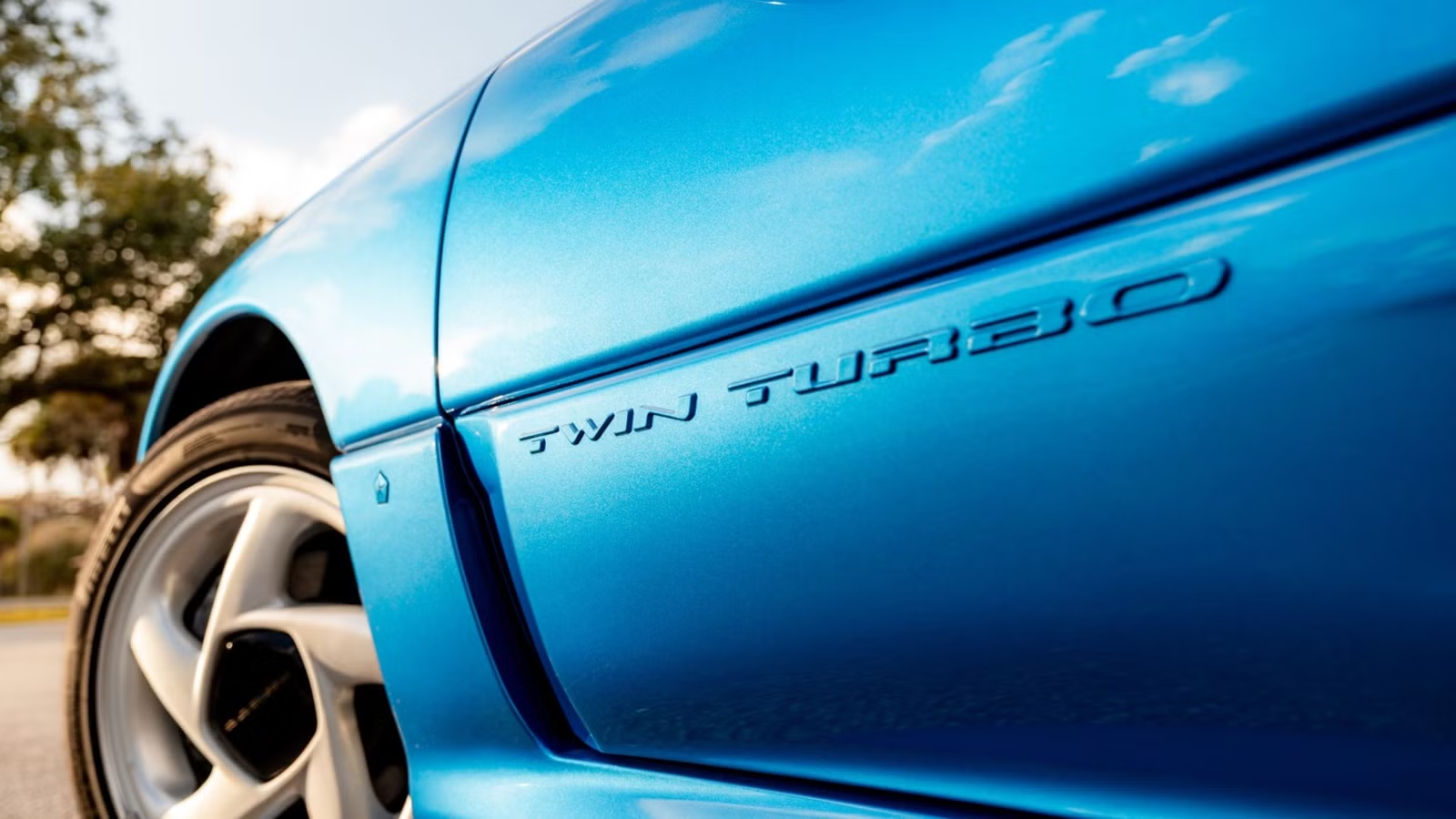
The 1990s sports car scene is probably one of the most forgotten eras in street performance, but it was actually a wild time with some of the greatest rides of all time. There was the Acura NSX, Mazda RX-7 Turbo, Nissan 300ZX Twin Turbo and, of course, the absolutely legendary Toyota Supra Turbo. While this was a time of Japanese imports and tuners, there were some domestic ass-kickers, like the C4 Chevrolet Corvette ZR-1 and the Dodge Viper R/T, that reclaimed the streets for American automakers. Lost in all of this was a Mopar sports car that captured JDM innovation and technology while, at the same time, putting them to shame on the road and on the window sticker.
The Great Mopar Performance Gap, Explained

Mopar performance established itself in 1957 with the Chrysler 300C featuring the 375-horsepower 392 FirePower V8, which was by far the most powerful engine on the planet at the time. They never let up with the pre-Golden Age 420 hp 413 Max Wedge and then dominated the classic muscle car era with the 440 Six-Pack and 426 Street Hemi, which took things to the 390–425 hp level. Even the 335 hp Chrysler 383 Magnum was equal to or better than most Ford and GM top-tier V8s, and it was actually just the fourth most powerful Mopar engine. In 1972, the Malaise Era set in, and all muscle cars were detuned into submission due to government emissions mandates and changing consumer trends towards fuel economy. The next time anyone remembers Mopar performance making a statement was in the Modern Muscle Car Era with the 2006 reboot of the Charger, but there were actually some standout cars in that performance gap.
’80s Dodge Sports Cars You Don’t Remember

Obviously, people remember the Dodge Viper, introduced in 1992, but there are a slew of sports cars that led up to it that have largely been forgotten over time. Dodge resurrected the Charger nameplate in the early ’80s on a subcompact front-wheel-drive car, which seemed like an insult to its legacy, but in 1987 got the Carroll Shelby treatment with the GLHS (Goes Like Hell Shelby) that could smoke a Mustang GT or IROC-Z. There was also another recycled name with the Daytona Shelby Z, which was packing a 197 hp 2.2-liter turbocharged I-4 that could hang with any V-8 of the day. Easily the coolest Dodge sports car that most people have never heard of is the TSi Conquest, which was also sold under the Chrysler and Plymouth marques, as well as by Mitsubishi, which called it the Starion. The top-spec version had a 176 hp, 223 lb-ft 2.6-liter turbocharged four-cylinder that made it competitive with any sports car, but more importantly, it was gorgeous and drove like a dream.
’89 Nissan Skyline GT-R Redefines Street Machines

We’re going to take a slight detour here and talk about the Nissan Skyline GT-R because, from a technological standpoint, it’s one of the most important cars to come along in a very long time. Introduced in 1989, the Skyline GT-R R32 had a 2.6-liter twin-turbo inline-six that produced 276 hp and 260 lb-ft of torque, but was built with tuning in mind and could easily be modified to produce 400 hp.

It was also an all-wheel-drive car, which made executing a launch easy even for novices, and it had radical, for the time, four-wheel steering, giving it a major advantage in corners. A stock ’89 GT-R R32 could hit 0–60 in 5.0 seconds, gobble up a quarter-mile in 13.5 seconds, and hit a top speed of 155 MPH, all of which were astounding for the late 1980s. The only downside to this amazing set of wheels was that it was not available in the United States, but it would definitely influence things on this side of the Pacific.
’91 Dodge Stealth R/T Turbo

When Dodge introduced the Stealth in 1991, it clearly used the Skyline GT-R R32 as a template, from the styling to the drivetrain. Unlike the Dodge Conquest, which was a badge-engineered Mitsubishi Starion, the Stealth was a collaborative effort between the two automakers. Dodge was actually in charge of the design, while Mitsubishi handled the mechanics, and the result was the most killer ride of the 1990s that wasn’t a Viper.
With GT-R-inspired technology such as all-wheel drive and four-wheel steering, the Stealth added innovations like four-wheel disc brakes, ABS, and electronically controlled suspension, as well as active exhaust on some models. Starting with a 164 hp base 3.0-liter SOHC V-6, the Stealth truly came alive with the R/T Turbo 300 hp DOHC twin-turbo version.
Stealth R/T Spec Sheet

The dual-cam, 24-valve Stealth R/T’s 3.0-liter V-6 was capable of 300 hp and 307 lb-ft of torque, which was positively impressive for 1991. It was, however, much heavier than its contemporaries, weighing in at 3,790 pounds, so it wasn’t quite as quick as its output numbers would indicate. Still, it turned in a respectable 5.7-second 0-60 time and 14.2-second quarter-mile ET. Much like the Conquest, the Stealth was all about the drive: smooth as silk on any paved surface, and it tracked the curves with confidence, making for one of the best driving experiences available, even by today’s standards. Some 1991 sports cars were slightly quicker than the Stealth, and muscle cars were slower, but none of them could offer the handling and driving pleasure of the Dodge/Mitsubishi grand tourer. Also, none of them looked quite as striking, as the Stealth really was a genuine head-turner.
’94 Stealth’s Stealthy Refresh

In 1994, the Stealth got a refresh with a new front fascia that replaced the pop-up headlights with flush ones and revised rear styling including updated spoilers. The most important change for the R/T Turbo, however, was that the 3.0-liter twin-turbo V6 was bumped up to 320 hp and 315 lb-ft of torque, a result of tweaking the turbo boost from ~9 psi to ~12 psi. Additionally, the five-speed manual transmission was replaced by a six-speed, making the Stealth substantially more engaging to drive. With the added power and an extra gear, the R/T Turbo could go from 0–60 in 5.0 seconds and was finally a 13-second car with a 13.8-second quarter-mile, which was outstanding for the time. Pretty much the only things that could beat a ’94 Stealth R/T Turbo were a Corvette ZR1 and, of course, a Dodge Viper, but both of those were far more expensive.
Mitsubishi 3000GT

The 3000GT was Mitsubishi’s version of the Stealth, which was also introduced in 1991 for the North American market, but unlike the Dodge, which was discontinued in 1996, it continued production until 1999, and 2000 in Japan. Identical to the Stealth in almost every way, including engine, power, and performance, the one big difference was the 3000GT’s active aerodynamics. The driver could electronically lower the front splitter by about three inches, which kept high-pressure air from getting underneath the car, thus reducing front-end lift at high speeds. Also, the rear spoiler could be adjusted by 15 degrees or so, which reduced lift and improved traction and stability at high speeds. The VR-4 was the 3000GT’s trim equivalent to the Stealth R/T Turbo, and despite being almost the same car, came in with an MSRP that was about $3,000 more.
Stealth Ushers in the Viper Era

To promote their new performance vehicle, Dodge managed to land pace car duties for the Stealth at the 1991 Indianapolis 500, which also happened to be the 75th anniversary of the iconic race. The problem was, the Stealth was built in Japan and the United Auto Workers (UAW) pitched a fit because the All-American race was supposed to showcase American automotive excellence. Fortunately, Dodge had a pre-production prototype that was built entirely in the U.S., which it rushed to complete as a replacement pace car — and that vehicle was the Dodge Viper.
Dodge managed to get two working Vipers for the ’91 Indy 500, and to say that it blew the minds of enthusiasts would be an understatement. The Viper would go into production the next year and was a raging success, in no small part due to the exposure it got at Indy. Two notable facts about this are: 1) Carroll Shelby drove the Viper at many of the pre-race festivities and, 2) race winner Rick Mears was gifted a Stealth because Dodge didn’t have any more Vipers to give away.
Ironically, the Stealth Flew Under the Radar

It’s clear that the Dodge Stealth R/T Turbo was exceptional, but also disappointing that so few people recognized it at the time. Through six model years, the Stealth sold 63,303 units, which would have been a decent total for a single model year, and the R/T Turbo only managed 15,569 sales. The Mitsubishi numbers were a little better, with 79,548 total units, including 15,630 VR-4 twin-turbos, but it had an additional three years of sales as it went until 1999, while the Stealth was mothballed in 1996. With a combined 142,851 Stealth/3000GT sales over nine model years, this car was not a success for either manufacturer. Even so, with just 31,199 top-trim R/T Turbo/VR-4s sold, averaging only 3,466 per year, this was a commercial disappointment, and it’s remarkable that neither Dodge nor Mitsubishi discontinued them earlier.
Stealth R/T’s Affordable Collectibility

The mystery of the Dodge Stealth R/T Turbo’s lack of popularity deepens as it was relatively affordable, with the 1991 model starting at $29,267. Compared to the MSRPs of similar high-performance rides that year like the $35,357 Nissan 300ZX Turbo and $64,000 Corvette ZR-1, Dodge was practically giving the R/T Turbo away. Even the 245 hp 5.7-liter base Corvette cost around $32,000 in ’91, and the Stealth could outrun it for substantially less money. While the Corvette has traditionally featured strong design across most generations, the C4 is nobody’s favorite, as it is rather bland, while the Stealth was genuinely striking, so that’s another advantage built into its modest price tag.
The upside of the Stealth being overlooked in its day is that, now, as a collectible, examples are quite affordable. A 1991 Stealth R/T Turbo has a Hagerty value of between $9,500 for a project car and $40,400 for a low-mileage, perfect condition showpiece. J.D. Power, which bases their values on real-world sales, tells us that a ’91 R/T Turbo has a low retail price of $3,200, a high of $10,600, with an average of only $6,175. The most we could find one selling for on Mecum was a ’91 R/T Pace Car Edition with 29 miles on it that was given away for $33,000 in 2019. Things are a little better on Bring a Trailer, with a top sale of $40,000 for an 8k-Mile 1991 Dodge Stealth R/T Turbo in 2024, as well as several others from various years that topped $30k. The bottom line is, it’s possible to get a like-new Stealth that doesn’t hurt the bottom line.
Sources: Bring a Trailer, Hagerty, J.D. Power, Mecum, Dodge

Related posts



Latest Post


No Comments