
This ’80s Grandpa Sedan Humbled Talladega On Five Cylinders
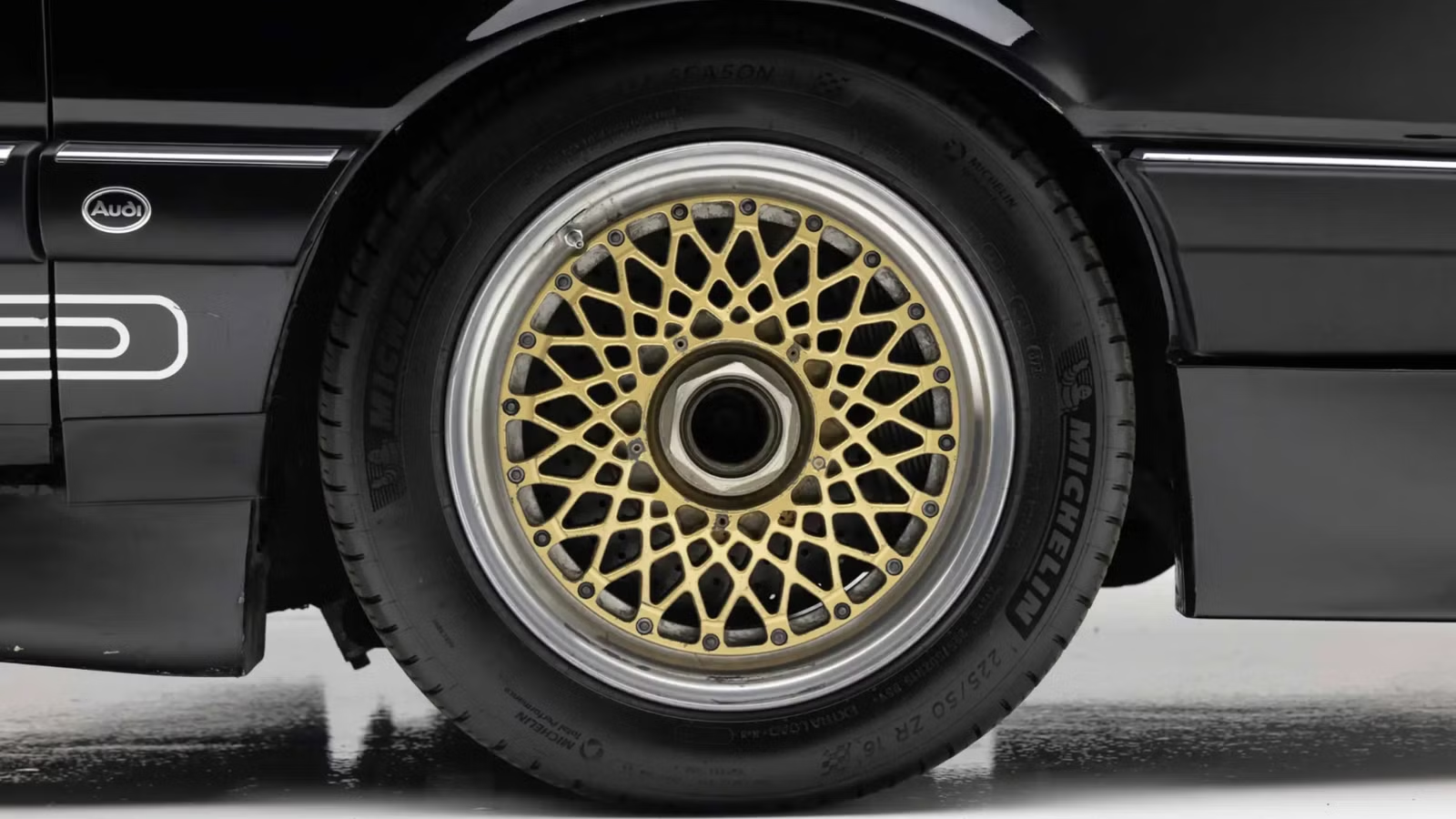
In March 1986, a four-door sedan lapped Talladega Superspeedway in 46 seconds. It recorded a lap speed of 206.3 mph, faster than any all-wheel-drive car had gone on a circuit.

Under the hood sat a 2.2-liter engine with five cylinders and 650 hp. There was no V8 and no V12, just a turbocharged inline-five.
Audi built the car because it was losing the American market over a safety panic that had nothing to do with speed. Three years and millions of dollars had already gone into the record attempt with nothing to show for it.
A Television Segment Nearly Ended Audi In America

Volkswagen of America recalled Audi models over sudden acceleration complaints in 1982 and 1983, long before anyone at the company thought about speed records. Recalls continued through 1987, and reported incidents were linked to six deaths and 700 accidents.
The problem was never unique to Audi. Federal regulators were looking into 50 car models from 20 manufacturers for sudden surges of power, and NHTSA dropped a similar investigation into General Motors automatics on the same day it opened a formal defect probe into Audi’s big sedan on August 15, 1986.
By then the company was already bleeding. Volkswagen of America had acknowledged a 15% sales drop in the Northeast and announced a service campaign to move the brake and gas pedals farther apart, which owners rejected as inadequate.
CBS broadcast a 60 Minutes segment called “Out of Control” on November 23, 1986. The program showed the sedan lurching forward while a driver pressed the brake, cutting to interviews with owners who blamed the car for crashes and deaths. Investigators later found the on-air failure had been rigged. A canister of compressed air sat on the passenger floor, connected by a hose to a hole drilled into the transmission.
NHTSA eventually concluded that drivers had pressed the accelerator instead of the brake. Transport Canada and Japan’s Ministry of Transport published reports in 1988 and 1989 that reached much the same conclusion, and none of it changed anyone’s mind.
Sales of the four-door fell from 47,766 in 1985 to 40,107 in 1986, then 25,943 in 1987 and 7,251 in 1988. The nameplate had all but vanished from new-car charts by 1989. Audi had started its record program years before any of this peaked. By the time the car reached Talladega, the company was trying to save a model the American public had already turned against.
The Audi 5000 CS Quattro Became A 650-HP Record Chaser

The car was the Audi 5000, known everywhere else as the 100 and 200, built on the C3 platform Audi launched in Europe in 1982. It was a comfortable executive sedan aimed at buyers who wanted a BMW alternative.
Audi’s rally program had made the brand a name in Europe, where the all-wheel-drive quattro won championships and headlines. That success meant almost nothing in North America, where rallying had no real audience.
So Audi went after world speed records instead, specifically the mark for the fastest all-wheel-drive car on a circuit. The 5000 CS was picked as the basis for a project meant to push turbocharging, all-wheel-drive traction, and aerodynamics as far as they would go.

However, it did not go as well as Audi had hoped. RM Sotheby’s notes that Audi spent millions over three years chasing the 200 mph mark without light at the end of the tunnel, burning through development time while the sales situation at home got worse.
The gap between the showroom car and the prototype was enormous. A production 5000CS Turbo Quattro made 162 horsepower and 177 lb-ft, respectable numbers for 1986 from a car that cost $33,800 and undercut nothing, as a BMW 528e that year listed at $31,500.
The record car made four times the power of the one in Audi dealerships. Everything else about it was pulled apart and rebuilt to survive what came next.
Bobby Unser Cracked 200 MPH On His First Run

Walter Röhrl was Audi’s first choice for the record attempt, which made sense for a driver who had won rallies for the company across Europe. According to RM Sotheby’s, his lack of experience on ovals led Audi to look elsewhere.
The company turned to Bobby Unser, a three-time Indianapolis 500 winner who had retired from racing four years earlier. He knew Talladega, he knew ovals, and he knew what a car needed to survive 200 mph on a banked circuit.
Unser reworked the setup and went out. He cleared 200 mph on his very first run, something Audi’s engineers had failed to manage in three years of trying.

On March 24, 1986, he lapped the 2.6-mile oval in 46 seconds at a record lap speed of 206.3 mph. The session produced 16 separate world records for Audi.
Unser said the all-wheel-drive system made the car feel like “it was superglued to the road. Even when I got over 200 mph.”
He was not finished with Audi that year. In July, Unser took an Audi up Pikes Peak and won the hill climb for the tenth and final time, four years into a retirement that clearly had not taken. He beat Michèle Mouton’s course record by 16 seconds.
Five Cylinders And 2.2 Liters Made Nearly 300 HP Per Liter

Extracting 650 hp from 2.2 liters works out to nearly 300 hp per liter, a figure that belonged to Group B rally cars and Formula 1 engines in 1986, not to sedans.
Audi’s inline-five existed because the company wanted more capability than a four-cylinder could give without the extra length and weight of a six. It also gave Audi a distinctive engine note that became part of the brand’s identity.

For the record car, the block was reinforced and topped with a 25-valve head running five valves per cylinder, opened at a 47-degree angle rather than the 25 degrees Audi used on its performance road cars. Titanium pistons and connecting rods cut reciprocating mass, high-flow injectors fed fuel at 2.0 bar, and dry-sump lubrication kept oil where it belonged under sustained high-speed loading.
The engine spun to 7,200 rpm during the record run against a 7,700 rpm ceiling. On the Talladega straights it pushed past 217 mph before the banking scrubbed speed off again.

The bodywork mattered just as much. Aluminum and Kevlar panels replaced the steel ones, Plexiglas went in place of most windows, and the interior lost nearly everything that made it a road car, dropping weight to 2,363 lbs.
Ride height came down by 1.6 inches, lowering the center of gravity and cleaning up airflow underneath. The C3 shape already helped, since the standard car had a drag coefficient of 0.30, the slipperiest of any large sedan on sale at the time.
The Prototype More Than Doubled In Value In Eighteen Months
The car survived because of a factory tour. A father and son collecting a new Audi V8 in Ingolstadt were shown around by Dr. Werner Laurenz, then head of motorsport engine development, and the three became friends.
Years later, Laurenz turned up at the family’s home in Dortmund with the 5000 CS on a trailer. The car was still roadworthy but headed for the scrapyard, so the family bought it. They refreshed the paint and had a specialist rebuild the engine.

It stayed with them for decades before selling without reserve at Bonhams in Paris in February 2025 for about $125,000. Eighteen months later, it crossed the block again at RM Sotheby’s Monterey sale as Lot 205, selling for $280,000 against an estimate of $250,000 to $300,000.
The catalog carried one important note. RM Sotheby’s stated that while the car is understood to have played a role in the Audi speed record program, it was not the record-setting car.
Source: The Washington Post, Audi, RM Sotheby’s, Bonhams, Bonhams

Related posts



Latest Post


No Comments