Lexus RX Hybrid vs Gas: Which One Is The Smarter Buy?
9 minutes reading
Thursday, 3 Sep 2026 09:00 0 8 autotech
The luxury crossover segment continuously presents buyers with a choice between conventional internal combustion and hybrid efficiency. Within the Lexus lineup, the 2026 RX 350 and RX 350h represent two distinct approaches to daily luxury driving.
Determining which vehicle delivers superior overall value requires an analysis that extends beyond surface-level fuel economy numbers. A complete ownership evaluation incorporates initial acquisition costs, long-term fuel expenditure, mechanical refinement, performance traits, and resale expectations.
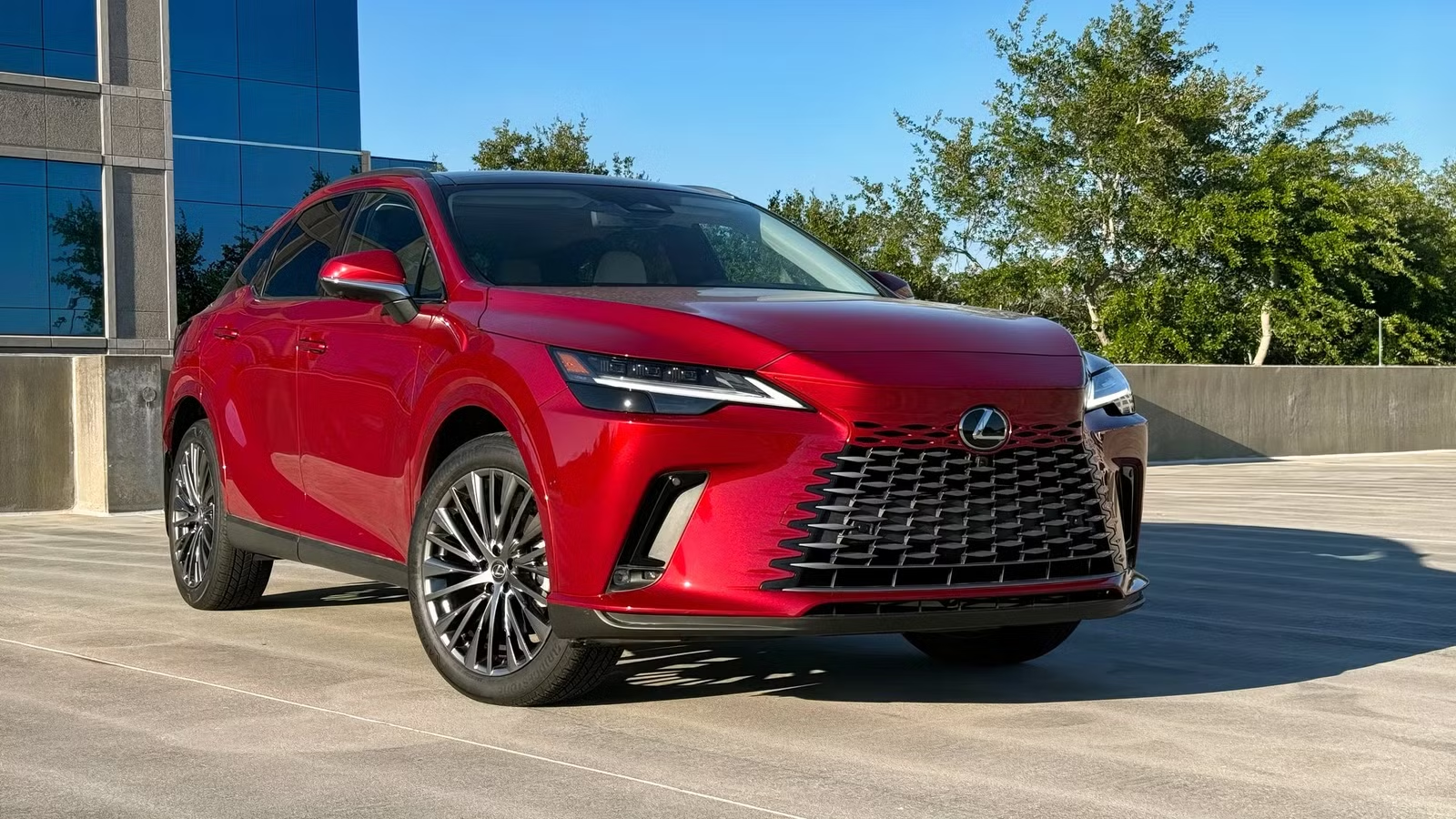
Close-up shot of 2025 Lexus RX 500h F SPORT Performance grille and front endLexus
Lexus has cultivated its reputation for outstanding reliability by prioritizing a conservative engineering philosophy that avoids experimental technology in favor of thoroughly proven platforms. As Toyota’s premium arm, Lexus leverages the mechanical resilience of Toyota’s long-tested, durable powertrains . Doing so ensures that components have already undergone decades of real-world refinement. This commitment is underpinned by a manufacturing culture that prioritizes rigorous oversight and attention to detail, ensuring every vehicle meets high quality standards.
Rather than chasing the latest, potentially temperamental trends, Lexus focuses on continuous improvement of its core systems, supported by exhaustive pre-production testing across extreme environments. This systematic, detail-oriented approach creates a level of mechanical predictability and long-term durability that consistently places the brand at the top of industry dependability studies, offering owners the rare combination of premium luxury and resistance to frequent, costly repairs.
How The ICE And Hybrid RX Models Compare
Front 3/4 of Lexus RX 450h+ Luxury drivingLexus
The entry point for the 2026 Lexus RX 350 in front-wheel-drive configuration has a starting MSRP of $52,775. Equipping the base model with all-wheel drive adds $1,600, bringing the starting price to $54,375. In contrast, the 2026 Lexus RX 350h includes all-wheel drive as standard equipment across its trim structure and starts at $55,075 MSRP. Comparing equivalent all-wheel-drive base models reveals a precise upfront price premium of $700 for the hybrid powertrain.
This pricing relationship remains consistent as buyers move up through matching equipment tiers. The RX 350 Premium AWD starts at $56,550, while the RX 350h Premium AWD commands $57,250. The RX 350 Premium+ AWD lists at $60,040, compared to $60,740 for the RX 350h Premium+ AWD. At the range-topping level, the RX 350 Luxury AWD costs $65,095, while the RX 350h Luxury AWD sits at $65,795. Comparing all-wheel-drive variants yields an exact $700 price delta across equivalent trims. When compared to front-wheel-drive gas models, the hybrid’s premium increases to $2,300.
The Hybrid Optimizes Fuel Consumption Returns
Lexus RX 450h+ engine bayLexus
The mechanical foundations of these two models cater to different driving priorities. The non-hybrid RX 350 utilizes a 2.4-liter turbocharged four-cylinder engine paired with an eight-speed automatic transmission. This setup produces 275 horsepower and 317 pound-feet of torque. The hybrid RX 350h pairs a naturally aspirated 2.5-liter inline four-cylinder engine with electric motors and an electronically controlled continuously variable transmission, generating a total system output of 246 hp and 233 lb-ft of torque. Fuel economy testing by the EPA highlights the efficiency gap between the two setups.
The front-wheel-drive RX 350 achieves an estimated 22/29/25 MPG on the city/highway/combined cycle. Equipping all-wheel drive lowers those estimates to 21/28/24 MPG. The hybrid RX 350h delivers an EPA-estimated 37/34/36 MPG. City driving showcases the largest divergence, with the hybrid securing a 16 MPG advantage over the all-wheel-drive gas model due to regenerative braking and low-speed electric power. Both powertrains require premium unleaded gasoline.
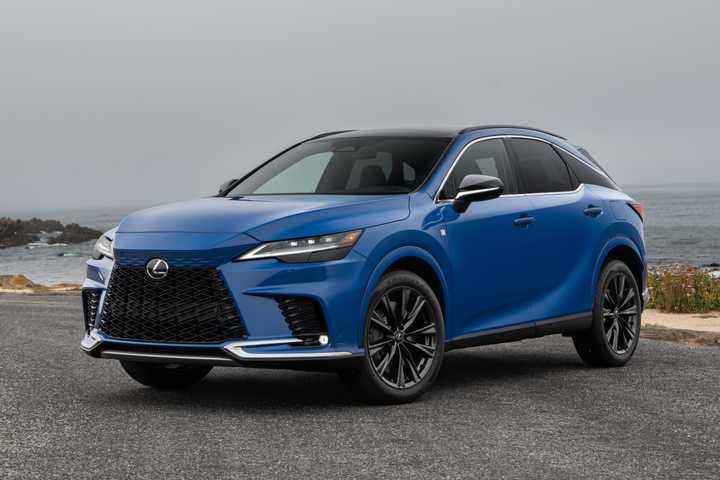
Front 3/4 shot of a blue 2026 Lexus RXLexus
Calculating the operational payoff period depends on annual mileage, fuel prices, and drive cycles. Assuming an average annual driving distance of 15,000 miles and a premium gasoline price of $4.10 per gallon, the financial calculations reveal a rapid return on investment. An RX 350 AWD consuming fuel at a rate of 24 MPG combined uses 625 gallons of gasoline annually, resulting in an estimated annual fuel cost of $2,562.50. The RX 350h AWD consuming fuel at 36 mpg combined uses 416.67 gallons annually, requiring an estimated annual fuel cost of $1,708.33.
The resulting operational savings equal $854.17 per year in favor of the hybrid. When comparing equivalent all-wheel-drive models with a $700 price gap, the hybrid engine recoups its initial premium in under 10 months or roughly 12,300 miles. If comparing the RX 350h AWD to a front-wheel-drive gas RX 350 with a $2,300 price difference, the payoff timeline extends to approximately 2.7 years or 40,400 miles. Over a typical five-year ownership period covering 75,000 miles, the RX 350h saves its owner approximately $4,270 in fuel costs compared to the all-wheel-drive gas model.
Impressive Performance Figures From Both Drivetrains
Front 3/4 action shot of 2025 Lexus RX 500h F SPORT Performance in black driving on desert roadLexus
On-road evaluations demonstrate distinct operational characteristics for each vehicle. The turbocharged RX 350 delivers stronger immediate acceleration and higher peak torque. Independent testing indicates a 0 to 60 MPH time of 7.2 seconds for the all-wheel-drive gas model. The conventional eight-speed transmission provides traditional gear shifts under hard acceleration, appealing to drivers who prefer defined engine power bands. Under heavy load, the turbocharged engine maintains a subdued exhaust note, though initial throttle response features a slight delay while boost builds.
The hybrid RX 350h achieves 0 to 60 MPH in 7.4 seconds, trailing the gas version by two-tenths of a second. However, initial off-the-line response feels brisk due to instantaneous electric motor torque. At low speeds and during stop-and-go driving, the hybrid operates in elevates overall cabin quietness when operating on electricity. Under heavy acceleration or steep grade climbing, the 2.5-liter engine revs high and holds steady engine speeds via the eCVT, introducing more engine noise into the cabin than the turbocharged variant under full throttle.
The Lexus RX’s Exemplary Value Retention
2025 Lexus RX350h F Sport Design front shotLyndon Conrad Bell – Photo
The 2026 Lexus RX is a segment-leading midsize luxury SUV when it comes to long-term value retention and running costs. iSeeCars highlights that the RX 350 will lose $19,038, or 38.9 percent of its value, after five years or 60,000 miles, which is almost 15 percent better than its main rivals. According to CarEdge, the Lexus RX Hybrid will cost you an estimated $57,867 over five years or 60,000 miles.
This includes $25,704 on depreciation, $12,910 on insurance, $6,415 on fuel, $10,246 on financing, and $2,592 on maintenance. In terms of ownership costs, Edmunds suggests that the base 350’s drivetrain is likely to set you back by $75,179 over five years and 60,000 miles, consisting of $10,483 for maintenance, $1,310 for repairs, $24,152 for depreciation, and $16,024 to fuel.
2025 Lexus RX350h F Sport Design EngineLyndon Conrad Bell – Photo
The Lexus RX badge achieves strong success in the U.S. because it creates a smooth blend of comfort, refinement, and everyday usability that American buyers have valued since the Japanese brand introduced it. It delivers quiet rides, reliable build quality, and easy ownership, which encourages long-term loyalty and strong word of mouth. It also offers controlled handling, efficient powertrains, and a cabin that feels upscale without overwhelming controls. Families appreciate its practical size and generous cargo space, and buyers trust its strong reliability record. Lexus dealers back it with a consistent service experience, which reinforces confidence and keeps demand steady across multiple generations.
Fans And Critics Love The RX
A front left three-quarter tracking shot of a black 2026 Lexus RXLexus
The Lexus RX is undeniably the best SUV you can consider if you value reliability above everything else. The range achieves impressive ratings across all of its testing thanks to its well-balanced drivetrain and interior design. J.D. Power gives the model an 85/100 overall score, which consists of 85/100 for quality and reliability, 82/100 for the driving experience, 84/100 for resale, and 87/100 for the dealership experience.
2025 Lexus RX350h F Sport Design rear 3/4 shotLyndon Conrad Bell – Photo
iSeeCars backs this with an 8.3/10 overall score, including 8.6/10 for reliability, 8.2/10 for retained value, and 8.0/10 for safety. The publication also indicates that you can expect the RX 350 to last you 14.7 years or 170,975 miles before you encounter any noteworthy mechanical issues, with a 31.7-percent probability of reaching 200,000 miles.
Impressive Long-Term Reliability
Low-angle front 3/4 action shot of 2025 Lexus RX in bronze driving on coast roadLexus
Beyond fuel economy, long-term maintenance items affect total ownership costs. Hybrid powertrains alter standard mechanical wear patterns. Regenerative braking systems handle a large portion of initial deceleration, converting kinetic energy into battery storage. This mechanism reduces wear on traditional brake pads and rotors, extending replacement intervals compared to conventional gas vehicles.
The hybrid model eliminates traditional accessory belts, using electric motors to power components like the water pump and air conditioning compressor. The eCVT utilizes a planetary gear set design with fewer moving parts than a traditional torque-converter automatic transmission, contributing to mechanical durability. While the hybrid battery pack represents a potential long-term replacement item, Lexus backs hybrid components with a 10-year or 150,000-mile factory warranty, mitigating secondary-owner financial risk. Non-hybrid models feature fewer total electronic modules but experience higher wear on friction brakes, starter components, and engine oil due to thermal cycling from the turbocharger.
The Hybrid Masters Long-Term Affordability And Reliability
A black 2025 Lexus RX Plug-In Hybrid SUV is driving. Lexus
Selecting between these two luxury crossovers depends on primary vehicle usage and regional driving conditions. The non-hybrid Lexus RX 350 represents the appropriate choice for specific driver profiles. These include drivers who predominantly cover open highway miles, where the hybrid’s efficiency advantage narrows. Buyers who prefer front-wheel drive to minimize initial purchase costs or live in warm climates with minimal precipitation. Enthusiasts who prefer traditional stepped gear shifting over continuous variable transmission dynamics. Owners who plan to tow small trailers should consider the gas RX 350, as it carries a 3,500-pound maximum tow rating, which is better than the hybrid.
The Lexus RX 350h stands out as the superior overall value for the majority of luxury crossover buyers. This includes urban and suburban commuters who operate in frequent stop-and-go traffic conditions, maximizing regenerative braking benefits. All-weather drivers, like standard all-wheel drive, come included at a minimal price premium over the gas equivalent. High-mileage owners are also looking to lower monthly fuel bills and reduce long-term brake maintenance costs.
Buyers seek maximum total driving range, as the RX 350h provides up to 619 miles per tank compared to roughly 430 miles in the gas model. For equivalent all-wheel-drive builds, the hybrid’s $700 price premium pays for itself within the first year of ownership. Combining a low upfront cost with reduced running expenses, superior city refinement, standard all-wheel drive, and strong expected residual value, the 2026 Lexus RX 350h represents the smarter overall financial and practical purchase.
Base Trim Engine
2.5L I4 Hybrid
Base Trim Transmission
2-speed CVT
Base Trim Drivetrain
All-Wheel Drive
Base Trim Horsepower
183 HP @6000 RPM
Base Trim Torque
233 lb.-ft. @ 4300 RPM
Base Trim Fuel Economy (city/highway/combined)
37/34/36 MPG
Base Trim Battery Type
Nickel metal hydride (NiMH)
Make
Lexus
Model
RX
Sources: Lexus, J.D. Power, iSeeCars, Edmunds, CarEdge, and the EPA.













No Comments