
The Spanish Two-Stroke That Invented The Dual-Sport Before Japan
When enthusiasts discuss the origins of the modern dual-sport motorcycle, the conversation usually begins with Japanese brands that popularized the concept during the late 1970s and early 1980s. Those machines undoubtedly brought the formula to a global audience, combining everyday usability with genuine off-road capability.

Yet the blueprint existed years earlier. Hidden in the history books is a lightweight Spanish motorcycle that blended trials-inspired agility with enduro performance long before the segment had a name. Although it never achieved mainstream success, its influence deserves far more recognition than it receives today.
Before Japan Claimed The Dual-Sport Formula, Europe Was Already Experimenting
By the late 1960s, recreational motorcycling was evolving rapidly. Riders increasingly wanted a single machine that could handle forest trails on the weekend without needing a trailer to reach them. Instead of owning separate road and competition motorcycles, many buyers looked for lightweight bikes that could legally travel public roads before tackling dirt tracks, fire roads, and rugged terrain. This growing demand encouraged manufacturers to rethink traditional motorcycle categories.

Spain proved to be fertile ground for this new direction. Rather than focusing on high-speed road machines, brands such as OSSA, Bultaco, and Montesa had built strong reputations through observed trials, scrambles, and enduro competition. Their engineers understood the importance of low weight, tractable power, and predictable handling on technical terrain. With extensive off-road racing experience already embedded in their designs, Spanish manufacturers were naturally equipped to create versatile motorcycles that blurred the line between competition bikes and everyday transport.
The OSSA Pioneer Arrived Years Before The Segment Had A Name

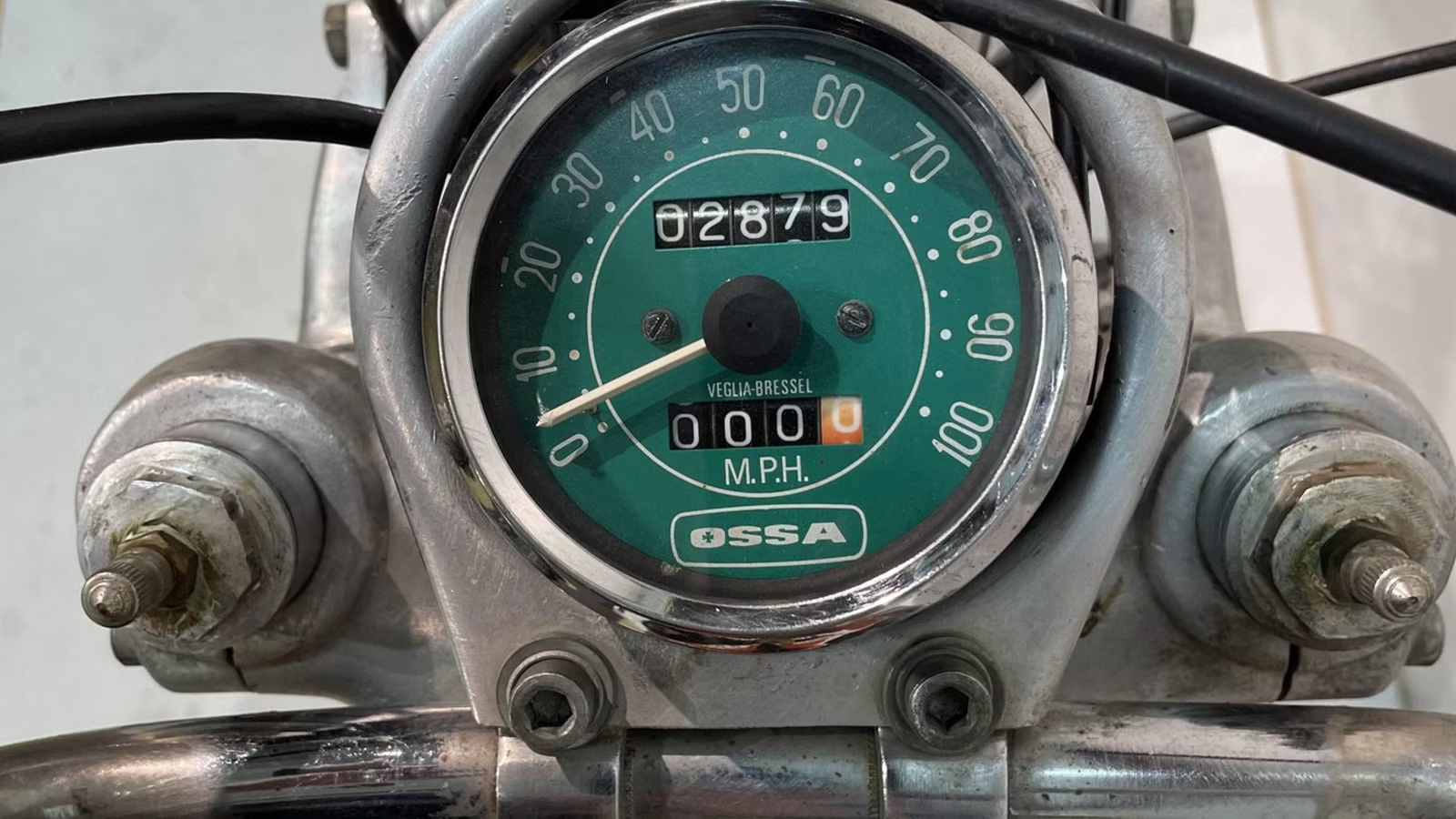
When OSSA unveiled the Pioneer for the 1969 model year, it was not presented as a conventional trail bike or a dedicated competition machine. Instead, the company described it as a versatile off-road motorcycle that borrowed heavily from its successful Stiletto scrambler and trials program while remaining practical enough for recreational riders.
It featured lighting equipment, a speedometer, and other road legal essentials, but its real focus remained tackling demanding terrain with confidence rather than chasing outright speed. That balance between road legality and genuine off-road capability was remarkably forward-thinking. The Pioneer could negotiate slow, technical sections with the composure of a trials bike before comfortably covering fire roads and connecting routes under its own power.
Decades before “dual sport” became an established market segment, OSSA had already demonstrated the core formula: one lightweight motorcycle capable of handling both public roads and challenging trails without significant compromise.
Its Lightweight Two-Stroke Delivered Exactly What Technical Trails Needed

Power came from a 244-cc air-cooled, single-cylinder, two-stroke engine producing approximately 21 bhp at 7,800 rpm. Rather than delivering a peaky powerband that demanded constant high revs, the engine was praised for its flexible torque, allowing riders to crawl through rocky climbs and slippery sections before accelerating cleanly onto faster trails.
Period sources list a 10:1 compression ratio for the original model, while later references note a 12:1 specification, indicating that OSSA introduced engine revisions during the Pioneer’s production run. Equally important was its remarkably low weight. Cycle World recorded a curb weight of just 243 pounds, making the Pioneer noticeably lighter than many contemporary off-road machines. Combined with its responsive engine, the reduced mass made direction changes easier, improved rider confidence in dense woodland, and helped the bike maintain traction where heavier motorcycles often became tiring to wrestle through technical terrain.
A Trials-Inspired Chassis Made It Feel Unlike Conventional Enduro Bikes
One of the Pioneer’s greatest strengths came from the engineering philosophy behind it. OSSA had already earned international respect in observed trials, particularly after signing British champion Mick Andrews, whose feedback helped shape the company’s off-road motorcycles.
Rather than prioritizing outright stability at high speed, the chassis was designed to remain balanced, predictable, and easy to place over rocks, roots, and uneven ground. That emphasis on precision gave riders confidence in situations where accurate wheel placement mattered more than outright horsepower.
The suspension complemented that approach. Up front were Telesco or Betor telescopic forks offering approximately seven inches of travel, while the rear featured five-way adjustable shock absorbers that allowed owners to tailor the ride to different terrain.
Combined with its compact dimensions and light steering, the Pioneer could weave through tight woodland sections and technical obstacles with an agility that many larger enduro motorcycles of the period struggled to match.
It Packed Technology Many Japanese Bikes Had Yet To Adopt

Beyond its engine and chassis design, the Pioneer also demonstrated how ambitious OSSA was with its technology. One of its most notable features was the Motoplat solid state electronic ignition system, which replaced traditional contact breaker points. For riders who regularly encountered mud, water crossings, and harsh off-road conditions, the system offered improved reliability because it was less vulnerable to moisture and required less maintenance than conventional ignition setups of the era.
OSSA also gave the Pioneer a distinctive appearance with lightweight fiberglass bodywork, helping keep overall mass low while creating a unique identity among contemporary motorcycles.
Despite its competition-inspired engineering, the machine included the equipment needed for road use, including lights and a speedometer. This combination allowed riders to travel legally between trails while retaining a motorcycle designed primarily for demanding off-road exploration.

Contemporary testers quickly recognized that the Pioneer did not fit neatly into existing motorcycle categories. In its 1969 evaluation, Cycle World famously described the machine as a “Stiletto scrambler in drag,” referencing its connection to OSSA’s lightweight competition scrambler while highlighting the way its road equipment disguised its dirt-focused character. The phrase captured the motorcycle’s unusual dual nature: a machine that looked suitable for everyday use but retained the aggressive capability of a competition-derived off-road bike.
Road testers praised its ability to move between slow, technical trails and faster connecting roads without losing its purpose. However, performance figures varied between publications. Period testing placed top speed around 70 to 73 mph, while later retrospectives have quoted figures closer to 80 mph. These differences likely reflect variations in testing conditions and model specifications rather than major differences in capability.
Japan Perfected The Formula, But Spain Got There First

The Pioneer’s importance becomes clearer when viewed alongside the motorcycles that later defined the dual-sport category. Models such as Yamaha’s DT series and Honda’s XL range brought similar ideas to a far wider audience, combining dependable engines, practical road equipment, and genuine off-road ability in a package accessible to everyday riders.
The key difference was scale. Yamaha and Honda possessed enormous production capacity, established dealer networks, and global marketing reach that allowed them to transform dual-purpose motorcycles into mainstream products. OSSA, despite its engineering talent and competition success, remained a much smaller Spanish manufacturer with limited production numbers and export visibility. As a result, the Pioneer’s innovative approach became overshadowed by the Japanese machines that followed.
Limited Production Helped Turn A Pioneer Into A Forgotten Classic

The Pioneer’s disappearance from mainstream motorcycle history was not caused by a lack of ability, but by the challenges facing a small manufacturer. OSSA produced motorcycles in far smaller numbers than the Japanese companies that entered the growing dual-purpose market, while its export reach and dealer support remained limited in comparison.
As Yamaha and Honda expanded globally with affordable, mass-produced alternatives, niche Spanish machines like the Pioneer gradually became harder to find and less visible to new generations of riders.
Today, the motorcycle deserves recognition because it demonstrated a concept that would become central to adventure and dual-sport riding decades later. By combining a lightweight competition-inspired chassis, flexible two-stroke power, and everyday usability, OSSA created a remarkably complete formula before the market had fully recognized it. The Pioneer remains a reminder that innovation does not always come from the largest manufacturers.
Sources: Cycle World, Motorcycleclassics

Related posts

Latest Post


No Comments