The Luxury Sedan That Quietly Outruns German Rivals
7 minutes reading
Tuesday, 25 Aug 2026 15:00 0 5 autotech
Compact luxury sport sedans have become a two-brand conversation, with BMW’s M340i and Mercedes-AMG’s C43 hogging the spotlight. But there’s a third contender that keeps getting overlooked, despite offering more horsepower than one German rival and a lower price than both. This Genesis sedan pairs a twin-turbo V6 with rear-wheel-drive dynamics and a genuinely upscale cabin, all while starting tens of thousands below its established competition. It’s the sleeper of the segment, and it’s time more buyers noticed.
The compact luxury sedan segment has always had a hierarchy. BMW and Mercedes sit at the top, backed by decades of badge equity and motorsport pedigree, while everyone else gets filed under “alternative.” That hierarchy made sense when Korean brands were still finding their footing. It doesn’t make as much sense anymore.
The 2026 Genesis G70, in its range-topping 3.3T guise, is the car that exposes the gap between reputation and reality. It’s a compact sedan wearing a mid-size engine’s output, built on a rear-wheel-drive platform tuned by engineers who clearly studied the segment’s benchmarks closely. The result is a car that drives like it belongs a class above its price point, delivering the kind of straight-line urgency and chassis composure that used to be the exclusive domain of the establishment.
Rear 3/4 shot of 2026 Genesis G70 parked on drivewayGenesis
None of this is a coincidence. Genesis built the G70 specifically to hunt the 3 Series and C-Class, and the 3.3T variant is where that intent shows up most clearly in the spec sheet, not just the marketing copy.
Twin-Turbo V6 Power Gives This Genesis Serious Straight-Line Pace
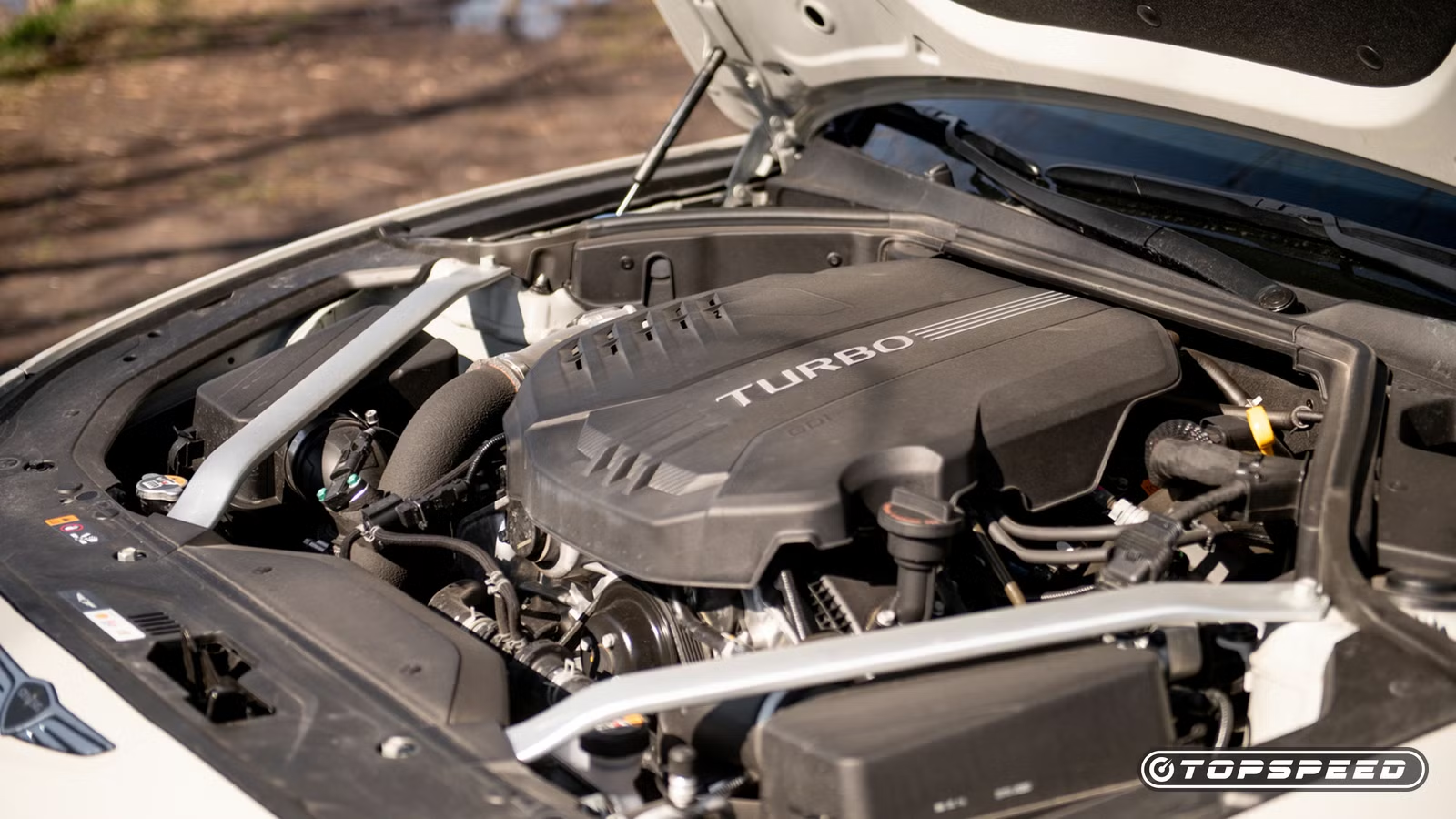
Close-up shot of 2025 Genesis G70 engine bayGenesis
Here’s the number that should turn heads: 365 horsepower and 376 pound-feet of torque, courtesy of a 3.3-liter twin-turbocharged V6 sitting under the G70’s hood. That output arrives via an eight-speed automatic, sending power to the rear wheels or all four depending on configuration, and it’s enough to push the G70 3.3T from 0-60 mph in roughly 4.5 seconds.
Why That Figure Isn’t Just Quick For A Compact Luxury Sedan
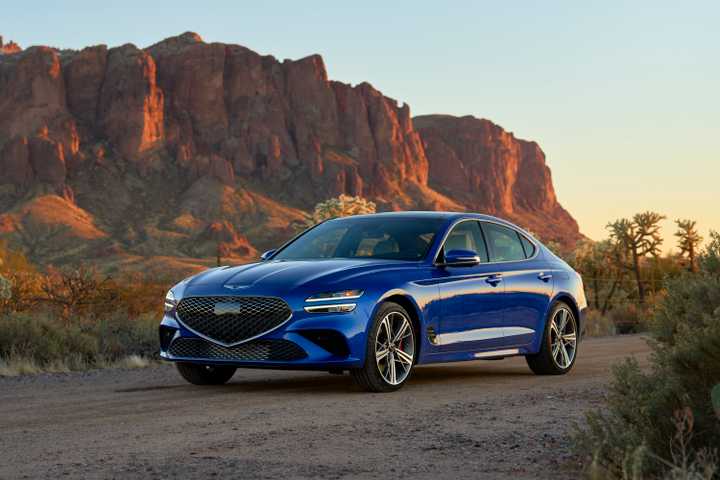
Profile action shot of 2026 Genesis G70 in blue drivingGenesis
It’s genuinely competitive with cars that cost significantly more, and it doesn’t rely on complex electrification to get there. While rivals lean on turbocharged four-cylinders bolstered by mild-hybrid assistance to hit their numbers, the G70 does it with an honest, high-displacement six-cylinder that delivers power in a broader, more linear band. Torque arrives as low as 1,300 rpm and holds strong through the mid-range, which means the G70 doesn’t need to be wound out to feel fast. It pulls hard from a stoplight and keeps pulling well past highway speeds, with Genesis quoting a top speed of 168 mph.
The engine itself has been in service since the G70 launched, and Genesis has used the years since to refine calibration rather than chase bigger numbers. That’s a sign of a powertrain that was engineered right the first time rather than one playing catch-up.
Sharp Handling And Rear-Wheel Drive Make It More Than A Highway Cruiser
Rear 3/4 action shot of 2026 Genesis G70 in blue driving on roadGenesis
Straight-line speed is easy to fake with enough boost. Composure through a corner is not, and this is where the G70 3.3T separates itself from a merely quick sedan and earns the “sport” part of its sport-sedan billing.
The RWD-based platform, standard on the 3.3T’s base configuration, puts the G70’s weight distribution and steering feel closer to what enthusiasts expect from a proper driver’s car than what they’d assume from a Korean brand’s first serious attempt at the segment. Standard Brembo brakes on every 3.3T trim provide the kind of stopping confidence that matters when a car this quick needs to shed speed just as fast as it builds it. Body control stays tight during hard cornering, with minimal lean, and the suspension tuning threads the needle between daily comfort and back-road eagerness better than most rivals manage.
2025 Genesis G70 overhead shotGenesis
Drive Mode Select lets owners toggle between Comfort, Sport, and Sport+ settings that meaningfully alter throttle response, steering weight, and transmission behavior rather than just adjusting a digital gauge cluster theme. In its sportier settings, the G70 holds gears longer and sharpens throttle mapping, rewarding drivers who actually want to use the chassis Genesis built rather than just admire it in a parking lot. All-wheel drive is available for buyers who want it, but the rear-wheel-drive variant is the one that shows off what this platform was actually designed to do.
A Refined Cabin Brings Genuine Luxury Without The German Price Premium
Shot of 2026 Genesis G70 interior showing cockpitGenesis
Performance numbers only tell half the story in this segment, because buyers cross-shopping the M340i and C43 are paying just as much for cabin ambiance as they are for acceleration times. This is traditionally where Korean brands lost ground to the Germans, and it’s also where the G70 has closed the gap most convincingly.
The interior wraps quilted leather across the seats and door panels, with contrast stitching and a driver-focused dashboard layout that doesn’t feel like a cost-cutting exercise dressed up with soft-touch plastic. Sport Prestige trims add heated and cooled front seats, a heated steering wheel, and a suite of tech features including adaptive cruise control and a full digital instrument cluster, all bundled in a way that doesn’t require chasing down a dozen individual options.
Shot of 2026 Genesis G70 Prestige Graphite interior showing seatingGenesis
Genesis backs it with a warranty that outpaces both German rivals by a wide margin, a detail that matters more once the factory coverage on a used M340i or C43 has run out. The G70’s rear seat and trunk remain its weak points, tighter than most buyers would like in this segment, but everywhere the driver and front passenger actually spend their time, the cabin holds its own against cars costing thousands more.
The Overlooked Alternative To The BMW M340i And Mercedes-AMG C43
Put the numbers side by side and the case for the G70 3.3T stops being a matter of opinion. The BMWM340i’s turbocharged 3.0-liter inline-six makes 386 horsepower and 368 pound-feet of torque, hitting 60 mph in 4.4 seconds depending on configuration and testing conditions, and it starts at approximately $62,300 before options. The Mercedes-AMG C43 counters with 416 horsepower and 369 pound-feet from a turbocharged four-cylinder assisted by a mild-hybrid system, reaching 60 mph in about 4.3 seconds, with a starting price around $64,150.
The G70 3.3T starts at roughly $53,600 depending on model year and drivetrain, undercutting the M340i by close to $10,000 and the C43 by even more, while delivering a 0-60 time that lands right in the in the same ballpark of both rivals. Yes, the C43 out-muscles it on paper by 51 horsepower, and the M340i edges it out in outright horsepower too. But neither German competitor beats the G70 on value, and the acceleration gap between all three is close enough that it disappears entirely in real-world driving.












No Comments