
The Bullitt Mustang Steve McQueen Tried To Buy Back For Years
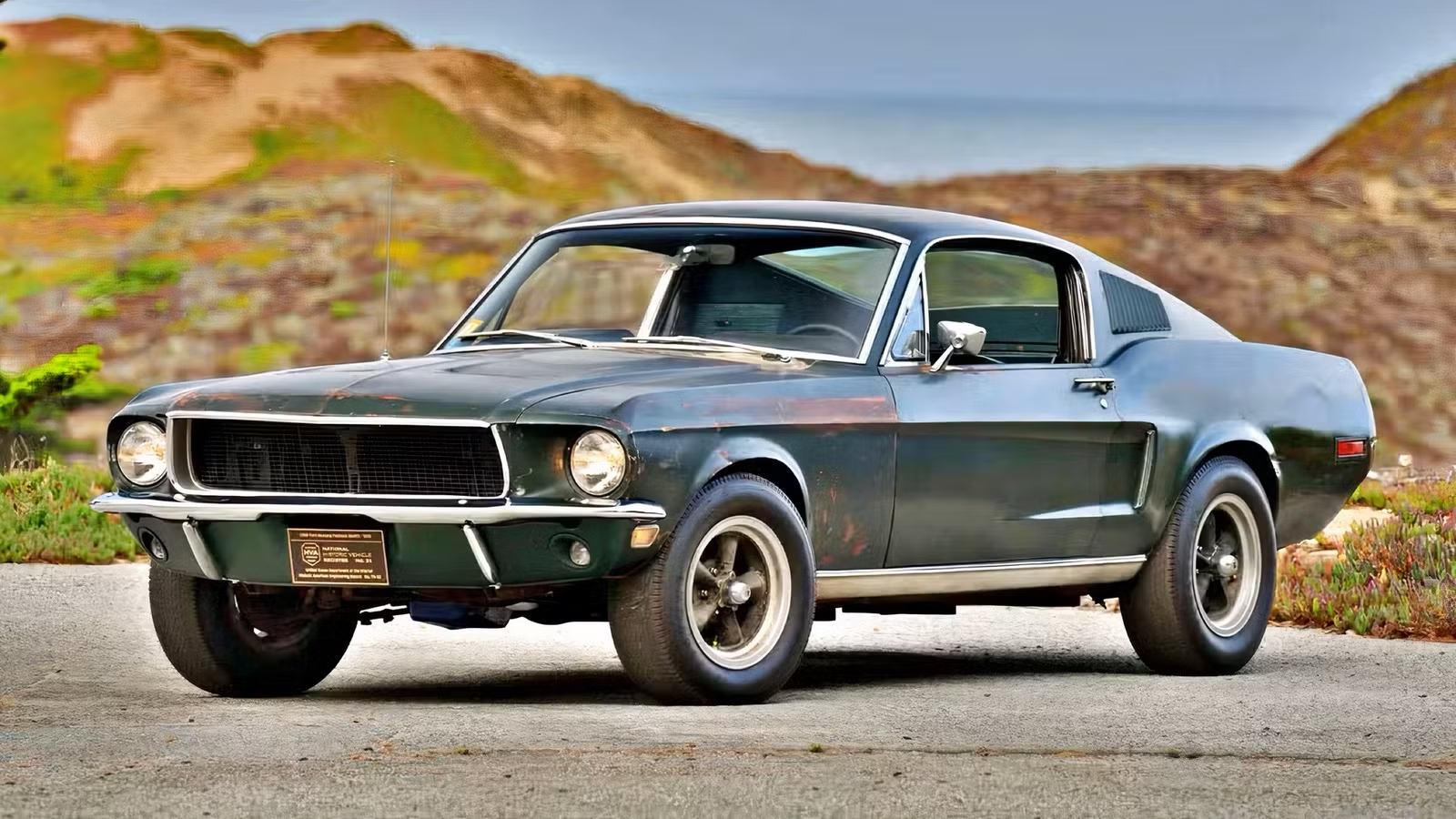
As movie cars go, the Ford Mustang used by Steve McQueen’s character in Bullitt has to be one of the most famous. If you know the movie, you’ll know why this Highland Green pony car captured the imaginations of so many car fans back in the ’60s and to this day.

The car became synonymous with McQueen’s on-screen persona, but the story didn’t end when filming wrapped up. Steve McQueen is famous for having one heck of a car and motorbike collection, so it’s perhaps no surprise that he wanted the OG Bullitt Mustang for himself. However, getting his hands on it proved a lot more difficult than expected.
How One Highland Green Mustang Became The Most Famous Movie Car Ever Made
Some movies and TV shows are good because the stories work; others work despite the story because of the actors in them; and some work because of the cars in them. Take KITT from Knight Rider . Technically, it is a 1982 Pontiac Trans Am, but ask anyone who grew up watching the show, and they’ll remember it for the red scanner light, sarcastic personality, and the ability to drive itself. The Trans Am has a lot going for it on its own, but the show made it one of the most recognizable cars ever.

Then there is something like the 1963 VW Beetle from The Love Bug. Herbie isn’t exotic, but the little white Beetle adorned with racing stripes and ’53’ painted on its hood became a character in its own right. The Ford Mustang GT from the Gone in 60 Seconds remake also deserves mention; it is one of the most famous movie Mustangs ever for more than just its 5.7-liter V8 , muscular finish, Chip Foose custom job, and paint scheme. Eleanor was a legitimately credited character in the original and became a cult hero.
A Stripped-Down, Debadged Fastback Was The Only Car Frank Bullitt Could Drive

If you’ve never seen Bullitt, go watch it. If you have, you’ll know that the 1968 Ford Mustang GT Fastback used by Steve McQueen in the movie is irreplaceable. Frank Bullitt is a San Francisco police officer who, as you may have guessed from some of McQueen’s other roles, doesn’t always do things quite by the book. So what better car for him to drive than the original blue-collar performance pony car?
The production team and Steve McQueen also wanted a car that would suit the grittiness of the movie and handle the winding hills and streets of Russian Hill. So, a Mustang GT Fastback with a naturally aspirated V8 under the hood fits the bill immediately.

McQueen’s character drives a ’68 GT Fastback with a 6.4-liter (390 cubic-inch) big-block V8 producing 325 horsepower and 427 pound-feet of torque, with power routed through a Borg-Warner T-10 four-speed manual. It has heavy-duty shocks in all four corners, heavy-duty coil springs, and reinforced shock mounts, subframe, and cross-beams to take the hammering it was given during filming.
Unlike most Mustangs of the time, it has no side stripes or graphics; it has been totally debadged and fitted with 15-inch American Racing Torq Thrust mag wheels, and gets a blacked-out tail panel. In short, it is the ideal car for a stern 1960s cop who drives fast.
The Bullitt Ford Mustang GT Fastback Became A Piece Of Hollywood History
When Bullitt arrived in ’68, Hollywood and Steve McQueen had already made quite a few movies about driving fast and jumping over things. What it didn’t have, though, was anything quite like this. The Mustang wasn’t added to the movie as some polished fantasy-factory machine, which made Frank Bullitt feel like a real guy who just happened to be driving a rather cool car.
That kind of distinction mattered; the car was there to be part of the movie’s stripped-back feel and, since then, it has become one of those rare bits of New Hollywood movie memorabilia that some people can spot from a single glance.
10 Minutes, No Music, No CGI — And The Best Car Chase Ever Filmed
Before one of the most famous movie-car scenes ever, we get glimpses of Bullitt driving the Mustang around and the growl of the big-block, but then there is the chase scene. This is where the Mustang stopped being just another battered car. McQueen’s character notices he is being tailed by a black 1968 Dodge Charger R/T before pulling over to let them pass. What follows is one of the best chase scenes ever, with two V8-powered cars from the golden age of muscle tearing through the city.
The chase lasts around 10 minutes, and took three weeks to film. McQueen handled much of the driving himself, while stunt drivers, including Bud Ekins (the man who performed the motorcycle jump in The Great Escape for McQueen), took over for some of the more dangerous sequences. At some points, they were hitting 110 mph, which is outrageous by today’s standards on a city street, never mind in 1968.

There are some errors, like the Charger seemingly gaining and losing hubcaps between shots, but it doesn’t matter. The good guy wins when the Charger crashes and explodes.
There is no music in the background, no CGI, and no one commenting on the danger—just real driving skill. Both cars bounce, slide, and launch over hills; the tires smoke, the engines are pushed hard, and both take a severe beating. Nearly 60 years later, it still feels very real.
Steve McQueen Gave The Car Something Special

Steve McQueen’s influence on the Mustang went way beyond simply sitting behind the wheel. He was a serious racer and car enthusiast, and that came across in Bullitt. The Mustang isn’t treated like a prop; it gets dirty, takes a hit, and is driven with real aggression that makes it feel like a real part of Frank Bullitt. Plus, it’s Steve McQueen; it doesn’t get much cooler.
Maybe the biggest compliment he could give the GT Fastback, though, was after the cameras stopped rolling. He reportedly didn’t just see it as another car from another movie. He wanted it. Unfortunately for him, it wouldn’t simply end up back in his garage when filming was over. Instead, it would go on a long, strange journey.
The Mustang’s Disappearance Made The Story Even Bigger

After Bullitt, the Mustang’s life became surprisingly normal. Robert Kiernan bought it in 1974 after spotting an ad in Road & Track, paying $3,500 for it. He knew it had been in the movie, but it wasn’t treated like some priceless artifact. His family actually used it as an everyday car. McQueen tracked Kiernan down and called him, asking about the Mustang and whether he would sell it. Kiernan’s answer was simple: no.
McQueen wasn’t quite ready to give up, though. In December ’77, he sent a letter asking to “get back my ’68 Mustang.” He wanted to keep it in the same condition it had been in during Bullitt, rather than restore it, and even offered to find Kiernan a similar model if it didn’t involve “too much monies.” Kiernan still wasn’t interested. At that point, the Bullitt Mustang belonged to his family, and that was that.
Its Whereabouts Stayed A Mystery For Decades

The Mustang then just disappeared from public view. The Kiernans continued using it until a clutch problem in 1980 left it parked, where it would remain. McQueen died that same year and never got his Mustang back, and the Bullitt Mustang became something of a car-world ghost story. People knew it was out there somewhere, but nobody outside a very small circle knew exactly where.
The family weren’t trying to create some elaborate mystery either. It was simply their car, and they had little reason to tell the world that they owned one of the most recognizable movie cars ever. That changed in 2015 when Sean Kiernan mentioned the Mustang to his boss, Casey Wallace, who was working on a documentary about Bullitt. Wallace immediately realized what Sean had sitting at home. After years of whispers, the real car had been found.
Camera Mounts, Original Dents, And A $3.4 Million Auction: The Mustang’s Survival Story

What’s even cooler about the original Bullitt Mustang is that it survived without being turned into some over-restored museum piece. The Kiernans put around 46,000 miles on the odometer, and it retained plenty of evidence from its time on screen, including the camera mounts underneath, all the dents, missing paint, and the large hole in the trunk made for a smoke machine. By the time Sean began bringing it back to life, it was rough, but still unmistakably the car McQueen had driven.
That originality became a huge part of the car’s appeal when it finally came up for air. It appeared at the 2018 Detroit Auto Show alongside the new Bullitt Mustang, effectively putting the original back in front of the world 50 years after the movie. Two years later, it went to auction, and sold for $3.4 million. It is now owned by a private collector. The car McQueen couldn’t buy back had gone from a family purchase to one of the most valuable Mustangs ever sold.
From Mexican Scrapyard To Museum Piece: The Full Story Of Both Bullitt Mustangs

The original Bullitt Mustang’s story is almost as good as the movie itself. Warner Bros. bought two Highland Green GT Fastbacks, with sequential VINs 8R02S125558 and 8R02S125559. The 558 was the stunt car, while 559 was the hero car used for McQueen’s close-ups and the one that sold for millions. The other was also thought to be gone forever, but it turned up in a Mexican scrapyard and has since been restored and displayed.
What makes the Bullitt Mustang even more remarkable is its legacy. The original went from ordinary Ford to movie star, family car, forgotten garage resident, and celebrity again, while its name lives on in the modern Mustang Bullitt. Ford revived the name for 2001, 2008, and 2019 cars, with the latter appearing alongside the original at its public reveal. Not bad for a Mustang that was never supposed to become a legend in the first place, let alone one this enduring.
Sources: Classic.com, Mecum, and Warner Bros.

Related posts


Latest Post


No Comments