
This Forgotten SUV Was America’s Fastest Sleeper For Over A Decade
Today, seeing a two-ton SUV with straight-line performance on par with sports cars and even supercars is quite normal. Family SUVs now pack 600-plus horsepower and are faster than purebred track cars from just a decade ago. This is now a multi-billion-dollar segment where every major luxury and performance automaker wants a piece. However, three decades ago, the concept of a performance SUV was practically unheard of. But in the early 90s, long before the industry realized what was happening, one audacious American automaker decided to quietly build one of the first high-performance SUVs that was capable of beating sports cars.
SUVs Were Never Meant To Be Fast

To appreciate just how radical this machine was, you have to look at the origins of the SUV. The term “Sports Utility Vehicle” leaned heavily on the word utility. Vehicles like the original Willys Jeep, the iconic Ford Bronco, the Land Rover Series models, and the early Chevrolet K5 Blazer were built to be rugged and practical. They were workhorses designed to haul timber, navigate unpaved trails, tow trailers, carry the whole family and survive the rigors of daily farm life.
These vehicles had tall ground clearance, heavy-duty solid axles, stiff leaf springs, and boxy styling. These were basically fancy trucks and speed was completely irrelevant. Driving an early SUV above highway speeds was an exercise in body roll, excessive steering play, and wind noise. Nobody bought a 4×4 expecting sports-car thrills; they bought one because it could crawl through mud and pull a stump out of the ground.
Performance Was Reserved For Dedicated Sports Cars

By the 1990s, performance was back in full swing after the oil crisis, and if you wanted great handling and neck-snapping acceleration, you bought a low-slung, lightweight two-door sports car. Iconic nameplates like the Chevrolet Corvette, the Nissan 300ZX Turbo, Mazda RX-7, and exotic Italian royalty like Ferrari and Lamborghini were the obvious choices. Even fast four-door sedans were still a niche subsegment restricted mostly to expensive European sports sedans from BMW and Mercedes-Benz. The idea of a sports SUV seemed counterintuitive. At the time, automakers saw zero financial or engineering reason to make such a vehicle.

America Decided To Change The Rules

As the 1990s dawned, American performance was undergoing an exciting renaissance. After surviving the smog-choked, low-horsepower era of the 1970s and 1980s, engineers were embracing electronic fuel injection, forced induction, and advanced engine management systems. Muscle cars were getting faster, and American brands were eager to push the envelope in ways foreign competitors wouldn’t dare attempt. A team of engineers inside General Motors began working on a project that was sure to disrupt the industry. The best part was that they didn’t need to start from scratch with a purpose-built chassis. GM wanted to take an everyday, unpretentious American workhorse and turn it into a straight-line monster.
A Small Truck-Based SUV Gets A Very Serious Powertrain

The foundation for this experiment already existed inside GM’s lineup. General Motors had been manufacturing compact pickup trucks and small SUVs based on its GMT330 platform with vehicles like the Chevrolet S-10/Blazer and the GMC Sonoma/Jimmy. These were modest, durable vehicles used by tradespeople, commuters, and small families. GM had already tested the waters in 1991 by releasing a limited-production high-performance pickup truck called the GMC Syclone.
The Syclone was a single-cab, short-bed mini-truck equipped with a turbocharged V6 and all-wheel drive. It shocked the automotive media by out-accelerating contemporary Ferraris in quarter-mile drag races. However, as incredible as the Syclone was, it suffered from one massive drawback: it was a tiny two-seater pickup with virtually no practicality. GMC knew that to truly make a lasting statement, they needed to adapt this incredible powertrain into a more practical, family-capable vehicle.
The GMC Typhoon Was A Performance SUV Based On A Truck

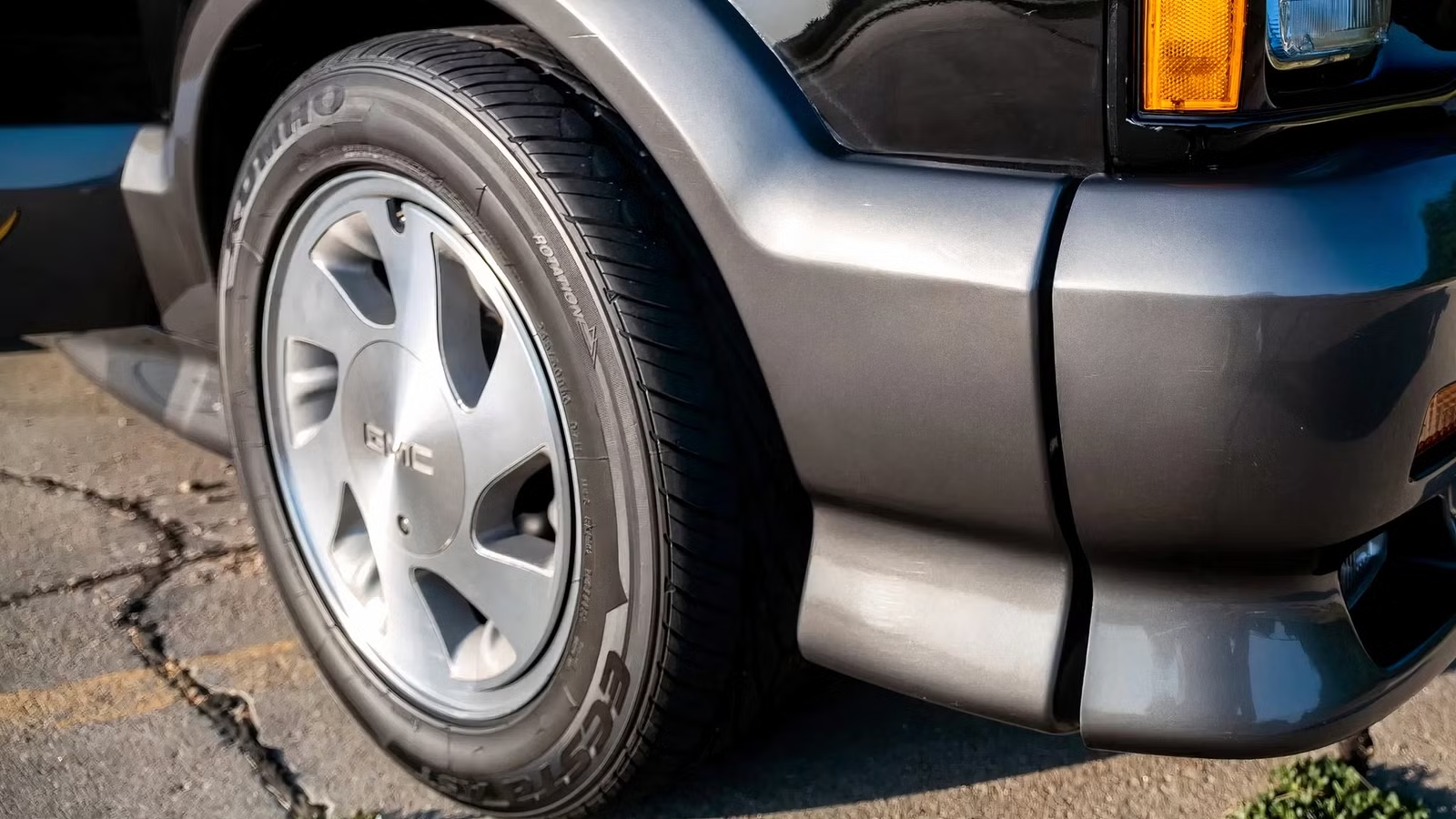
Enter the 1992 GMC Typhoon. Built for just two model years (1992 and 1993), the Typhoon took the boxy, compact two-door GMC Jimmy SUV chassis and transformed it into a genuine performer. Unlike traditional SUVs of the era that had chrome trim, high-profile off-road tires, and tall ride heights, the Typhoon looked mean and low to the ground. It was famously painted in black, but was also available in other colors, including Forest Green, Garnet Red, and Frost White.
The Typhoon had some aggressive styling with lower body cladding, flared wheel arches, integrated fog lamps, and distinctive 16-inch turbine-style aluminum wheels. This was strictly a two-door SUV, which was still impractical. Inside, it had bolstered leather bucket seats and rear seats that could only sit two smaller people. But the party piece was under the hood.
A Powerful Turbo V6 Made All This Possible

Traditional American performance cars are known for having big V8s, but underneath the Typhoon’s bulging hood sat a mechanical masterpiece: the 4.3-liter LB4 V6 engine. A standard 4.3-liter Vortec V6 made a modest 190 hp and 260 hp in its most powerful form. GM’s engineers heavily reworked the engine specifically for boosted applications. They installed nodular iron main caps, lower-compression pistons, special head gaskets, high-flow intake manifolds, unique exhaust manifolds, and a 48 mm twin-bore throttle body borrowed from GM’s 5.7-liter V8.
It was then fitted with a Mitsubishi TD06-17C turbocharger pushing up to 14 psi of boost. This turbocharged V6 made 280 hp and a massive 360 lb-ft of torque. This was a radical shift from traditional American performance. For decades, Detroit’s answer to fast cars had been simple: build a bigger, naturally aspirated V8. The Typhoon rejected that tradition in favor of forced induction and efficient electronic engine management. This approach had been pioneered before by the legendary 1987 Buick GNX.
This $30,000 SUV Started Humiliating Sports Cars

When auto journalists got their hands on the GMC Typhoon in 1992, the performance numbers sent shockwaves through the automotive industry. First off, it was priced at roughly $29,970, which was a hefty sum at the time, equivalent to nearly $65,000 today, but the Typhoon proved to be an absolute giant-killer on the street. During independent testing by Car and Driver, the 3,822-pound Typhoon rocketed from 0 to 60 mph in just 5.3 seconds and smashed the quarter-mile in 14.1 seconds. In wet conditions or off a stoplight, nothing on four wheels could touch it. For reference, it had a similar quarter-mile time as the C4 Corvette with the 300-hp LT1 V8 and two tenths behind the Ferrari 348ts with a 300-hp V8.
The secret to this ferocious off-the-line launch wasn’t just raw engine power; it was how the Typhoon put that power down. Power was sent through a heavy-duty 4L60 four-speed automatic transmission to a BorgWarner 4472 full-time all-wheel-drive transfer case. The transfer case used a viscous coupling to split torque continuously: 35% to the front wheels and 65% to the rear. Drivers could hold the brake, build boost at a standstill, release the pedal, and experience violent launches that left rear-wheel-drive sports cars spinning their tires in disbelief. To tame all that torque, GMC upgraded the brakes with anti-lock front discs and fitted an electronic self-leveling rear air suspension that kept the SUV flat during hard launches and tight cornering.
The SUV That Was Decades Ahead Of The Market

When car guys talk about the modern super-SUV boom, they default to the 2003 Porsche Cayenne or the BMW X5 M as the pioneers that established the high-performance SUV market. While those SUVs certainly popularized the segment for modern buyers, the GMC Typhoon established the exact blueprint a full decade earlier.
The Typhoon proved that high ground clearance and all-wheel drive weren’t just great for snow or off-road, but were secret weapons for straight-line traction and street performance. Today, every top-tier performance SUV follows the exact formula pioneered by the Typhoon: a powerful turbocharged engine, all-wheel drive, adaptive suspension, and aggressive exterior styling. Vehicles like the Jeep Grand Cherokee Trackhawk, Dodge Durango SRT Hellcat, Lamborghini Urus, and the Porsche Cayenne Turbo GT all follow the same formula GMC’s engineers used back in 1992.
The Typhoon Is Now A Very Valuable Collector’s Car

Because the Typhoon was expensive to manufacture and targeted the enthusiast market, production numbers were extremely low. Over its brief two-year production run, GMC built just 4,697 units worldwide (2,497 for 1992 and 2,200 for 1993). For years, many Typhoons were driven hard, modified, or neglected by secondary owners who didn’t recognize their historic value. As a result, clean, unmodified, survivor-condition examples are exceptionally rare today.
In the current collector market, values for the GMC Typhoon have surged, as significant cars from the 1990s are in high demand.
Cars with 70,000–100,000 miles typically fetch between $20,000 and $28,000. Cars with 30,000–60,000 miles consistently command between $32,000 and $40,000. But pristine cars with less than 20,000 miles are above $50,000, with examples under 1,000 miles selling for over $200,000. Collectors now recognize the Typhoon as an irreplaceable landmark in American automotive history.
The Typhoon Predicted The Future

Looking back at the GMC Typhoon through the lens of modern automotive design, it is clear that the GMC Typhoon predicted the exact trajectory of the global car market three decades in advance. The features that made the Typhoon so good—from the smaller turbocharged engine to the rear-biased all-wheel drive, sport-tuned air suspension, and supercar-rivaling acceleration in a practical SUV package—have become standard for luxury and performance brands around the world. It is easy to look at modern 600-horsepower SUVs and forget where the madness started. But long before high-powered SUVs dominated suburban roads and even drag strips, a boxy two-door GMC had already pioneered the performance SUV craze we see today.
Sources: GMC, Bring a Trailer, Hagerty

Related posts

Latest Post


No Comments