
The Indian Cruiser That Quietly Handles Every Riding Scenario
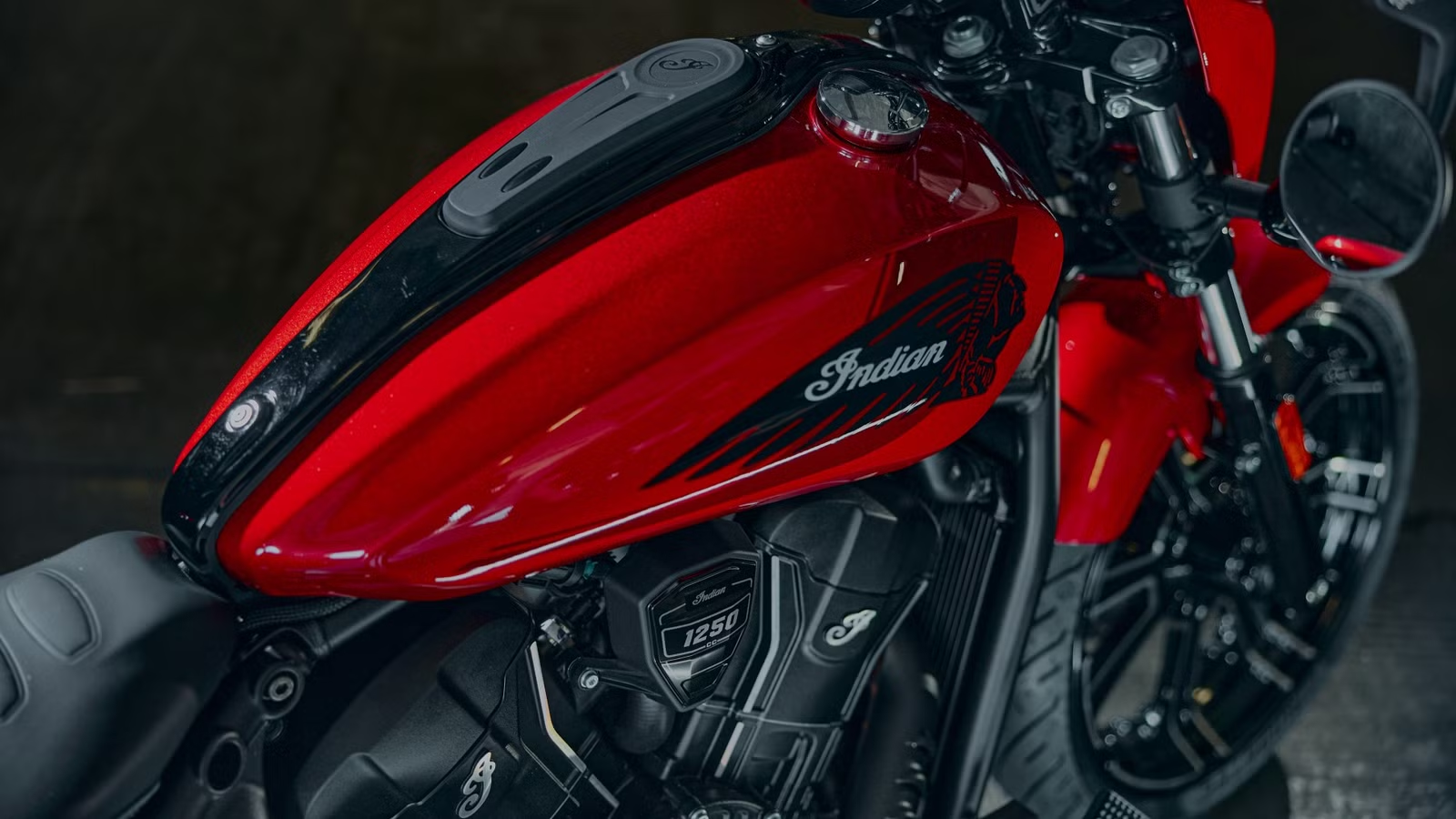
Indian Motorcycle is America’s oldest motorcycle brand, as the brand is fond of reminding us every now and again. It has built its 125-year legacy with distinct styling and mechanical innovation. It has stuck to its roots of making V-twin cruisers and expanded into full-size and full-dress tourers while taking a few excursions into other genres like street bikes and even a few race bikes, but sticking to its roots doesn’t mean it has stayed stagnant; it is continuously innovating to keep up with the changing demands of its target audience.
Keeping Up With The Customer’s Changing Demands Isn’t Easy

For a brief time in history, a significant number of people could easily afford two-wheeled land barges that were singular in their purpose: to cover big miles on the highway. And they were willing to forgive them their faults in the city. Today’s customer is more discerning and would like one motorcycle for everything. It needs to be agile in traffic, easy to park, comfortable out on the highway, and it needs to draw admiring looks wherever it goes. To do this, legacy brands like Indian run the real risk of moving away from what made them so iconic in the first place—but this is also where the creativity of a brand shines.
Evolution, Not Revolution, Is The Answer

Indian realized that alienating its core audience was not a good idea, so it decided to take an evolutionary approach to change. It started giving its traditional cruisers and tourers electronic controls to tame them and make them easier to live with. At the same time, it conceived of a new line of middleweight cruisers that would appeal to a new customer base. These middleweight cruisers were not just easy to purchase, but easy to ride as well. The idea was that not only would you attract new customers into the fold, but also introduce your traditional fans to new ideas, so everyone could grow together.
A True No-Compromise Cruiser Is A Unicorn – But It Is Possible

Compromise is how life goes, and so it is with motorcycles as well, so making a completely no-compromise cruiser is an almost impossible task, the keyword being ‘almost’. Indian, with its wealth of experience, has put its mind to making a machine that eliminates the compromise we expect between practicality and fun.

That is, it needs to be physically unintimidating for the city, with enough comfort for long highway miles in the saddle. The company has been doing a brilliant job with its current crop of products, even the most affordable model still feels like an Indian. And we think the company has got a solution to demanding cruiser riders: this is the Indian cruiser that quietly handles every riding scenario.
Meet The Sport Scout RT: Indian’s Mid-Size Cruiser With Hard Luggage, A Quarter Fairing, And No Compromises

The Indian cruiser range is broadly divided into three main families. The beginner-friendly Scout Sixty range sits at one end, while the full-size Chief range occupies the other. In the middle lies the Scout range—a midsize cruiser line that sports a slightly bigger engine than the Scout Sixty and features a six-speed gearbox. Just like the other two cruiser ranges, there are a variety of options available, of which the Sport Scout RT offers hard luggage, a quarter fairing, impressive chassis components, and feels built for those who hate compromise. Whether you like to ride in the city or go away for the weekend, the Sport Scout RT has you covered.
At $16,999, It Undercuts Comparable Harley-Davidson Tourers While Overlapping The Chief Range

The Sport Scout RT sits near the top of the Scout range, which means it is nearly at the level of Indian’s full-size Chief range of cruisers when it comes to specs, and its price overlaps with the Chief range. Its positioning as one of the premium Scout variants means that it has a premium price of $16,999. It feels built to cost less than a Harley-Davidson to own, and the Indian also sports connected tech and a four-inch TFT display. It also has an appreciable level of safety.
Spanking New Engine Gives It Excellent Performance

The SpeedPlus engine is a brand-new engine, and the engine that powers the Sport Scout RT was updated to the SpeedPlus 1250 for 2025. This engine powers the entire 2026 Scout range as well, in slightly different states of tune. This is a 60-degree V-twin that displaces 1,250 cc and has a compression ratio of 12.5:1. It is one of the few American V-twins that is wholly liquid-cooled and has a DOHC setup with four valves per cylinder. The result is 105 horsepower and 82 pound-feet of torque at 6,300 RPM for the Sport Scout. Unlike the Scout Sixty range, this has a six-speed gearbox with an assist-and-slipper clutch and a belt final drive.
Hybrid Steel-And-Aluminum Frame Keeps Weight Down Without Sacrificing Cruiser Character

The Sport Scout RT has a very interesting frame, making it one of the cruisers perfect for weekend getaways. It is a hybrid frame which uses steel tubes for the main frame, but aluminum for the subframe. The SpeedPlus engine is used as a stressed member. This helps cut some weight and gives it better handling. It has 41 mm telescopic forks at the front and dual shocks with preload adjustment at the rear. Suspension travel available is 4.7 inches at the front and three inches at the rear.
There is a single 298 mm semi-floating brake disc at the front with a two-piston floating caliper and an identical brake disc at the rear with a single-piston caliper. The Sport Scout uses a notably large 19-inch front wheel and a standard-for-a-cruiser 16-inch rear wheel. They are eight-spoke alloy wheels shod with tubeless tires.
A 25.7-Inch Seat Height And 568-Pound Wet Weight Make It Accessible Without Feeling Small
The Sport Scout RT is a midsize machine with a length of 86.9 inches and a width of 37.6 inches, married to an extra-long wheelbase of 61.5 inches. The ground clearance stands at 4.4 inches and the laden seat height at 25.7 inches, so it is sufficiently low for pretty much anyone. It has a fuel tank that can hold 3.4 gallons, and it weighs 568 pounds ready to roll. Its size makes it an ideal choice to replace every other bike in your garage.
A Full Feature Set Is Available, But No Six-Axis IMU

Indian’s take on luxury can feel more thoughtful than flashy, which is why the features list can seem a little short sometimes. The Sport Scout RT has a four-inch circular TFT display with Indian’s Ride Command system, which means not only do you get Bluetooth and navigation, you also get connected features. It is available in three colors: Black Smoke, Chalk, and Sunset Red Metallic. It has all-LED lighting, keyless ignition, a USB charging port, locking hard saddlebags that offer over 10 gallons of usable space, and a quarter fairing.

When it comes to electronics, it has ABS, ride modes, traction control, and cruise control; there is no six-axis IMU available. Speaking of things that aren’t available, this is a solo motorcycle, and you can opt for pillion accommodation and foot pegs from the accessories list.
How The Sport Scout RT Stacks Up Against The Super Scout, Chief Dark Horse, And Harley’s Closest Rivals

If you stick to Indian, the Super Scout approaches this problem from the opposite angle as the Sport Scout RT, and has a great balance of style, comfort, and everyday rideability. The Super Scout styles itself a light tourer, and once you take off the windshield and saddlebags, it is a comfortable cruiser that you can ride around town. It has the exact same engine and chassis as the Sport Scout, but it has smaller wire-spoke wheels.
You could also upgrade to the Chief Dark Horse with the larger Thunderstroke 116 engine. The Chief range balances torque, comfort, and real-world practicality really well. Also, if you like air-cooled V-twins old-school and with an abundance of torque, this is the cruiser that you should look at. It also has all the features of the Sport Scout RT, and it throws in rear cylinder deactivation as well.

If you want to look at the competition, there is no equivalent Harley-Davidson at that exact price point, but you could either opt for a cheaper, sportier Harley-Davidson Sportster S with luggage, or throw in a couple of thousand more dollars and go up to either the Low Rider S if you prefer sportiness or the Heritage Classic if you prefer touring. They both have a base price of under $20,000, but that can go up rapidly with options. The Low Rider S in particular nails plush comfort, strong performance, and simplicity perfectly.
Source: Indian Motorcycle

Related posts

Latest Post


No Comments