The Hybrid Sedan That Quietly Took Over The Company’s Lineup
8 minutes reading
Tuesday, 18 Aug 2026 16:00 0 76 autotech
Toyota is currently capitalizing on the crossover and SUV sales craze in the U.S. by offering a wide variety of high-riding options suited to multiple driving scenarios. Despite this, one of Toyota’s hybrid sedans is rising to the top of the sales charts.
Toyota has traditionally approached the sedan segment with a philosophy of continuously improving its product offerings. The Japanese brand has always prioritized long-term mechanical durability and affordable starting prices, resulting in strong appeal to the mass market. This approach also significantly lowers research and development costs and simplifies maintenance for the end consumer.
Toyota achieves this by utilizing highly engineered components and modular platforms that share parts across various vehicle classes. Doing so bolsters the industry-leading resale values that American buyers have come to rely on. This strategy centers on providing an easy ownership experience, where the vehicle is marketed as a dependable tool rather than a temperamental luxury, appealing to a pragmatic demographic that values a low total cost of ownership and predictable performance.
The Camry Became Toyota’s Sales Hero
Rear 3/4 action shot of 2026 Toyota Camry being drivenToyota
Based on Toyota’s July 2026 sales report, the Camry is proving to be the brand’s true success story in the U.S. and reclaiming the market share it lost to the RAV4 since the new-generation was introduced. The brand reports 30,536 unit sales for the month, reflecting a 17.2-percent increase, year-on-year. This increases its year-to-date tally to 509,580 units, resulting in a 15.5-percent year-on-year increase.
By contrast, the Toyota RAV4 achieved 31,285 unit sales during July. While this is more than the Camry, its year-on-year sales performance for the month dropped by 21.3 percent. The brand confirms 185,240 unit sales this year so far, which reflects a 33.7 percent year-on-year sales decline.
A Trusted Option You Can Count On
Front 3/4 view of a 2026 Toyota Camry Nightshade parked on streetToyota
iSeeCars gives the Camry range an 8.2/10 overall score, including 8.6/10 for reliability, 8.6/10 for retained value, and 8.0/10 for safety. The publication indicates that the model will run for 13.1 years or 171,901 miles without encountering any noteworthy mechanical issues, and has a 31.8 percent probability of hitting 200,000 miles.
In terms of depreciation, the publication indicates that the model will lose $9,992 or 34.3 percent of its initial sale price after five years or 60,000 miles, which is a bit less than the average competitor in the midsize hybrid sedan segment. J.D. Power gives the 2026 Toyota Camry model year an 82/100 consumer-verified overall score, including 80/100 for quality and reliability, 82/100 for the driving experience, 92/100 for resale, and 76/100 for the dealership experience.
Well-Known For Its Value Retention
2026 Toyota Camry Front 3/4Toyota
Where depreciation is concerned, you can expect the model to lose $10,829 or 37.7 percent of its value over five years or 60,000 miles, which is well under the segment average. CarEdge highlights that the Toyota Camry will cost $36,432 to own over the same period, with $14,274 accounting for depreciation, $10,060 for insurance, $4,530 for fuel, $6,056 for interest, and $1,512 for maintenance.
According to Edmunds’ True Cost To Own calculator, you can expect a new base front-wheel-drive 2025 Toyota Camry LE to cost you $38,952 over the course of five years. This includes $10,795 worth of depreciation, but excludes the $28,700 MSRP. You’ll also find yourself spending $7,631 on insurance, $3,213 on maintenance, and just $773 on repairs. Your taxes and fees will also be incredibly low, with the calculator showing that you’re only likely to spend $3,627. Fuel will cost you $7,226, based on average driving distance in the U.S.
Fuel Savings Are A Huge Benefit
The rear of a gray 2025 Toyota Camry hybrid sedan. Toyota
As per the EPA’s official fuel consumption estimates for the 2025 Toyota Camry, you’ll find that Edmunds‘ estimates are pretty much on par. The front-wheel-drive LE is the most efficient model, returning a 53/50/51 MPG consumption result on the city/highway/combined cycle with a 663-mile range claim from the 13-gallon tank. It also indicates that this will save you up to $5,000 in fuel costs every five years and costs $1.59 to drive every 25 miles.
The all-wheel-drive XSE is the least frugal model, but this is only by a fractional amount. The EPA indicates that it returns a 43/43/43 MPG result with a 559-mile range claim and suggests that this will save you up to $3,750 in fuel costs every five years and cost $2.38 to drive every 25 miles. Expect to pay $53 to refill the 13-gallon tank, featured in all derivatives. The front-wheel-drive LE is the most attractive model, with it set to cost you $1,200 in fuel every year. The flagship all-wheel-drive XSE is just a bit more expensive to run, with its $1,350 annual fuel cost.
Toyota Keeps Pricing Competitive
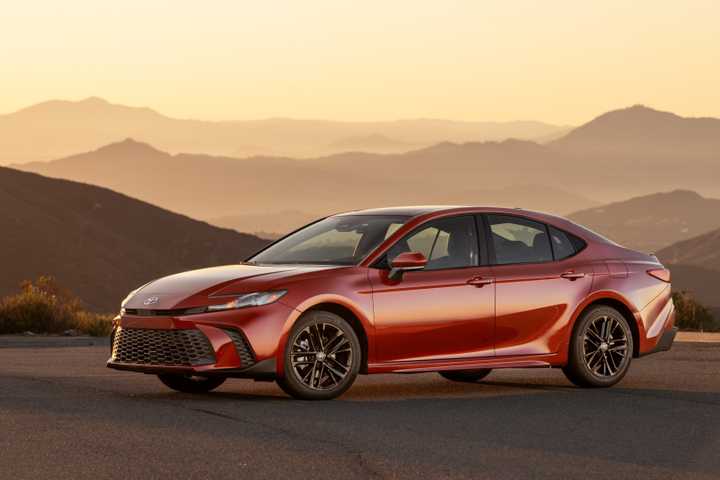
Front 3/4 shot of 2026 Toyota Camry Hybrid lineup parkedToyota
Toyota kicks the range off at $29,600 for the base LE front-wheel drive model, making it the most competitively priced hybrid vehicle in the segment. A lower starting price point for a newer car is always going to be a strong strategy, which is a factor that is clearly evident in its sales results.
The most expensive Camry option is the XSE, which starts at $36,000. Toyota offers the all-wheel drive system across all trims for an additional $1,525. All of these prices exclude the brand’s $1,295 destination fee. There are some optional extras available across all trims, but they are relatively few and far between, as the brand prefers to take a more defined five-trim pricing strategy.
How Toyota Gets Reliability Right
Low-angle shot of 2025 Toyota Camry XLE in blue posing in front of bridge at night.Toyota
The Toyota Camry has always been a value proposition product that caters to those wanting a practical family car that doesn’t compromise on build quality or reliability. The lower trim models may not be the most prestigious options that you can consider, but the new-generation examples are much more comprehensively kitted out compared to previous generations.
Toyota designed the A25A-FXS as the hybrid variant of its Dynamic Force 2.5-liter inline-four unit to deliver high thermal efficiency and smooth low torque. The engine operates on the Atkinson-like cycle with a 14.0:1 compression ratio, and D-4S combined direct and port injection to speed combustion and reduce pumping losses.
The Japanese brand’s engineers also designed the cylinder head and intake ports to increase tumble flow and use longer stroke dimensions to improve torque per displacement. The valvetrain features dual overhead cams with variable valve timing on both intake and exhaust to broaden torque and enable Miller Atkinson modes.
Rear 3/4 view of a 2026 Toyota Camry NightshadeToyota
Toyota machines the block and head from aluminum alloy and uses forged steel internals where strength matters to keep mass low while retaining durability. Thermal management includes cooled EGR and refined cooling passages to control combustion temperatures. For hybrid duty, Toyota calibrates the engine for low RPM efficiency and smooth transitions to electric drive, which reduces stress on the internal parts.
Toyota integrates the A25A-FXS into its TNGA architecture to standardize parts and service procedures, which improves reliability and lowers long-term maintenance costs. Designers focus on tight manufacturing tolerances and robust sealing to limit oil consumption and extend service intervals overall.
Class-Leading Waranty Adds Owner Confidence
Front shot of 2026 Toyota Camry in silver parkedToyota
Toyota’s HEV systems last for years, with some owners declaring their packs to still be going strong after well over 15 years or 150,000 miles of driving. Toyota covers the Camry’s entire HEV battery pack for any manufacturer-related defects over a 120-month or 150,000-mile period, while all related systems will be covered for 96 months or 100,000 miles, reflecting the Japanese brand’s commitment to its tried-and-tested gasoline-electric hybrid drivetrain technology.
The 2026 Toyota Camry is backed by a standard three-year or 36,000-mile bumper-to-bumper limited warranty and a five-year/60,000-mile powertrain warranty. As a hybrid-exclusive model, it also includes a 10-year or 150,000-mile hybrid battery warranty and an eight-year or 100,000-mile warranty on related hybrid components. Routine maintenance follows a 5,000-mile or six-month interval, primarily involving tire rotations and multipoint inspections, while synthetic oil changes are typically required every 10,000 miles or 12 months.
These services are covered for the first two years or 25,000 miles at no cost through the ToyotaCare program. Regarding safety, a significant recall currently affects approximately 51,644 Camry units from the 2025 and 2026 model years due to a loose bolt in the power inverter, which can cause a loss of power or, in rare cases, an electrical fire. Owners of affected vehicles produced between August and November 2025 should contact their dealer for a free inspection and repair.
Base Trim Engine
2.5-liter Four-Cylinder Hybrid
Base Trim Transmission
CVTi-S CVT
Base Trim Drivetrain
Front-Wheel Drive
Base Trim Horsepower
184 HP @6000 RPM
Base Trim Torque
163 lb.-ft. @ 5200 RPM
Make
Toyota
Model
Camry
Segment
Midsize Sedan
Source: Toyota, Edmunds, iSeeCars, J.D. Power, and the EPA













No Comments