
Japan’s Twin-Turbo Engine That Made 1,000 HP From The Factory
The golden age of Japanese performance tuning was built on a simple, intoxicating premise: buy a factory car, turn up the boost, and embarrass machinery that costs ten times as much. The engines that made this possible — the Toyota 2JZ-GTE and the Nissan RB26DETT — became legends not because of their factory output, which was deliberately strangled by the famous 276 hp “Gentleman’s Agreement,” but because of what happened when owners started pushing them beyond their limits. They were over-engineered safety nets for tuners, capable of doubling or tripling their power without ever needing to pull the head or swap a piston.

When the successor to the Skyline GT-R arrived in the form of the Nissan R35 GT-R, the world was skeptical. This new car was a radical departure, abandoning the straight-six heritage in favor of a high-tech, aluminum V6 layout. Early rumors suggested the car was “untunable” thanks to a locked-down ECU that Nissan claimed was uncrackable. But as soon as the first shops in Japan and the US bypassed the security, it became clear that Nissan hadn’t just built a new supercar. They had built one of the most capable tuning platforms ever conceived.
The Giant Killer: Why The R35 Defined An Era
|
Nissan GT-R (DBA) Factory Specs |
|
 57 autotech Engine |
3.8L VER38DETT Twin Turbo V6 |
|
Power |
545 hp @ 6,400rpm |
|
Torque |
463 lb-ft @ 3,200-5,800rpm |
|
0-60 mph |
2.6-2.9 Seconds |
|
Top Speed |
196 mph |
|
Transmission |
6-Speed Dual-Clutch (GR6) |
The Nissan GT-R R35 arrived in 2007 with a singular purpose: to disrupt the supercar hierarchy. It was engineered as a giant killer, a high-tech platform capable of shaming Italian exotics on the Nürburgring for a fraction of the cost. The appeal wasn’t just raw power; it was the sophisticated AWD system and a dual-clutch transmission that allowed anyone to achieve hypercar-level acceleration with clinical consistency.
However, the GT-R’s lasting legacy isn’t found in its factory lap times. Its true impact lies in the headroom Nissan left for the aftermarket. While the chassis and electronics provided the foundation, the heart of the car — the VR38DETT twin-turbo V6 — is what transformed it into a global tuning benchmark.
Enthusiasts gravitate toward the R35 because it represents a rare peak in mechanical over-engineering. It is a car that was built to be modified, and the closer you look at the VR38, the clearer it becomes that its factory output was merely a starting point for what this platform can actually achieve.
1000 HP Factory Builds Are Proof Of Its Capabilities

While Nissan itself never built a straight-off-the-line 1,000-hp R35 GT-R, the brand’s motorsport and tuning arms have pushed the platform well beyond the four-figure mark over the years. The Nissan DeltaWing GT-R LM NISMO program used a heavily developed VR38-based architecture in competition development, and Nissan’s own NISMO Omori Factory has demonstrated 1,000+ hp-capable VR38 builds for time attack and development purposes — showing the engine’s four-figure potential even if official FIA GT3 and Super GT cars ran restricted outputs.
Even Infiniti — Nissan’s luxury sister brand — built and presented the QX80 R-Spec for last year’s SEMA, which officially featured a factory-tuned R35 GT-R engine pushing a clean 1,000 hp to the wheels, proving the platform can handle it straight from the factory. To make it happen, Nissan installed Garrett G-Series turbochargers, a custom fuel system and intake, exhaust manifold, engine coolers, and new rods and bolts.
The Takumi Secret: VR38DETT’s Built-In Over-Engineering

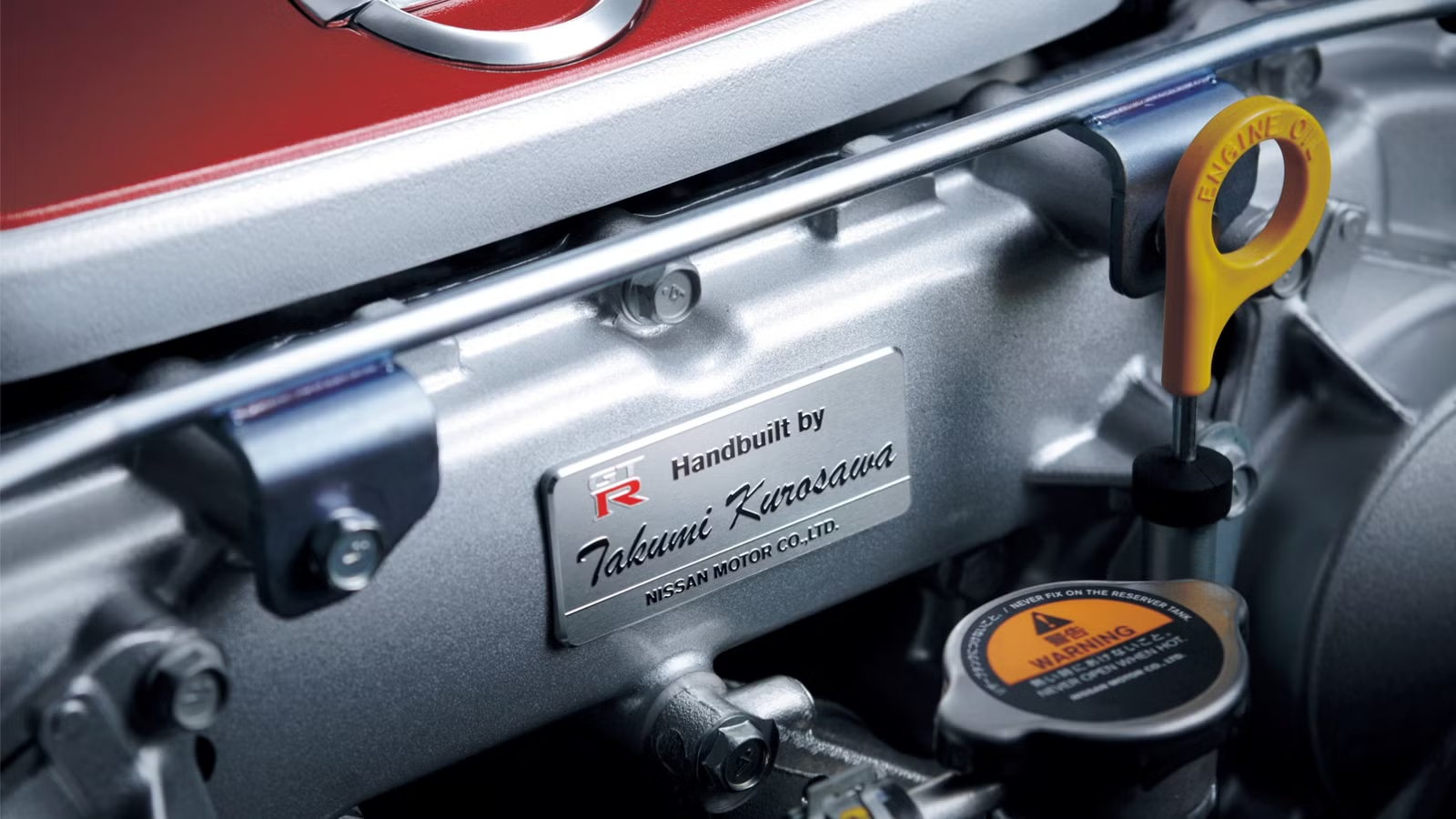
That engine is the VR38DETT. Unlike the mass-produced VQ engines found in the Nissan 350Z, the VR38 is a hand-assembled masterpiece. Each unit is built in a dust-free clean room by one of only five master craftsmen, known as Takumi, whose names are literally stamped on the engine block. That level of precision is exactly why the engine survives the abuse it does.
In its standard form, the R35 GT-R — specifically the DBA generation (2012–2016) used as a tuning benchmark — is a highly respectable sports car, designed to deliver hypercar performance with daily driver reliability.

These factory numbers are impressive, but they only scratch the surface of the car’s potential. The reason the GT-R became a tuning legend is not because of how it leaves the factory, but because of the headroom Nissan’s engineers baked into the hardware. This transition from supercar to hypercar-killer starts with the physical architecture of the engine.
Why The VR38 Block Refuses To Break

The secret starts with a closed-deck aluminum block that provides immense structural rigidity. While most aluminum engines require heavy cast-iron liners to survive high boost, Nissan used 0.15mm plasma-sprayed mirror bores — a technique that reduces friction and improves heat dissipation, allowing for higher cylinder pressures without the risk of knock.
The real genius, however, lies in the integrated exhaust manifolds. Unlike traditional setups where the turbo bolts to a separate manifold, Nissan combined the manifold and housing into a single unit (dubbed “turbo-fold”). This is a massive advantage for tuning. It reduces the exhaust path to almost nothing, which virtually eliminates turbo lag. More importantly, it removes a common failure point: the gasket between the manifold and the turbo. Under the extreme heat of a 1,000 hp run, traditional gaskets often fail, but the VR38’s monoblock design stays sealed and efficient.
Head Flow and the 1,200 HP Benchmark

The rest of the engine follows the same logic. It features a symmetrical intake system with independent throttle bodies for each bank to ensure perfectly balanced airflow, a magnesium oil sump for weight savings and heat dissipation, and a thermostatically controlled cooling system that keeps the oil stable during 200 mph pulls.
Even the factory cylinder heads are race-spec, featuring sodium-filled valves for heat management and ports that flow enough air to support nearly 1,200 hp before they become a bottleneck.
This 1,200 hp figure isn’t an enthusiast’s estimate; it is a proven mechanical threshold for airflow. The definitive evidence comes from T1 Race Development, whose Stage 1 Engine Build is rated for 1,200 hp while utilizing the factory, unported cylinder heads. By reaching this milestone without CNC porting, T1 has verified that the OEM head casting is not the primary restriction for most high-performance builds.
However, as any seasoned tuner will tell you, flow does not equal safety. While the heads can breathe for 1,200 hp, the factory rotating assembly is a different story. The stock connecting rods are notorious for bending once torque figures cross the 600–650 lb-ft threshold, typically around 800 whp. Similarly, factory piston ring lands are prone to cracking under the immense cylinder pressures required to chase four-figure power.
The credibility of the VR38’s over-engineering lies in the fact that you can reach 1,200 hp on the stock head’s high-velocity port design and 37mm intake valves. These components satisfy the engine’s volumetric efficiency by up to approximately 30 psi of boost. It is only beyond this mark that the airflow reaches a state of sonic choke, where the physical volume of the port limits further gains. For the average builder, this means the path to 1,000 hp is a bottom-up affair: you must build the short block with forged rods and pistons to survive the force, even if the factory heads are already prepared for the flow.
The 1,000 HP Path: Tuning The VR38DETT

Can you hit 1,000 hp on factory internals? Yes, but you are effectively playing a high-stakes game of mechanical Jenga. In the GT-R world, everything changed with the 2012 DBA update. The earlier 2008 through 2011 cars had thinner connecting rods that would often bend once you pushed past 600 lb-ft of torque. The DBA models received beefier rods, making the 1,000 hp goal a reality for those willing to risk it.
To hit that four-figure number on an unopened engine, you need a very specific recipe:
- Turbochargers: You need 60mm+ turbochargers, such as the Garrett G25-660 or HKS GT1000 kits.
- Fueling: Stock injectors are inadequate at this level. You need 1,700cc injectors and at least twin 450lph fuel pumps.
- The E85 Magic: You cannot hit these numbers safely on pump gas. The cooling properties and high octane of E85 allow for the aggressive timing needed to reach 1,000 hp while keeping cylinder temperatures in check.
- Mapping and Torque Shaping: This is the most critical part. A tuner will purposefully limit torque to around 650 to 700 lb-ft in the mid-range to protect the rods, then let the horsepower climb to 1,000 at the top of the rev range where the mechanical stress is more manageable.
While 1,000 hp is the headline, most tuners will tell you to back off to 800 or 900 hp for street use. At 1,000 hp, you are on the wrong side of the safety margin. One bad tank of fuel or an overboost spike will send those expensive Takumi-stamped parts onto the tarmac. If you’re chasing higher numbers, you need to start with forged rods and pistons before approaching the limits of the factory heads at around 1,200 hp.
Where Godzilla Fails: The GR6 Transmission

The irony of the VR38DETT is that while the engine is a tank, the car itself has a significant bottleneck. The BorgWarner GR6 dual-clutch transmission is the real weak link.
Before you even think about 1,000 hp, you have to address the gearbox. The factory clutch baskets will crack under the pressure, and the 1st-gear assembly is known to strip during hard launches. A 1,000 hp build requires an extreme gearbox build — billet clutch baskets with 18 to 20 plate kits and strengthened gearsets from companies like Dodson or Sheptrans. Without these, you aren’t building a fast car. You’re building a very expensive paperweight.
The Benchmarks: AMS, Litchfield, And Cobb

The Cobb Tuning Brown Car is the most famous documented example of just how far you can push this block. It utilized a completely unopened long-block — not even the valve covers were removed to inspect the cams. In that configuration, it produced a verified 879 wheel horsepower on E85, which translates to roughly 1,000 hp at the crank, and it survived over 10 full race weekends of brutal Time Attack abuse without a single mechanical failure.
Then you have the AMS Alpha 10. This package became the gold standard for the 1,000 hp street car. By using upgraded turbos and cooling, AMS proved that a GT-R could run mid-9-second quarter-mile passes while retaining the factory engine internals. In fact, a private owner went one step further and achieved an 8-second pass on stock turbos with the help of AMS. Anything is possible if you’re willing to risk it all.
In the UK, Litchfield Motors is the authority. Their Stage 5 kit uses Garrett G25-660 cores to hit the 1,000 hp ceiling. Their Version 8 ECU mapping is the secret sauce: a specific Safe Map for standard engines limits the car to roughly 750 to 800 hp for daily use, while the hardware remains capable of 1,000 hp for those looking to push the limits on the drag strip.
What Does A 1,000 HP GT-R Actually Cost?

Building a 1,000 hp GT-R is an exercise in financial discipline. Here is how the costs break down for a DBA (2012+) model compared to doing it the safe way with forged internals. The figures below are estimates; for a specific breakdown, speak with a certified engine builder and/or tuner.
|
Component |
Stock Internals |
Forged Internals |
|
Used DBA GT-R |
$85,000-$105,000 |
$85,000-$105,000 |
|
Turbo & Bolt-on Kit |
$12,000-$15,000 |
$15,000 |
|
Fueling (Injectors/Pumps) |
$3,000-$4,000 |
$3,500-$4,500 |
|
Gearbox Build (Mandatory) |
$15,000 |
$18,000 |
|
Engine Build (Labor/Parts) |
N/A |
$15,000-$20,000 |
|
Total Build Cost |
$30,000 + Car |
$55,000 + Car |
Keep in mind that the “Risky” path often ends up being more expensive in the long run if a rod decides to make an unscheduled exit through the side of the block.
It’s also worth noting that later EBA-generation GT-Rs have been excluded from these valuations simply because prices are holding firm north of $110,000, making the total build cost substantially higher.
Is The VR38DETT Still King?

The VR38DETT has officially taken the mantle from the RB26 and 2JZ. It offers a level of refinement and straight-out-of-the-box potential that the old iron blocks couldn’t match. However, a credible new challenger has emerged: the BMW S58.
Found in the current M3 and M4, the S58 is already being dubbed the new 2JZ because it is hitting 1,000 hp on stock internals with even less effort than the Nissan. For now, the VR38 remains the king of the street, but for the first time in nearly two decades, Godzilla is finally looking over its shoulder.
Sources: Litchfield, AMS, Cobb Tuning, T1 Race, ETS, Hagerty, Classic.com, BringaTrailer, Nissan USA.

Related posts



Latest Post


No Comments