
Fuel Injection vs. Carburetor: The Full History
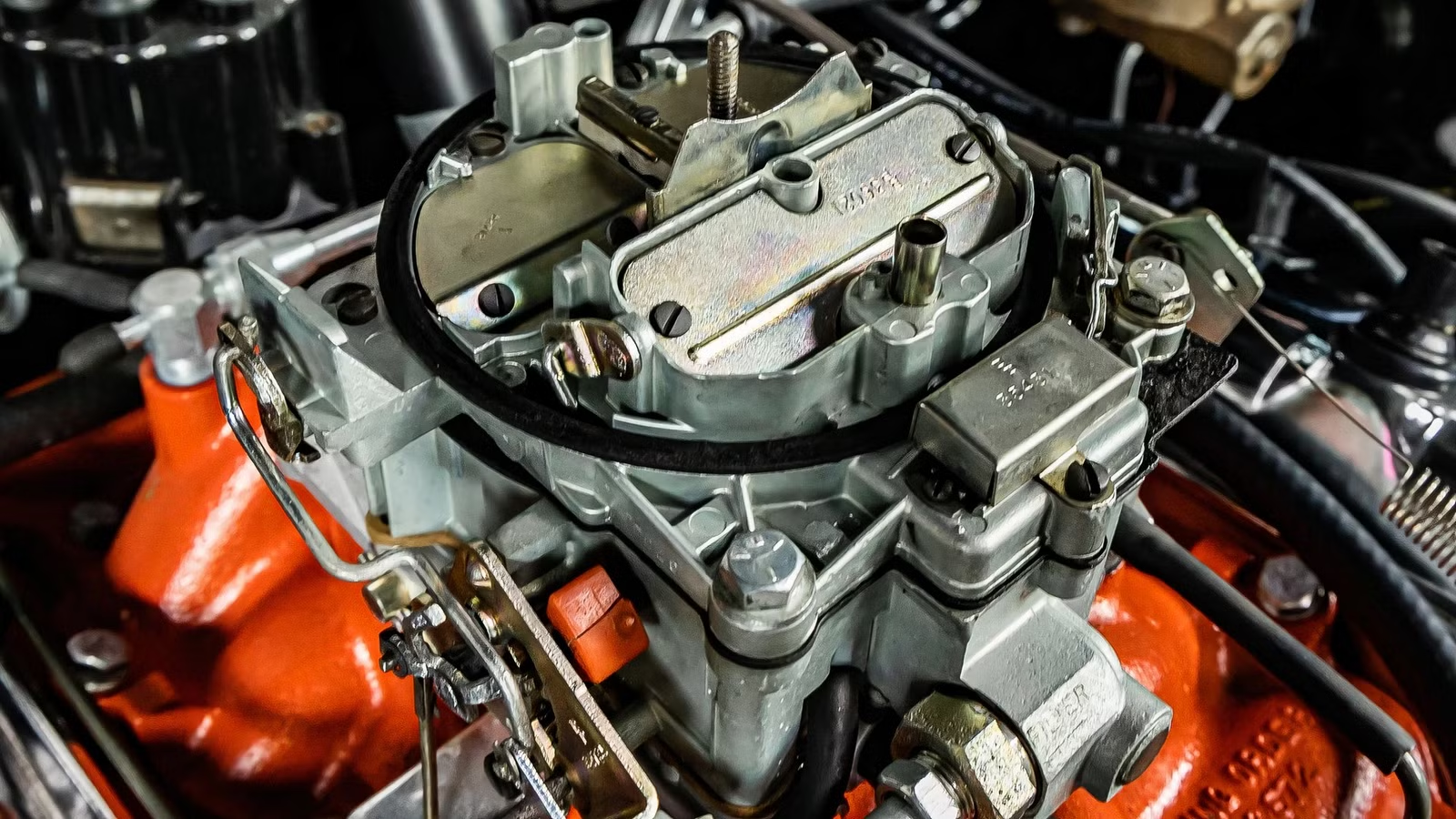
The battle between carburetors and fuel injection systems is almost as old as the automobile itself. From driving some of the industry’s greatest technological innovations to remaining at the heart of the classic enthusiast community, their evolution has been a long and winding, often bumpy and fascinating journey.
Bosch And Mercedes-Benz Led The Fuel Injection Charge

The 1954 Mercedes-Benz 300 SL is credited as the world’s first production car with mechanical direct fuel injection – and it’s also considered the genesis of the modern supercar. It was based on the German manufacturer’s W194 race car from 1951, which was equipped with a three-liter in-line six-cylinder carburetor-fed engine producing just 175 hp.
Mercedes-Benz turned to Bosch to develop its first fuel injection system for the 300 SL in order to make it more competitive against its rivals from Ferrari and Jaguar at the time. With fuel injection having proven significantly superior to carburetors in aircraft engines during World War II, it was no surprise that it was eventually adopted for road and race car use, giving the 300 SL a significant power boost to 215 hp. However, it used an array of pumps, camshafts and linkages that made direct injection too complex and expensive for mainstream production.
Despite this, diesel direct fuel injection had, in fact, been used for many years by injecting fuel directly into the combustion chamber, relying on the high compression ratio — around double that of a gasoline engine — to generate sufficient heat for spontaneous ignition of the fuel/air mixture. In contrast, without the benefit of modern electronics, gasoline engines required the fuel and air to be mixed prior to reaching the cylinder, after which it is ignited by a spark plug.

Mechanical Indirect Fuel Injection

Early mechanical indirect injection systems were pioneered by Chevrolet with its Rochester Ramjet system that was introduced on the 283 ci (4.6-liter) small-block V8 in the 1957 Corvette, and by Bosch for the 1958 Mercedes-Benz 220 SE. These systems injected fuel into the intake ports rather than directly into the cylinders, and were entirely mechanically controlled.
Chrysler went a different route in 1958 by launching its Bendix Electrojector electronically controlled indirect fuel injection system on some of its range-topping models such as the Chrysler 300D, DeSoto Adventurer, Dodge D-500 and Plymouth Fury. It promised more power, better fuel economy and easier cold starts, but the transistor-based system was very sensitive to temperature and voltage fluctuations and proved extremely unreliable. As a result, it was only offered for a single model year before being withdrawn.
Bendix reportedly licensed the patents to Bosch, which refined and developed the system into the first mass production electronically controlled indirect injection system, Bosch D-Jetronic, which was launched in 1967 on the Volkswagen Type 3 1600 E. Continuous evolution made the electronic systems more sophisticated and widely adopted over the ensuing years. This progressive shift was spurred on by the dual oil crises of the 1970s, combined with ever-tightening emissions and fuel economy regulations.
Notoriously Expensive, Complicated, Unreliable

Early fuel injection was notoriously complicated, difficult to maintain and very expensive. Most workshops didn’t have the experience or equipment to deal with the systems, and they severely hampered the ability of tuning shops and backyard mechanics to easily extract more performance from an engine by simply fitting larger carburetors with revised jetting and a less restrictive airflow — more air and fuel equating to a bigger bang and better performance.
Therefore, it was no surprise that carburetors remained in favor for decades, with early fuel injection systems often ripped out by dealers, tuners and owners, and replaced with simple, effective, widely available and inexpensive carbs.
Enter The Computer And Electronic Age

The 1980s started sounding the death knell for carburetors in production cars. This was driven by a combination of unrelenting pressure on emissions and fuel economy targets, along with the rapid development of consumer electronics and reliable microchip-powered electronic control units that were cheap, effective and reliable.
This led to wide-scale adoption of electronically controlled fuel injection systems that eliminated most of the issues that afflicted the early mechanical versions. Accordingly, fuel injection swarmed in very quickly and kicked carburetors out the door, making them redundant in mass-produced vehicles.
The last production car fitted with a carburetor in America was the venerable Ford LTD Crown Victoria, with the final models coming off the line in 1991. Trusted for fleet and police applications, it had the optional 351 (5.8-liter) Windsor V8 engine with a Motorcraft twin-barrel carburetor, producing a meager 150-180 hp (or up to 250 hp in some instances as a police interceptor with an upgraded engine and transmission).

The Crown Vic was relegated to the history books along with the Jeep Grand Wagoneer from the same year, which produced just 144 hp/280 lb-ft from its 360 ci (5.9-liter) AMC V8. Based on the original SJ platform, the Grand Wagoneer’s origins dated all the way back to 1963, making both cars dinosaurs in a rapidly changing era.
The pickup segment held onto its carb-fed origins a bit longer, with the base-specification Isuzu Pickup still using a carburetor for its 95 hp 2.3-liter 4ZD1 engine until it was eventually phased out in 1994.
Rapid Development, Going Full Circle

From the original single-point fuel injection that essentially replicated a carburetor with one injector in the throttle body, the technology rapidly developed into multi-point injection using groups of injectors located in each of the intake ports and firing simultaneously.
Sequential multi-point injection followed in the early 1990s, with individual injectors firing independently as engine management systems became more advanced, and camshaft position sensors made timing of the injections more accurate.
Ultimately the industry turned full circle in the 2000s as gasoline direct injection (GDI) was introduced, finally achieving what diesel had done as far back as 1936 with the Bosch-developed mechanical direct diesel injection first introduced on the Mercedes-Benz 260 D.
With individual injectors placed in each cylinder, GDI uses an extremely high injection pressure of more than 5,000 psi (350 bar) combined with a higher compression ratio and precise metering to achieve optimal combustion. This results in greater efficiency, increased performance, lower fuel consumption and reduced CO2 emissions (in combination with a particulate filter). This technology is also particularly well suited to the modern generation of smaller-capacity turbocharged engines (although many decry these engines as highly stressed, overcomplicated and unreliable).
Carburetors Still Have A Cult Following, And New Solutions

As brilliant, dependable, and pervasive as fuel injection is, carburetors still have a cult following, particularly among muscle car enthusiasts, tuners, and those specializing in restomods. Accordingly, you can still buy a dazzling range of Holley, Weber and Edelbrock carburetors for a variety of applications, and even SU carbs for British classics, to suit your needs.
Specialized manufacturers have also developed aftermarket throttle-body injection (TBI) systems, employing the technology often used on motorcycles. Available as a bolt-on system that resembles the old faithful carburetor and preserves the engine’s original appearance, it uses higher fuel pressure and an ECU-controlled fuel supply that contributes to better performance, economy and emissions.
So, while fuel injection may be king in the mainstream automotive sphere, carburetors are anything but dead.
Credits: Mercedes-Benz, Chrysler, Ford, Bosch

Related posts





Latest Post


No Comments