
The Two-Door Plymouth SUV With A 440 Big-Block Bronco Fans Forgot
By the mid-1970s, five American automakers were offering short-wheelbase, V8-powered SUVs. The idea was that drivers would love to whip these things around off-road, tearing up the trails, and enjoying the sun on their face. You can think of them as muscle cars for the dirt. But one ultra-rare version offered a big-block V8. While most have forgotten its name, collectors are rediscovering the ultimate off-road muscle SUV.
The Golden Era Of The Muscle SUV

The granddaddy of all American off-roaders was the Willys Quad developed for WWII. Soldiers loved them, nicknaming them the “Jeep,” and inspiring Willys to sell the “Civilian Jeep” after the war. The automaker redesigned the soft-top SUV for the 1972 model year with an 83.5-inch wheelbase. It was also engineered to accommodate a 304 AMC V8 that made 150 net horsepower and 245 lb-ft.
International Harvester primarily sold farm equipment. But it launched its “Scout” SUV in 1961 as a direct Jeep CJ competitor. In 1965, it upgraded the short-wheelbase SUV with an available 266V8 which made 154 hp. When it designed the Scout II in 1971, it added a 345 V8 option.
In 1966, Ford decided to join the short-wheelbase SUV party with its Bronco. This drop-top SUV had a 92-inch wheelbase, and it was soon available with a 298 V8. In 1969, Ford replaced the 289 option with a 302 V8. Finally, the 1978 Bronco got a 351 power plant.


In 1969, General Motors built its own SUV on a shortened C/K pickup truck chassis. It launched as the 1969 Chevrolet K5 Blazer with a 104-inch wheelbase and 36.6-foot turning radus. In 1970, it was joined by the mechanically-identical GMC Jimmy. This was a true full-size SUV with a removable fiberglass roof. Because it was a bigger SUV than the Bronco, aimed at customers who needed more cargo room or towing capacity, it’s unsurprising that it had a 307, 350, and finally a 400 V8 option.
Meanwhile, the ultimate short-wheelbase off-road SUV was brewing. And it would offer a big-block V8 with enough displacement to trounce all its competitors.
Dodge Built A Gnarly Off-Roader

By the early 1970s, Dodge realized the market for nimble, 4WD SUVs was a lucrative one. It was already building a healthy lineup of pickup trucks. But the shortest wheelbase Dodge D100—with a regular cab and short bed—had a 115-inch wheelbase. The automaker began by cutting the truck’s frame down for a 106-inch wheelbase to form the “Dodge Ramcharger” with a 36.9-foot turning radius.
The modifications to the D100 frame didn’t stop there. Dodge also engineered a full-time 4WD system using the NP-203 transfer case.
Full-time 4WD systems must allow the front and back wheels to spin at different speeds to drive on pavement. But off-road this can be a problem. If one axle is passing over an obstacle such as navigating a stream bed, its wheels can spin out of control while the other axle stops spinning altogether. Dodge solved this problem by installing a lock in the Inter-Axle Differential to force it to put equal power to both axles.

The rear axle featured a heavy-duty 9.25 inch differential. Base engines, such as the slant-six, 318 V8, and 360 V8 were available with a manual transmission or a TorqueFlite automatic. You could also order them in a 2WD Ramcharger with independent front suspension.
The Ramcharger’s top trim engine was Mopar’s legendary 440 big-block V8. Mid-1970s emissions regulations had forced the automaker to detune the power plant. But with its wedge-shaped combustion chambers, it still earned an SAE net horsepower rating of 235 @4,000 rpm and 400 lb-ft of torque. It was only available with the automatic transmission and in a 4WD configuration. The 440 V8 makes this the highest displacement of any short-wheelbase off-road SUVs from its era.
The Plymouth Trail Duster Was A Muscle Car For The Dirt

Plymouth was traditionally the budget-friendly brand in the Chrysler Corporation family. It had to subsist on the scraps of Dodge engineering. So, in the 1960s and 1970s, it developed a true knack for making entry-level vehicles feel special through hilarious, often irreverent marketing.
Can’t afford a Dodge Charger? What about the same engine in a stripped-down street racer with an adorable “meep meep” horn and emblems of a cute Looney Tunes bird? Consider the Plymouth Road Runner.

Can only afford a compact car? How about a sporty coupe with the nickname of a mischievous sidekick: the Plymouth Scamp.
When Plymouth’s Barracuda grew so successful that Chrysler moved the badge up to the new “E-Body” chassis, Plymouth needed a new badge for its sporty, compact, “A-body” muscle car. The result was the 1970 Plymouth Duster. Special editions continued to use basic options and a hilarious name (i.e. tacky pinstripes equaled the “Gold Duster” and a fold-down rear seat came with “Space Duster” badges).
When Chrysler offered Plymouth a badge-engineered Dodge Ramcharger, the vehicle practically named itself: The Plymouth Trail Duster.
Plymouth Put Its Own Twist On The Ramcharger

The Ramcharger and Trail Duster were mechanically identical. But Plymouth put its own spin on the SUV. It offered a series of woodsy colors with a slight muscle-era twist. “Sunstone” was a sort of muted Hemi Orange. “Light Blue” harkened back to Richard Petty’s Plymouth Superbird. “Medium Gold Metallic” was a fun over-the-top color option.
The automaker also offered top-trim “Boca Raton” seats with a psychedelic stripe pattern. The door panels matched the vehicle color and also featured storage compartments. Finally, there were big muscle-car-style callouts available, including a stylized “4×4” accentuating the two-tone paint job, or a Wild West-style “Trail Duster” on the tailgate.

The fun-loving Trail Duster was ready to party. Options included a vinyl top with roll-up windows or a removable hard top. You could also get an insulated center console that doubled as a cooler. Another innovation was the under-hood storage so you could keep your jack and wrenches in the engine compartment, freeing up the back for more gear.
The first model year of the Trail Duster was a truly bare-bones vehicle. The entry-level configuration didn’t even feature a passenger seat. The rear bench and hard top both cost extra as well. The glass for the front windows was actually integrated into the removable roof. Later model years got standard pickup truck doors with roll-up windows.

Buyers could configure the Trail Duster as a true off-roader, complete with a roll bar, skid plates, heavy-duty shock absorbers, a hand throttle, low-mounted mirrors, and rear bumper steps. You could also add luxurious options such as power steering, AC, and cruise control.
The Off-Road SUV Time Forgot

For the first Ramcharger generation (1974-1980), Dodge leaned into its pickup trucks’ existing following and sold 109,073 SUVs. Renewing it for a second generation was a no-brainer. Dodge has, of course, doubled down on SUV sales, and today’s long-lived Durango continues the tradition. But Plymouth only sold approximately 36,000 Trail Dusters. It was the brand’s first and final SUV.
The Trail Duster’s low sales numbers are tragic for Plymouth fans. But they’re an opportunity for collectors. Over the past 12 months, the average first-gen Ford Bronco on Classic.com sold for $89,412. The top sale was $357,500. Short-wheelbase muscle-era SUVs certainly have appeal. And the Plymouth Trail Duster is the model time forgot. For now.

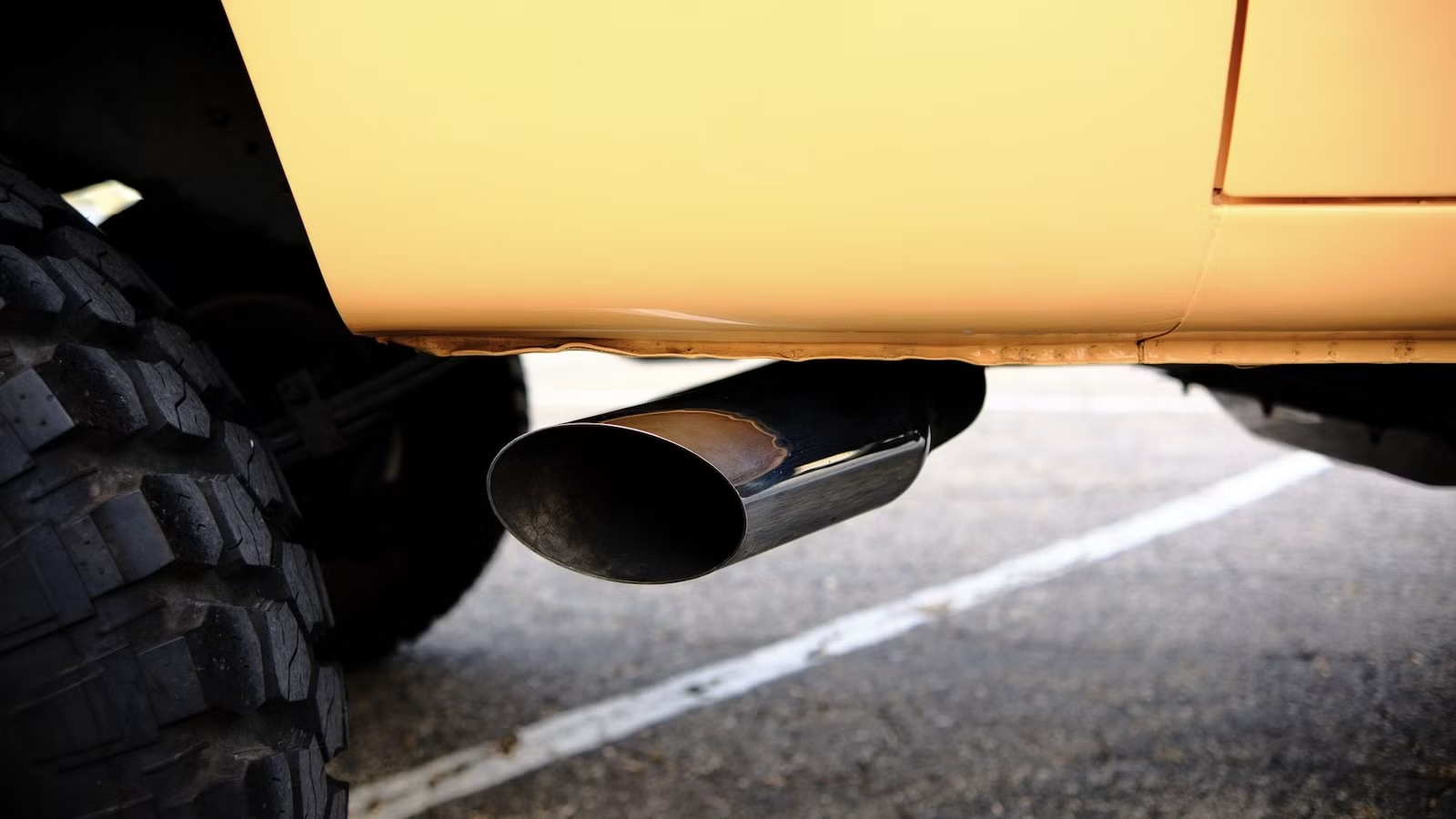
Just three Plymouth Trail Dusters were listed on Classic.com over the past year. The average sales price was $44,717. The top sale was for $57,500. That top sale was VIN AA0JF9C129072, which has a 340 cu-in V8 and TorqueFlite automatic and was rebuilt before selling on Bring a Trailer in February 2026. The two other SUVs on Bring a Trailer sold for $26,000 and $34,400. VIN AA0BF8S205297 (pictured) is a 1978 with a 360 V8 which was refurbished before selling on Bring a Trailer in late 2025 for $42,250. You must go back to 2024 to find any Trail Dusters that sold on Bring a Trailer for less than $20,000.
Off-Road SUVs Are An American Tradition

It’s hard to tell exactly why the Plymouth Trail Duster failed in the first place. Perhaps truck and SUV buyers simply had never considered the Plymouth brand and Mopar did a poor job marketing it. Perhaps Plymouth got too clever with its marketing and badging for the 1970s buyers. But it certainly wasn’t the fault of the SUV itself. Obviously, the chassis and V8 engine options were capable enough to inspire generations of Dodge SUVs. But the combo might have even been ahead of its time.

Drop-top 4WDs still have a surging market with the perennial Wrangler, and now the retro Bronco. Today, a big block V8-powered SUV would fit right in next to the Wrangler 392 and turbocharged Bronco Raptor.
The current popularity of powerful, off-road SUVs may be the very reason first-gen Broncos and similar vehicles are surging in value. Enthusiasts want to convoy with Wrangler owners, but drive something a bit different. And no short-wheelbase muscle-era V8 SUV was more unique than the zany Plymouth Trail Duster.
Sources: Classic.com, Bring a Trailer, Plymouth

Related posts


Latest Post


No Comments