
The Real-World Costs To Replace A Toyota Hybrid Battery
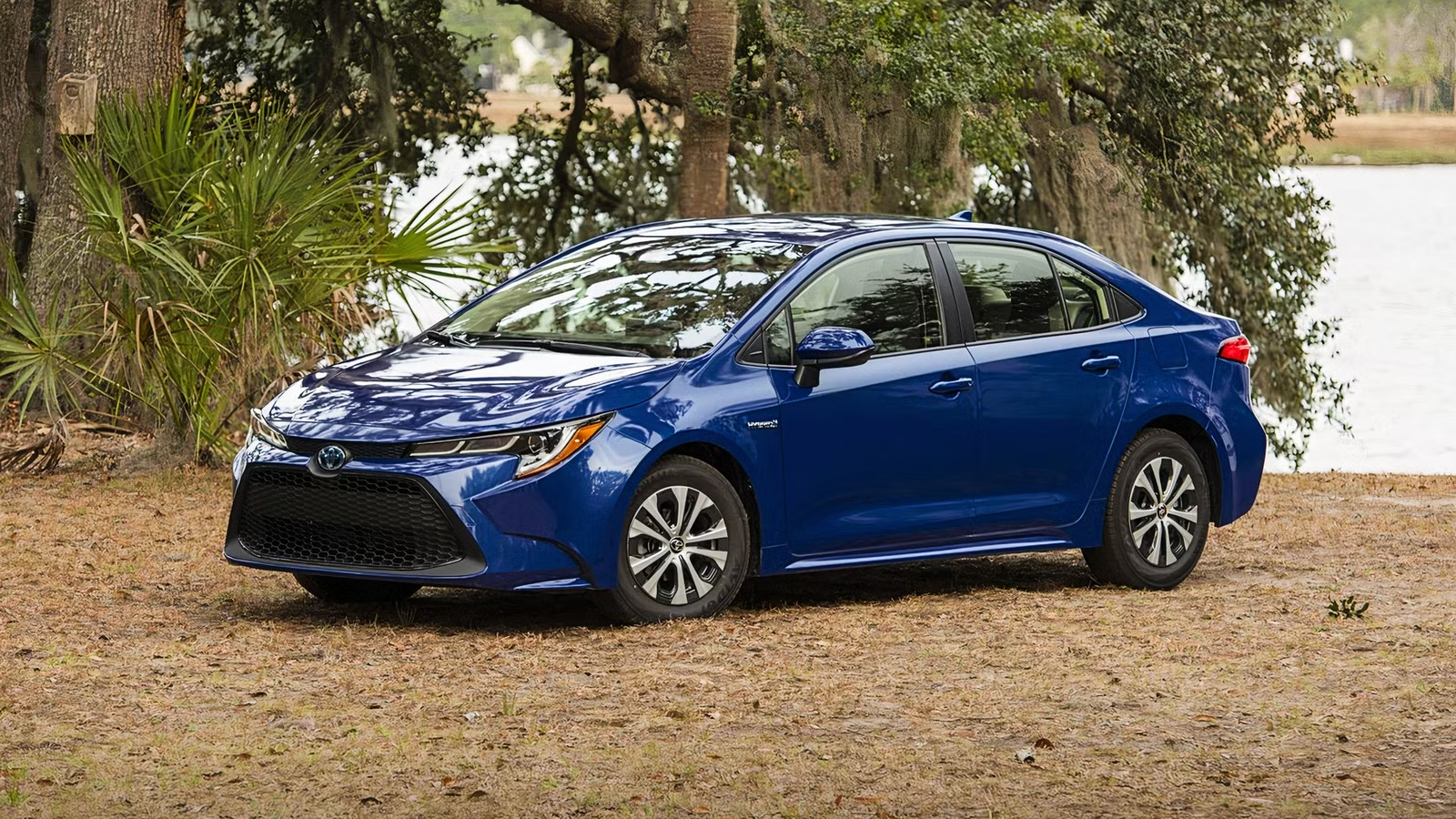
One thing that you have to keep in mind when purchasing a hybrid vehicle for long-term ownership is the fact that you’re going to have the battery pack replaced as time and use progresses. Thankfully, this isn’t as big an issue compared to an EV battery pack replacement, because hybrid batteries are substantially cheaper and easier to replace because of their smaller dimensions and capacities. They also tend to last a lot longer than EV batteries, because they don’t take full responsibility for providing the drivetrain with energy. It’s quite hard to deny that Toyota sits at the very top of the hybrid vehicle industry in the global market. The Japanese manufacturer is one of the pioneers of gasoline-electric hybrid technology, with a portfolio that dates all the way back to 1997.

Honda may occasionally outsell Toyota in individual sales on a monthly basis, but Toyota retains most of the hybrid vehicle market share by a noteworthy margin. Thanks to this substantial investment in hybridization and electrification technology, the brand has trickled its development costs down into all of its hybrid offerings. It extends this to the used parts catalog, resulting in a battery replacement cost that is relatively easy to source and understand. Toyota also benefits from a very comprehensive warranty offering as a means to prove it offers the most dependable and reliable systems that you can currently get your hands on.
Toyota’s Multiple Hybrid Battery Options And Replacement Costs
Toyota currently offers more than 15 different hybrid models in the U.S. These range from sedans, crossovers, and SUVs. For the sake of consistency, we won’t include the mild-hybrid vehicles, which means we have to exclude the brand’s truck range. The Japanese manufacturer applies different battery capacities to all of its HEV’s specification sheets, ranging from 0.91 kWh to 1.8 kWh. Despite this, it lists the same $3,365.69 price for its replacement battery pack across all models in its online parts catalog. J.D. Power suggests that older Toyota Hybrid battery replacements cost $1,250, labor inclusive.
Toyota’s Long-Standing History In The Hybrid Industry
- Toyota launched the first mass-produced hybrid car, the Prius, in 1997, pioneering the gasoline-electric hybrid market.
- The Prius became globally available in 2000 and quickly set the standard for fuel-efficient vehicles.
- Toyota expanded its hybrid lineup over the years to include popular models like the Camry Hybrid, Highlander Hybrid, and RAV4 Hybrid.
- Toyota introduced hybrid technology into Lexus, its luxury division, starting with the RX 400h in 2005.
- By 2021, Toyota sold over 17 million hybrid vehicles worldwide, reducing CO₂ emissions by millions of tons.
- Toyota continues innovating with plug-in hybrids and advanced hybrid systems, reinforcing its commitment to eco-friendly technology.

Obviously, this excludes the labor and installation costs, which is likely to add around $600 to $800 to the price, depending on the vehicle. This is still an expensive cost to consider. However, you need to bear in mind that an HEV’s battery pack is destined to last substantially longer than the ones you’d use in a PHEV or a dedicated EV.
Reddit users have indicated that they’ve paid around $2,000 for a battery pack replacement on their Toyota Prius, including labor charges. Reconditioned battery packs with installation may cost half of this, but you’ll likely be subject to a somewhat lower lifespan and capacity.
What Happens When Your Toyota Hybrid Battery Expires
Several symptoms will start to present themselves when your Toyota’s hybrid battery reaches the end of its lifespan. This will negatively affect its performance and efficiency. The first thing you’re sure to notice is a noticeable and significant fuel economy drop, as the hybrid system heavily relies on this part to alleviate consumption from the ICE system. When this occurs, you’ll also be subject to inconsistent or reduced acceleration due to the diminished power output from the hybrid battery.
Modern hybrid systems contribute quite a bit of power to Toyota’s drivetrain, because the Atkinson-cycle engine is essentially a low-power unit. Another common symptom is increased frequency of the gasoline engine starting up, even at low speeds or idle, since the weakened battery can’t provide sufficient electric power on its own. Dashboard warning lights and messages will illuminate, signaling that diagnostic trouble codes have detected an issue within the hybrid battery system.
Another issue you’ll need to be on the lookout for is the battery fan. This unit cools the battery pack when in use, so it will run louder or more often as the system works harder to manage the battery’s declining efficiency and overheating risk. A diminished battery will typically run at a higher temperature because of how it takes in more energy to maintain a charge level.
There have also been cases of a fluctuating state of charge on the dashboard display, where the battery level rapidly swings between full and low, reflecting a loss of the battery’s ability to hold a steady charge. These symptoms often appear gradually, but ignoring them can lead to more noticeable performance issues or even complete battery failure. When these signs become prominent, an inspection by a Toyota-certified technician can confirm if a battery replacement is necessary.
How Long Toyota’s Hybrid Battery Lasts

Toyota hybrid batteries typically last anywhere between eight and 15 years or around 100,000 to 150,000 miles under regular use before needing replacement. This depends entirely on usage and conditions, so it will differ depending on the model. Many Toyota hybrids achieve even greater longevity, especially when owners follow recommended maintenance and use the vehicle regularly. The battery works best when it isn’t subject to deep drains, but Toyota’s charging system ensures this never occurs while in use. Key factors like climate, driving habits, and consistent use influence battery lifespan, but much less than it would with an EV’s significantly larger pack.
For the sake of context, milder climates and smooth driving conditions contribute to extended battery life, while excessive heat or frequent aggressive driving can accelerate wear. Thankfully, Toyota’s design integrates the battery within the car’s cooling and management systems to keep temperatures moderate and efficiently extend its life. Toyota’s hybrid systems also include regenerative braking, thanks to its decision to incorporate a direct-drive unit rather than a conventional transmission. This helps preserve battery health by reducing reliance on the battery alone, particularly during acceleration or high-energy demands.

In real-world usage, some Toyota hybrids have shown robust battery performance, exceeding 200,000 miles without significant degradation. Regular hybrid system checks and adhering to Toyota’s maintenance schedule allow technicians to monitor battery health and address any issues early, which also boosts longevity. Many Toyota owners experience long-lasting hybrid batteries, sometimes beyond the initial warranty period, with minimal noticeable reduction in battery performance.
Should replacement be necessary, Toyota hybrid batteries are generally available for a few thousand dollars, with refurbished options often costing less. The long-term cost-effectiveness of Toyota hybrid batteries, coupled with the vehicle’s overall fuel efficiency, continues to appeal to owners seeking low maintenance and high reliability, even when considering potential battery replacement down the line.
Toyota’s Class-Leading Hybrid Battery Warranty

Toyota issues all of its hybrid vehicles with a standardized warranty package as standard, which includes a 36-month or 36,000-mile basic warranty, 60-month or 60,000-mile powertrain warranty, and 60-month coverage for corrosion with unlimited miles. The brand also covers all hybrid components for 96 months or 100,000 miles, while the battery features a class-leading coverage of 120 months or 150,000 miles. You have the option of extending the basic warranty package up to 10 years or 125,000 miles via Toyota. All Hybrids also include the ToyotaCare package, which consists of two-years or 24,000-miles worth of scheduled servicing and roadside assistance.
Toyota’s Standard Warranty Offering
|
Type |
Length |
|---|---|
|
Full Warranty |
36 Months/36,000 Miles |
|
Powertrain Warranty |
60 Months/60,000 Miles |
|
Maintenance Warranty |
24 Months/25,000 Miles |
|
Roadside Warranty |
24 Months/25,000 Miles |
|
Corrosion Warranty |
60 Months/Unlimited Miles |
|
Federal Emissions Performance |
24 Months/24,000 Miles |
|
Federal Emissions Defect |
36 Months/36,000 Miles |
|
Seat Belt And Airbags |
60 Months/60,000 Miles |
Toyota implemented this warranty offering in 2020, extending from the previous eight-year or 100,000-mile coverage. Toyota covers the hybrid battery for defects and manufacturing issues, ensuring repair or replacement at no cost within the warranty period. Coverage applies to Toyota’s entire lineup of hybrids, including the Prius, RAV4 Hybrid, Camry Hybrid, and Highlander Hybrid.
Additionally, the hybrid component warranty covers the electric motor and power control unit. Routine maintenance and wear-and-tear items, such as the 12-volt battery, fall outside this coverage. As we’ve mentioned, Toyota’s hybrid systems are typically very reliable and trustworthy, but the brand has had its fair share of recalls in this department over the years.
Sources: Toyota, Reddit

Related posts





Latest Post


No Comments