
When Oldsmobile Created The First Turbocharged Production Car
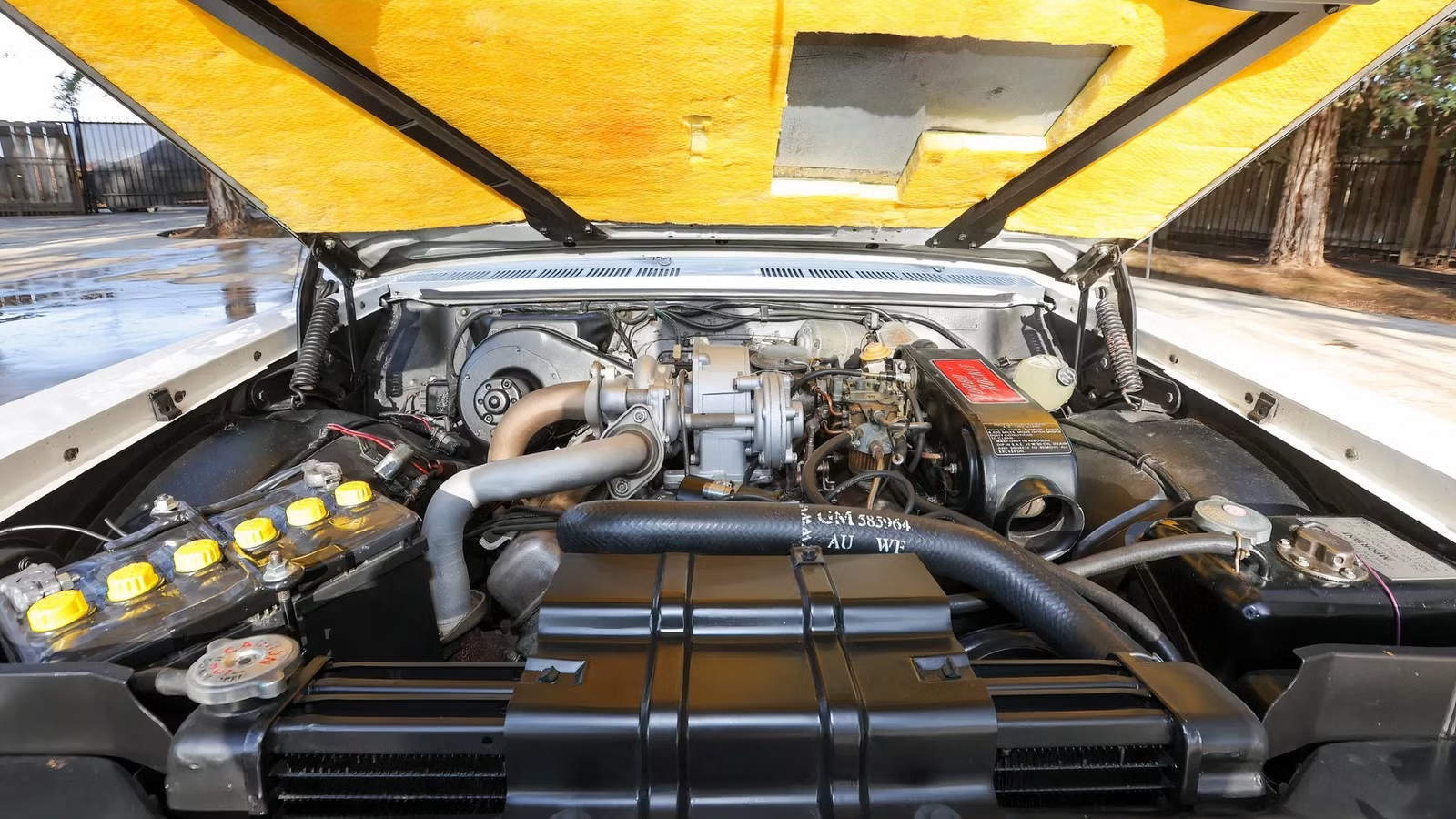
Everyone assumes turbocharging started with European sports cars sometime in the 1970s or 1980s. That assumption is off by about two decades. Oldsmobile beat the world to forced induction with a genuinely wild idea, one that needed its own dedicated fluid tank just to keep from tearing itself apart under boost. Reviewers were stunned, but dealers were far less thrilled. The car in question barely lasted two model years before Oldsmobile quietly pulled the plug, yet it set a precedent every turbocharged engine since has leaned on, whether anyone building them today realizes it or not.
The Forgotten Race For More Power In 1960s Detroit

By the start of the 1960s, American automakers were locked in a quiet arms race over horsepower, even though the muscle car era everyone remembers was still a couple of years away. Big V8s were the obvious route to more power, but engineers inside General Motors were also chasing a very different idea, one borrowed from diesel trucks and aircraft rather than anything on a typical showroom floor. Forced induction had never been tried on a mainstream American passenger car, and the technology carried a reputation for being heavy, complicated, and better suited to industrial equipment than a family sedan.
Two rival divisions within the same company ended up racing each other toward the same finish line without much public fanfare. Neither one set out to make headlines. Both were simply trying to solve an engineering problem, how to get real power out of a smaller, lighter engine without resorting to the big-inch V8s that were starting to feel old-fashioned. What came out of that quiet internal competition would end up predating everything the performance world associates with turbocharging by nearly two decades, even though almost nobody outside a handful of GM engineers realized it at the time.
A Complicated Idea Detroit Wasn’t Ready For


One of the two engines that emerged from this race solved its detonation problem in a way nobody had tried in a production car before. Rather than simply lowering compression or retarding ignition timing, engineers built a dedicated reservoir that sprayed a water and alcohol mixture straight into the intake charge whenever boost built up, cooling things down enough to prevent the engine from tearing itself apart. On paper, it was elegant. In the real world, it asked 1962 car buyers to understand and maintain a system that felt more at home on a fighter plane than in a driveway.
Most owners had no idea the reservoir even existed, let alone that it needed regular refilling from a specific bottle sold at the dealer. When it ran dry, a safety valve quietly shut off the boost rather than risk damaging the engine, leaving drivers with a car that suddenly felt gutless for no obvious reason. Confused customers brought their cars back to dealers convinced something had broken, and more often than not, the fix was as simple as topping off a fluid nobody had told them to check. That gap between brilliant engineering and everyday usability would end up defining the entire project.
The Oldsmobile Jetfire Turbo-Rocket V8 Finally Gets Its Due

That engine was the Oldsmobile Jetfire’s Turbo-Rocket V8, and it beat the rest of the automotive world to mass-production turbocharging by the better part of a decade. Built around Oldsmobile’s aluminum 215 cubic-inch V8, shared in naturally aspirated form with the Buick Special and Pontiac Tempest, the Turbo-Rocket added a Garrett AiResearch turbocharger and boosted output to 215 horsepower at 4,600 rpm and 300 lb-ft of torque at 3,200 rpm. That figure mattered for a specific reason, since it made the Jetfire the first American production car to reach one horsepower per cubic inch, a benchmark enthusiasts of the era treated as nearly mythical. Contemporary road tests put the Jetfire at roughly nine seconds to 60 mph and a top speed around 110 mph, genuinely quick numbers for a compact car in 1962.
The Complicated System That Doomed The Turbo-Rocket

The system responsible for keeping detonation in check was Oldsmobile’s Turbo-Rocket Fluid, a 50-50 mix of methanol and distilled water sprayed into the intake whenever the turbocharger built boost. It worked exactly as designed, provided owners kept the small reservoir topped off, which turned out to be a big ask for buyers used to nothing more demanding than checking their oil. Once the tank ran dry, a safety valve cut boost automatically to protect the engine, and the car simply went soft, with no warning light most drivers understood and no obvious explanation for the sudden loss of power.
Dealers fielded a steady stream of confused customers, and Oldsmobile eventually offered a factory conversion that pulled the turbocharger entirely and replaced it with a conventional four-barrel carburetor, an admission that the idea had outrun what the market was ready to maintain.
How The Jetfire Stacks Up Against Its Closest Rival

The Jetfire didn’t arrive in a vacuum, and comparing it with the only other turbocharged production car of its era says as much about American engineering culture in 1962 as the Jetfire’s own numbers do. Two GM divisions solved the same detonation problem in dramatically different ways within months of each other, and the contrast between their approaches explains why one nameplate barely registers outside dedicated collector circles today while the other became a genuine automotive footnote. Comparing the two side by side also helps explain why collector interest in each car looks so different six decades later.
The Chevrolet Corvair’s Rival Turbocharged Six

Chevrolet reached the same finish line just months later with a completely different approach. The Corvair Monza Spyder used a turbocharged version of the rear-mounted, air-cooled 145 cubic-inch flat-six, producing 150 hp at 4,400 rpm and 210 lb-ft of torque at 3,300 rpm, healthy gains over the standard engine but well short of the Jetfire’s output. Where Oldsmobile relied on fluid injection to control detonation, Chevrolet kept the Corvair’s system mechanically simpler, with a basic wastegate and no dedicated cooling fluid to babysit. That simplicity made the Corvair easier to live with day to day, even if its smaller six-cylinder never came close to matching the Jetfire’s one horsepower per cubic inch milestone.
Neither engine survived long. Oldsmobile discontinued the turbocharged Jetfire after the 1963 model year, while Chevrolet kept the turbocharged Corvair six in production a little longer before the entire Corvair line was phased out by the end of the decade. Both cars proved the same uncomfortable point at almost the same moment, that 1960s America had the engineering talent to build turbocharged performance cars well before anyone assumed the technology existed, but not yet the fuel, emissions, or manufacturing tools to make it live up to its promise on a mass-market budget.
That mechanical mismatch shows up in today’s collector market too. A well-kept Corvair hardtop with its turbocharged six currently trades around $8,500 in good condition, according to current valuation data, while a genuinely sorted Jetfire commands closer to $30,000 or more given how few survive with their original turbocharged hardware intact, per current market valuation data. Scarcity, not raw performance, is what separates the two prices, since unmolested Jetfires are far harder to find today than Corvairs of the same vintage.
The Quiet Engine Behind Every Turbo Since

Turbocharging went quiet in American showrooms for the rest of the 1960s and most of the 1970s after both experiments folded. It resurfaced in 1978, when Buick strapped a turbocharger to its 3.8-liter V6 for the Regal Sport Coupe, a decision that eventually produced the Grand National and GNX a decade later. Buick’s engineers were not starting from zero. They were finishing a job Oldsmobile had started sixteen years earlier and abandoned before the technology, the fuel, and the buying public had caught up with the idea.
Today, turbocharging is not a novelty reserved for exotic sports cars; it is the default way most manufacturers build a modern four-cylinder engine. Every time a compact sedan or a crossover makes surprising power from a small displacement engine, it is quietly cashing a check the Jetfire wrote in 1962 and never got credit for. Oldsmobile is gone, and the Jetfire barely lasted two model years, but the idea it proved, that boost belongs in ordinary cars and not just racetracks, never actually died. It just waited for the rest of the industry to catch up.
Sources: Hagerty, Bring a Trailer, Mecum.

Related posts





Latest Post


No Comments